
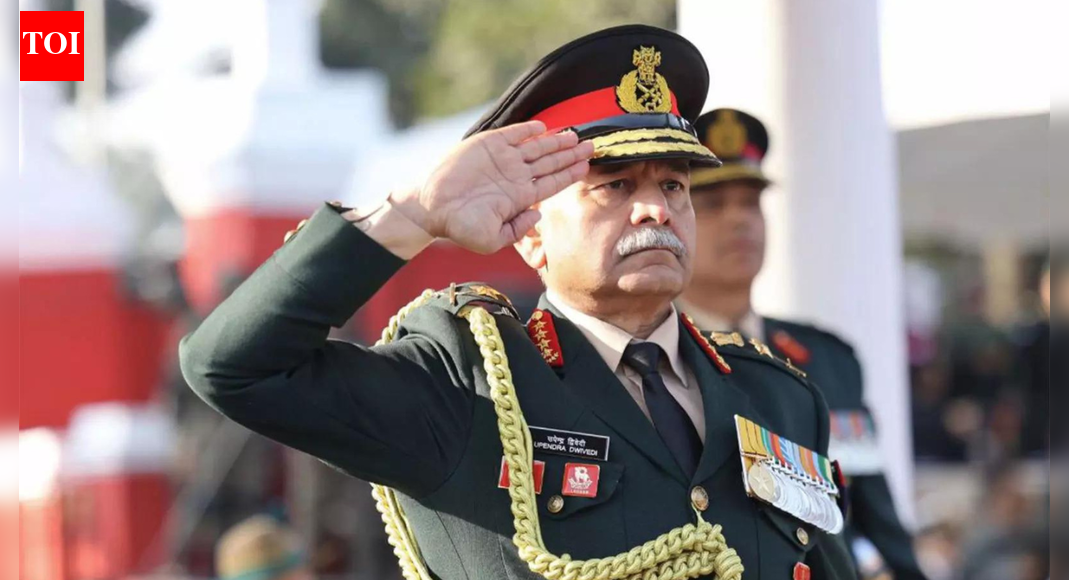
General Upendra Dwivedi (ANI photo) NEW DELHI: Army chief General Upendra Dwivedi on Tuesday reflected on Operation Sindoor, describing the counterterror military action as “ongoing” and warning Pakistan, that any “future misadventure will be resolutely responded.”General Dwivedi issued a direct warning to Islamabad, saying, “At least 6 terror camps still active across the LoC & 2 across the International Border after Operation Sindoor against Pakistan. Will act, if any (nefarious) attempts are carried out.”Addressing the annual Army Day press conference, General Dwivedi said a “clear decision to respond decisively was taken at the highest level.” He added, “Operation Sindoor was conceptualised and executed with precision. Through 22 minutes of initiation on 7th May and an orchestration that lasted 88 hours up to 10th May, the operation reset strategic assumptions by striking deep, dismantling terror infrastructure, and puncturing the longstanding nuclear rhetoric. The Army successfully destroyed seven out of the nine targets and thereafter played a pivotal role in ensuring a calibrated response to Pak actions.”Upendra Dwivedi highlighted the heavy losses suffered by the Pakistan Army, saying that about 100 of their personnel were killed in firing along the LoC and IB during heightened military tensions.The Army chief stressed that the counterterror operation, launched in retaliation to the Pahalgam terror attack, remains “ongoing,” and reiterated the warning of a “resolute response” to any future misadventures. He also acknowledged the coordinated national effort behind the operation, saying, “I must acknowledge the proactive role of all stakeholders at the national level, including CAPFs, Intelligences, civic bodies, state administration and other ministries, whether it’s MHA, Railways and many more…”Also read: Project-75I; How India’s $8 billion submarine upgrade reshapes the Pakistan, China equationCalling the mission a benchmark in joint operations, General Dwivedi said, “Operation Sindoor was the best example of tri-service synergy under clear-cut political directive and full freedom to act or respond.”He also added that military responses in future will be a combined action and reflected on PM Modi’s vision, General Dwivedi said, “Now the battle of the future will not be won by a single arm or even a single service. It will be a national level enterprise. The Prime Minister captured this vision through the mantra of ‘Jai’ where jointness integrates our effort, Atmanirbharta empowers our capability and accelerated innovation drives ideas into action. So, based on the lessons drawn during Operation Sindoor and in line with the Indian Army’s belief that change must come at the velocity of relevance. We prefix the verb acceleration to all our nouns, that is initiatives.”Commenting on the broader security situation in the North, the Army chief said, “The situation along the Northern Front remains stable, but needs constant vigil. Apex-level interactions, renewed contact, and confidence-building measures are contributing to the gradual normalisation of the situation that has also enabled grazing, hydrotherapy camps, and other activities along the Northern Borders.” On India-China border, he said “With our continued strategic orientation on this front, our deployment along the Line of Actual Control remains balanced and robust. Concurrently, capability development and infrastructure enhancement are progressing through a whole-of-government approach.”The Army chief also responded to and rejected China’s repeated claims on Jammu and Kashmir’s Shaksgam Valley, reiterating India’s position: “India considers the 1963 agreement between Pakistan and China on Shaksgam Valley.”In the intervening nights of May 6 and May 7, Indian armed forces carried out precision strikes under Operation Sindoor, destroying nine major terror hideouts in Pakistan-occupied Kashmir (PoK) and mainland Pakistan. The strikes targeted headquarters of Jaish-e-Mohammad in Bahawalpur and Lashkar-e-Taiba in Muridke.Following the operation, India clarified that the strikes were aimed solely at terror infrastructure and not Pakistan’s state machinery. However, Islamabad attempted retaliatory missile and drone attacks, all of which were intercepted and neutralised by India’s air defence systems, preventing any loss of life or property.India then launched retaliatory strikes on Pakistan’s military installations, destroying key airbases, including Rahim Yar Khan and the Nur Khan airbase.About the AuthorTOI News DeskThe TOI News Desk comprises a dedicated and tireless team of journalists who operate around the clock to deliver the most current and comprehensive news and updates to the readers of The Times of India worldwide. With an unwavering commitment to excellence in journalism, our team is at the forefront of gathering, verifying, and presenting breaking news, in-depth analysis, and insightful reports on a wide range of topics. The TOI News Desk is your trusted source for staying informed and connected to the ever-evolving global landscape, ensuring that our readers are equipped with the latest developments that matter most.”Read MoreEnd of ArticleFollow Us On Social MediaVideos‘BRICS Brings Countries Together’: Jaishankar Frames Bloc as Global Welfare Platform Under IndiaIndia Rejects Europe’s Pressure To Cut Russia Ties As Germany Pushes Defence Shift Amid Ukraine WarDonald Trump’s Iran Trade Tariff Warning Puts India In A Bind Over Exports, Chabahar And US TiesMinority Killings Shake Bangladesh As Hindu Auto Driver Murder Draws Global Outrage Pressure Mounts’Very Positive Meeting’: Ashwini Vaishnaw Participates In US-Led Ministerial On Critical MineralsCongress MP says India remains “heavily invested emotionally and politically” in Bangladesh”Our Youth Is Creative And Innovative,” PM Modi At Viksit Bharat Dialogue“Deeply Impressed,” CEOs Share Takeaways After Meeting PM Modi | VideoFrom Defence To AI: PM Modi Urges German CEOs To Make India Their Global Manufacturing Base’Real Friends Always…’: Trump’s New Envoy Sergio Gor Pledges To Reset India-US Ties123Photostories7 questions to ask your child’s teacher if your child struggles with attentionWinter Special: How to make traditional home-style Cheeni ke ParatheKerala Assembly elections: The mechanics of electoral competition5 most underrated forms of self-care you’re probably ignoring (But need right now)Discover Your Powerful 2026 Maha Mantra According To Your Birth Date12 must-try three-ingredient breakfast ideas for bachelorsSuniel Shetty films that showcased his acting range from ‘Border’, ‘Hera Pheri’, to ‘Chup Chup Ke’Baby names inspired by rare names of Lord HanumanBreathtaking pictures of Nupur Sanon and Stebin Ben’s stylish Hindu wedding5 animals that survive by pretending to be dead123Hot PicksShaksgam ValleyDubai AirportGold rate todayBengaluru newsCigarette price hikePublic holidays January 2026Bank Holidays JanuaryTop TrendingDonald TrumpCharlie KirkVanessa Bryant and Natalia Bryant Net WorthBrooks Koepka and Jena Sims Net WorthDrake Maye WifeBill GatesConnor McDavid WifeTariffs on Tehran Trade PartnersBengaluru Dental Student SuicideMLB Trade Rumors
NEW DELHI: Army chief General Upendra Dwivedi on Tuesday reflected on Operation Sindoor, describing the counterterror military action as “ongoing” and warning Pakistan, that any “future misadventure will be resolutely responded.”General Dwivedi issued a direct warning to Islamabad, saying, “At least 6 terror camps still active across the LoC & 2 across the International Border after Operation Sindoor against Pakistan. Will act, if any (nefarious) attempts are carried out.”Addressing the annual Army Day press conference, General Dwivedi said a “clear decision to respond decisively was taken at the highest level.” He added, “Operation Sindoor was conceptualised and executed with precision. Through 22 minutes of initiation on 7th May and an orchestration that lasted 88 hours up to 10th May, the operation reset strategic assumptions by striking deep, dismantling terror infrastructure, and puncturing the longstanding nuclear rhetoric. The Army successfully destroyed seven out of the nine targets and thereafter played a pivotal role in ensuring a calibrated response to Pak actions.”Upendra Dwivedi highlighted the heavy losses suffered by the Pakistan Army, saying that about 100 of their personnel were killed in firing along the LoC and IB during heightened military tensions.The Army chief stressed that the counterterror operation, launched in retaliation to the Pahalgam terror attack, remains “ongoing,” and reiterated the warning of a “resolute response” to any future misadventures. He also acknowledged the coordinated national effort behind the operation, saying, “I must acknowledge the proactive role of all stakeholders at the national level, including CAPFs, Intelligences, civic bodies, state administration and other ministries, whether it’s MHA, Railways and many more…”Also read: Project-75I; How India’s $8 billion submarine upgrade reshapes the Pakistan, China equationCalling the mission a benchmark in joint operations, General Dwivedi said, “Operation Sindoor was the best example of tri-service synergy under clear-cut political directive and full freedom to act or respond.”He also added that military responses in future will be a combined action and reflected on PM Modi’s vision, General Dwivedi said, “Now the battle of the future will not be won by a single arm or even a single service. It will be a national level enterprise. The Prime Minister captured this vision through the mantra of ‘Jai’ where jointness integrates our effort, Atmanirbharta empowers our capability and accelerated innovation drives ideas into action. So, based on the lessons drawn during Operation Sindoor and in line with the Indian Army’s belief that change must come at the velocity of relevance. We prefix the verb acceleration to all our nouns, that is initiatives.”Commenting on the broader security situation in the North, the Army chief said, “The situation along the Northern Front remains stable, but needs constant vigil. Apex-level interactions, renewed contact, and confidence-building measures are contributing to the gradual normalisation of the situation that has also enabled grazing, hydrotherapy camps, and other activities along the Northern Borders.” On India-China border, he said “With our continued strategic orientation on this front, our deployment along the Line of Actual Control remains balanced and robust. Concurrently, capability development and infrastructure enhancement are progressing through a whole-of-government approach.”The Army chief also responded to and rejected China’s repeated claims on Jammu and Kashmir’s Shaksgam Valley, reiterating India’s position: “India considers the 1963 agreement between Pakistan and China on Shaksgam Valley.”In the intervening nights of May 6 and May 7, Indian armed forces carried out precision strikes under Operation Sindoor, destroying nine major terror hideouts in Pakistan-occupied Kashmir (PoK) and mainland Pakistan. The strikes targeted headquarters of Jaish-e-Mohammad in Bahawalpur and Lashkar-e-Taiba in Muridke.Following the operation, India clarified that the strikes were aimed solely at terror infrastructure and not Pakistan’s state machinery. However, Islamabad attempted retaliatory missile and drone attacks, all of which were intercepted and neutralised by India’s air defence systems, preventing any loss of life or property.India then launched retaliatory strikes on Pakistan’s military installations, destroying key airbases, including Rahim Yar Khan and the Nur Khan airbase.


