
Everest Base Camp: Kerala student reaches Everest Base Camp on just ₹16,000 after working at a vegetable shop

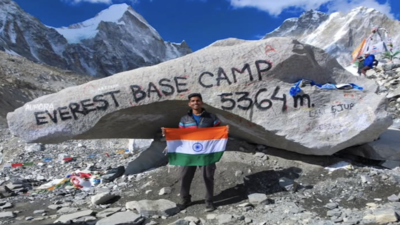
The mountain did not open its path to him easily. It asked for cold, hunger, bruised feet and long days on the road. It asked for discipline when life was uncertain and courage when the odds looked bluntly unfair. But Kesav Suneesh, a 21-year-old from Kerala’s Alappuzha district, kept walking. A B.Com student from IHRD College in Karthikappally, he reached Everest Base Camp after funding much of his journey through savings earned as a helper in a vegetable shop and a food delivery boy. With only ₹16,000 spent on the trek, his story is not just about reaching a destination. It is about refusing to let scarcity decide the size of a dream. Scroll down to read more…
A dream that began at ground level
For Kesav, Everest was never a casual ambition. He knew the summit would demand far more than determination. The cost of a full Everest expedition, estimated at around ₹50 lakh, placed the actual peak far beyond his present means. But instead of abandoning the dream, he broke it into smaller steps and began with the one milestone that was possible: Everest Base Camp at 5,364 metres.What makes his achievement striking is not only the altitude, but the ordinary life from which it rose. Kesav worked in Kayamkulam, saving what he could from modest jobs. The money he collected from months of work, roughly ₹35,000 from the vegetable shop and additional earnings from delivery work, became the base of his Himalayan attempt. It was a journey financed not by privilege, but by persistence.
The road to Nepal was part of the test
Kesav’s trip was not a packaged adventure or an easy tourist route. He travelled by second-class trains and buses to keep costs low, crossed into Nepal through the Sonauli border, and made his way to Salleri before beginning the trek on foot. From there, the mountains demanded everything they had not yet taken. Over eight days, he covered more than 132 kilometres, passing through Paiya, Tengboche, Dingboche and Lobuche before finally reaching Gorakshep, close to Everest Base Camp. He carried a tent, slept wherever possible, and cooked his own food to stay within budget. In a world where many dreams are talked about endlessly, Kesav’s was tested in the simplest and most unforgiving way: by distance, weather and fatigue.He first began this broader journey in September 2025, but life intervened. After his grandmother died in January, he returned home. The detour could have ended the mission. Instead, he went back to work, saved again and restarted the climb on April 7. That second attempt carried a quiet resolve that made the eventual arrival at Base Camp feel hard-won rather than lucky.
Discipline from school and college helped carry him
Kesav says his endurance was shaped long before the trek began. His years in Scouts and Guides at NRPM HSS in Kayamkulam, followed by NCC in college, helped train his body and his mind. Those experiences did not make Everest easy, but they gave him the steadiness to keep moving when the trail grew steep and the air grew thin.His journey also says something about the kind of ambition that survives in difficult circumstances. It is not flashy. It is practical, patient and deeply rooted in routine. Kesav did not wait for perfect conditions. He worked, saved, travelled cheaply and kept going.
Base Camp is the beginning, not the end
Standing at Everest Base Camp gave Kesav a first glimpse of a dream he still hopes to finish one day. He knows the summit is a different challenge altogether, one that requires advanced equipment, proper guidance and weeks of preparation. But he is not speaking in past tense. He still speaks like someone who expects to return. His plan is to complete his studies, find a stable job and save toward the ultimate climb. For now, the mountain has given him something else: proof that the first step matters, even when the final one is still far away. At 21, Kesav Suneesh has already done what many only imagine. He has shown that a dream can begin in the narrow spaces of ordinary work and still rise to extraordinary heights.


