
Elon Musk may have just told Microsoft: You would not have given $10 billion to Sam Altman, unless you saw …

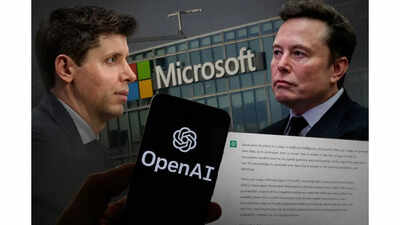
Trial in Elon Musk’s lawsuit against ChatGPT-maker OpenAI entered its third day. Tesla CEO returned to the court to give his second testimony. During the trial, Musk said that he was “a fool” for putting money in OpenAI that started off as non-profit, but later created a for-profit arm. At issue was a 2020 deal with Microsoft that promised billions of dollars in investment and gave Microsoft exclusive rights to use OpenAI’s product. Elon Musk said he felt Microsoft’s investments indicated it expected a potentially large return, and was concerned that Microsoft could come to control the development of artificial general intelligence, or AGI, a hard-to-define level of capability in which AI matches or exceeds humans.“With all due respect to Microsoft, do you really want Microsoft controlling artificial general intelligence?” Musk said.“Microsoft would only put $10 billion — which is a huge sum of money — into something if they feel like they will get a return,” Musk said during the testimony. “There’s no way Microsoft is just giving that as a donation or any kind of charitable way. That’s an amount of money that doesn’t make any sense.” Elon Musk further revealed that Microsoft’s partnership felt like a “bait and switch” and risked corporate control of AGI. The tech billionaire has sued the AI company for ‘stealing a charity’ and is seeking up to $140 billion in punitive damages from both OpenAI and Microsoft.
OpenAI and Microsoft rewrite their $13 billion deal
In another news, OpenAI and Microsoft recently announced a revised partnership that ends Microsoft’s exclusive license to OpenAI’s technology—the same technology Microsoft had been backing since 2019, to the tune of $13 billion. The new deal allows OpenAI to sell its products freely across rival cloud platforms, including Amazon Web Services and Google Cloud. It’s as much an admission as it is an agreement: the old arrangement wasn’t working for OpenAI anymore.Under the reworked terms, Microsoft stays OpenAI’s primary cloud partner. OpenAI products still ship on Azure first, unless Microsoft decides otherwise. But OpenAI can now serve its full product lineup to customers on any cloud—a meaningful shift for enterprise deals that increasingly run through AWS or Google Cloud.Microsoft’s license to OpenAI’s IP runs through 2032, now non-exclusive. The revenue structure has also been cleaned up: OpenAI continues paying Microsoft a 20% revenue share through 2030, now capped and no longer tied to OpenAI’s technology milestones. Microsoft stops paying a revenue share to OpenAI entirely. Shares of Microsoft dipped roughly 1% in premarket trading Monday, as some investors read the shift as the company losing a hard-won competitive edge.The two companies say the work ahead remains ambitious—scaling gigawatts of new datacenter capacity, collaborating on next-generation silicon, and applying AI to cybersecurity. The chip collaboration is notable: both companies have been working to reduce their dependence on Nvidia by developing custom AI silicon, and the revised partnership keeps that work intact.


