
Donald Trump may have made Nvidia CEO join him on Beijing trip at 11th hour, but China’s stand on American chips remains clear: Thanks, but…

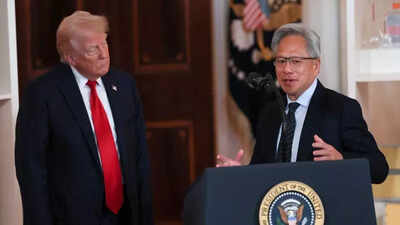
Nvidia CEO Jensen Huang’s last-minute scramble onto Air Force One in Alaska was supposed to signal a thaw. Two days later, as Donald Trump’s Beijing summit with Xi Jinping wrapped up, the Nvidia chief was flying home with the same problem he flew in with—China still isn’t buying. The US president himself confirmed it on Friday, telling reporters mid-flight that Beijing has passed on the H200 chip because, in his words, “they want to develop their own.“Donald Trump may have made Nvidia CEO join him on Beijing trip at 11th hour, but China’s stand on American chips remains clear: Thanks, but…That admission came barely a day after Bloomberg and Reuters reported that the US Commerce Department had cleared roughly 10 Chinese firms—including Alibaba, Tencent, ByteDance and JD.com—to import the H200, Nvidia’s second-most-advanced AI chip. Distributors Lenovo and Foxconn got the green light too. On paper, the deal works out to 75,000 units per buyer. In practice, not a single chip has shipped.
The 25% fee, the inspection clause, and the part Beijing doesn’t like
The American side of the framework is unusually tight. Under terms finalised in January, every H200 has to physically pass through US territory for third-party inspection before being re-exported to China. Nvidia, in turn, hands over 25% of each sale to the US Treasury. That’s the structure Washington approved. Beijing simply hasn’t approved it back.US Trade Representative Jamieson Greer told Bloomberg the call now sits with Chinese officials. “It’s going to be a sovereign decision for China,” he said, adding that the bilateral meeting didn’t even touch chip export controls. Trump was vaguer, saying the issue did come up and that something could still happen on it, though he offered no timeline.Huang’s presence was the wildcard everyone watched. He wasn’t on the original delegation list and joined only after Trump personally called him following media coverage of the snub, boarding the presidential plane during a refuelling stop in Alaska. The Nvidia chief shared the cabin with Tim Cook, Elon Musk, and executives from Micron, Qualcomm, Meta and Coherent.
Why DeepSeek running on Huawei chips matters more than any signed deal
The bigger story is what China is building instead. Just before the summit opened, DeepSeek confirmed for the first time that its latest model has been optimised to run on Huawei silicon—exactly the shift Huang has been warning about for months. Commerce Secretary Howard Lutnick said last month that Chinese firms which had earlier placed H200 orders with Nvidia later pulled out, citing pressure to buy domestic.Nvidia’s market share in China has slid from around 95% to what Huang himself describes as essentially zero. Analysts peg the lost revenue at $3.5–4 billion a year if the H200 channel ever opens. For now, the company’s $78 billion annual revenue guidance assumes none of it comes back.Trump did say he and Xi discussed AI “guardrails”—”standard guardrails that we talk about all the time,” he added, without elaborating. US officials had previewed the topic before the trip, floating the idea of a dedicated bilateral channel for regular AI discussions. None was announced.


