
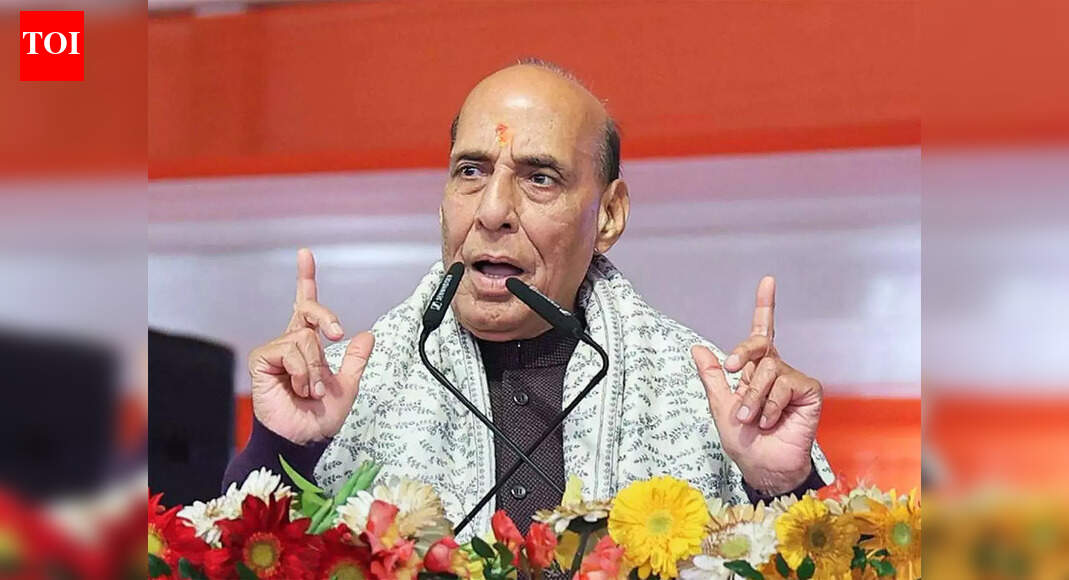
Defence minister Rajnath Singh (File photo) NEW DELHI: Defence minister Rajnath Singh on Friday warned of what he described as an emerging trend of “white-collar terrorism” in the country, saying highly educated individuals were increasingly being found involved in anti-social and anti-national activities.Speaking at the 104th foundation day function of Bhupal Nobles’ University in Udaipur, Singh referred to the November 10 car bomb blast near the Red Fort in Delhi, pointing out that those behind the attack were doctors. Blasts Rock Delhi; Casualties In Red Fort Area As Explosions Follow | NIA, NSG At Spot, Area Sealed “Today, an alarming trend of white-collar terrorism is emerging in the country. Highly-educated people are working against society and the country,” Singh was quoted as saying by news agency PTI.Referring to the Delhi blast, he added, “The perpetrators of the (Delhi) bomb blast were doctors – those who write ‘Rx’ on prescriptions, yet have RDX in their hands. This highlights the need for knowledge to be accompanied by values and character.”The explosives-laden i20 car that detonated outside the Red Fort on November 10, killing 15 people, was driven by Dr Umar-un-Nabi. Investigations later uncovered what officials described as a ‘white-collar’ terror module, leading to the arrest of three doctors — Muzammil Ganai, Adeel Rather and Shaheena Saeed — among others.Singh stressed that education must go beyond professional achievement. “The purpose of education is not only professional success but also the development of morality, ethics and human character,” he said.Elaborating on the idea, the defence minister said knowledge alone was insufficient. “Singh added that knowledge leads to competence, which leads to prosperity, and prosperity leads to righteousness, and ultimately, true happiness comes only from righteousness.”“Any education system that cannot fulfil this objective, which does not impart humility, a sense of character and ‘dharma’ (righteousness) along with knowledge, is incomplete,” he said.Clarifying his reference to religion, Singh said it should not be seen narrowly. “When I talk about religion, it should not be associated with going to the temple, mosque or church for prayer. Religion is a sense of duty. Education devoid of religion and morality will not be useful to society, and sometimes it can even prove fatal. This is why educated people are sometimes found to be involved in crimes,” he said.Terrorism, he noted, was not limited to the uneducated. “Terrorists are not necessarily illiterate; they can hold university and college degrees, yet they become terrorists because they lack wisdom,” Singh said, adding, “Therefore, wisdom is essential.”The defence minister also spoke about India’s growing defence ecosystem, saying several defence startups were doing commendable work. “I am confident that in the next 15-20 years, India will become fully self-reliant in weapons,” he said.Highlighting technological change, Singh said artificial intelligence, machine learning and other emerging technologies were transforming lives and work patterns, and stressed the need to use them positively to advance national development.Referring to India’s economic trajectory, Singh said the country was currently the world’s fourth-largest economy and was on course to become the third-largest by 2030, adding that universities would play a crucial role in this journey.He also cautioned against confusing self-respect with ego. “While the feeling of self-respect is important, it should never transform into arrogance,” Singh said.Encouraging students to think big, he said, “Do not work with a small mind. The bigger your heart, the more the feeling of happiness.”Calling teachers the backbone of the education system, Singh said, “In India, teachers are viewed with respect. They have been the initiators of the greatest social changes in the country.”He further highlighted the importance of values in personal and public life, advising students against developing a sense of ego.Pointing to global challenges, Singh said the world today faced issues such as environmental problems, health crises and questions of digital ethics, which could not be addressed through a single discipline.“Solutions can only be found through a multidisciplinary approach. Universities must teach the students not only what to think, but also how to think. They must create an environment where students can think holistically,” he said.On academic research, Singh said its purpose should extend beyond publications. “Mere publication in journals cannot be the ultimate goal of research; its goal should be to bring about changes on the ground, whether in policymaking or in finding solutions to other social problems. Universities should promote solution-driven research,” he added.Chittorgarh MP CP Joshi, Nathdwara MLA Vishvaraj Singh and several other political leaders were present at the event.About the AuthorTOI News DeskThe TOI News Desk comprises a dedicated and tireless team of journalists who operate around the clock to deliver the most current and comprehensive news and updates to the readers of The Times of India worldwide. With an unwavering commitment to excellence in journalism, our team is at the forefront of gathering, verifying, and presenting breaking news, in-depth analysis, and insightful reports on a wide range of topics. The TOI News Desk is your trusted source for staying informed and connected to the ever-evolving global landscape, ensuring that our readers are equipped with the latest developments that matter most.”Read MoreEnd of ArticleFollow Us On Social MediaVideosNot All Are Illiterate: Rajnath Singh Cites Red Fort Blast, Flags Educated, White Collar Terrorists’Arunachal Pradesh Is And Will Always Be…’ Jaishankar Warns China, Blasts Harassment Of IndiansBullet Train Gets August 15, 2027 India Launch Date, Minister Shares Details On Tunnel BreakthroughCleanest City Hit By Water Contamination As Lab Links Indore Diarrhoea Outbreak To Pipeline LeakUS Lawmaker Raja Krishnamoorthi Condemns Violence Against Hindus In Bangladesh Urges Global Action UpOpen Letter From Pakistan Backs India As Baloch Leader Signals Diplomatic Break With Islamabad’Bad Neighbours Who Persist With Terror’: Jaishankar Warns Pakistan, Hopes Improved Bangladesh TiesBangladesh Jamaat Signals Unity Rule With BNP Ahead Of Polls, Pushes Back On India Meeting ClaimsAfter Indus Treaty Setback India Clears Chenab Hydropower Project Triggering Fresh Panic In PakistanAnother Hindu Targeted In Bangladesh, Wife Alleges Trader Hacked And Burned Alive On Road Home123PhotostoriesWinter Special: How to make Carrot Tomato Soup at homeFull Moon 2026: Cosmic Guidance For Every Zodiac SignLohri outfit inspiration: 5 Bollywood celeb looks worth recreating in 2026″He might not…”: How Sharmila Tagore reacted to Soha Ali Khan’s decision to live in with Kunal Kemmu before marriage– 5 Indian celebrities who were in live-in relationshipsFrom Angelina Jolie to Sushmita Sen: Celebrities who chose adoptionWhat your poop colour says about your health and risk of serious diseasesChennai’s Metro Makeover: Vadapalani Skywalk To Ease Crowds, Cut Crossings And Speed TransfersSixth Time Lucky? After Years Of Setbacks, Bengaluru’s Skydeck Finally Turns West For TakeoffChef Sanjeev Kapoor shares deliciously healthy menu to follow in New Year5 stunning national parks to explore without fear of venomous snakes123Hot PicksPremarital Test OmanVande Bharat Sleeper TrainJanuary Bank holidayGold rate todayIncome Tax RefundBahrain Golden Visa 2025Bank Holidays DecemberTop TrendingJustin Thomas Net WorthWWE Star Nikki BellaCardi BCeeDee Lamb Luxury Car CollectionStefon DiggsCaitlin ClarkTom BradyMicah Parsons vs CeeDee Lamb Net WorthNHL Injury UpdateVanessa Bryant
NEW DELHI: Defence minister Rajnath Singh on Friday warned of what he described as an emerging trend of “white-collar terrorism” in the country, saying highly educated individuals were increasingly being found involved in anti-social and anti-national activities.Speaking at the 104th foundation day function of Bhupal Nobles’ University in Udaipur, Singh referred to the November 10 car bomb blast near the Red Fort in Delhi, pointing out that those behind the attack were doctors.
“Today, an alarming trend of white-collar terrorism is emerging in the country. Highly-educated people are working against society and the country,” Singh was quoted as saying by news agency PTI.Referring to the Delhi blast, he added, “The perpetrators of the (Delhi) bomb blast were doctors – those who write ‘Rx’ on prescriptions, yet have RDX in their hands. This highlights the need for knowledge to be accompanied by values and character.”The explosives-laden i20 car that detonated outside the Red Fort on November 10, killing 15 people, was driven by Dr Umar-un-Nabi. Investigations later uncovered what officials described as a ‘white-collar’ terror module, leading to the arrest of three doctors — Muzammil Ganai, Adeel Rather and Shaheena Saeed — among others.Singh stressed that education must go beyond professional achievement. “The purpose of education is not only professional success but also the development of morality, ethics and human character,” he said.Elaborating on the idea, the defence minister said knowledge alone was insufficient. “Singh added that knowledge leads to competence, which leads to prosperity, and prosperity leads to righteousness, and ultimately, true happiness comes only from righteousness.”“Any education system that cannot fulfil this objective, which does not impart humility, a sense of character and ‘dharma’ (righteousness) along with knowledge, is incomplete,” he said.Clarifying his reference to religion, Singh said it should not be seen narrowly. “When I talk about religion, it should not be associated with going to the temple, mosque or church for prayer. Religion is a sense of duty. Education devoid of religion and morality will not be useful to society, and sometimes it can even prove fatal. This is why educated people are sometimes found to be involved in crimes,” he said.Terrorism, he noted, was not limited to the uneducated. “Terrorists are not necessarily illiterate; they can hold university and college degrees, yet they become terrorists because they lack wisdom,” Singh said, adding, “Therefore, wisdom is essential.”The defence minister also spoke about India’s growing defence ecosystem, saying several defence startups were doing commendable work. “I am confident that in the next 15-20 years, India will become fully self-reliant in weapons,” he said.Highlighting technological change, Singh said artificial intelligence, machine learning and other emerging technologies were transforming lives and work patterns, and stressed the need to use them positively to advance national development.Referring to India’s economic trajectory, Singh said the country was currently the world’s fourth-largest economy and was on course to become the third-largest by 2030, adding that universities would play a crucial role in this journey.He also cautioned against confusing self-respect with ego. “While the feeling of self-respect is important, it should never transform into arrogance,” Singh said.Encouraging students to think big, he said, “Do not work with a small mind. The bigger your heart, the more the feeling of happiness.”Calling teachers the backbone of the education system, Singh said, “In India, teachers are viewed with respect. They have been the initiators of the greatest social changes in the country.”He further highlighted the importance of values in personal and public life, advising students against developing a sense of ego.Pointing to global challenges, Singh said the world today faced issues such as environmental problems, health crises and questions of digital ethics, which could not be addressed through a single discipline.“Solutions can only be found through a multidisciplinary approach. Universities must teach the students not only what to think, but also how to think. They must create an environment where students can think holistically,” he said.On academic research, Singh said its purpose should extend beyond publications. “Mere publication in journals cannot be the ultimate goal of research; its goal should be to bring about changes on the ground, whether in policymaking or in finding solutions to other social problems. Universities should promote solution-driven research,” he added.Chittorgarh MP CP Joshi, Nathdwara MLA Vishvaraj Singh and several other political leaders were present at the event.


