
CDS General Anil Chauhan NEW DELHI: Chief of Defence Staff (CDS) General Anil Chauhan on Tuesday called for a three-pronged approach to deter terrorism.According to General Chauhan, who was speaking at an IIT Bombay event, India must prepare itself for short but intense conflicts, longer land-centric conflicts, and create an “asymmetry with the weaker adversary,” a reference to Pakistan. ‘India Faces Two War Realities: Counter Terror Strikes And Long Conflicts’, Says CDS Anil Chauhan “The question is what kind of threats and challenges India should be prepared for. I think this should be based on two major facts. One, both our adversaries—one is a nuclear weapon state and the other is a nuclear-armed state. Hence, we should not allow that level (nuclear) of deterrence to be breached,” he said.The country’s senior-most military officer was referring to China and Pakistan, respectively.“Hence, in my view, we should be prepared to fight short-duration, high-intensity conflicts to deter terrorism—something like Operation Sindoor. Second, we should be prepared for a land-centric, long-duration conflict because we have land disputes, though we should try and avoid it,” he added.Elaborating on the third approach, General Chauhan remarked, “We must exploit new domains and create asymmetry with our weaker adversary, while ensuring these asymmetries are not exploited by other nations. Terrorism will remain a threat and will require both defensive and offensive responses.”The CDS further observed that modern warfare is becoming shorter, yet “faster and smarter,” citing Operation Sindoor as an example.“Warfare in the new domains is faster and smarter. It is also shorter in duration, and the tempo of such warfare is very, very high. Decisions are compressed in time, and the effects of war are felt almost instantly. This was clearly visible in Operation Sindoor, a conflict that lasted only about four days and gave India a decisive victory,” he noted.Arch-rivals India and Pakistan were engaged in a brief but intense conflict from May 7 to 10 following Operation Sindoor, under which the Indian armed forces targeted nine terror camps in Pakistan and Pakistan-occupied Kashmir. The operation came in retaliation for the April 22 Pahalgam terror attack, in which 26 civilians were killed by Pakistan-backed terrorists.The hostilities ended on May 10, with a ceasefire declared following a request from Islamabad.About the AuthorTOI News DeskThe TOI News Desk comprises a dedicated and tireless team of journalists who operate around the clock to deliver the most current and comprehensive news and updates to the readers of The Times of India worldwide. With an unwavering commitment to excellence in journalism, our team is at the forefront of gathering, verifying, and presenting breaking news, in-depth analysis, and insightful reports on a wide range of topics. The TOI News Desk is your trusted source for staying informed and connected to the ever-evolving global landscape, ensuring that our readers are equipped with the latest developments that matter most.”Read MoreEnd of ArticleFollow Us On Social MediaVideosExperts Warn India As Yunus Loses Control In Bangladesh After Hadi Killing Sparks Unrest NationwidePAN-Aadhaar Deadline Nears: How To Link Before December 31 Or Risk Inoperative PAN From Next Year“Neither Janmat Nor Janpath”: Bjp Alleges Growing Rebellion Against Rahul Gandhi Within CongressPak PM Sharif’s Party Leader Threatens India, Warns Missiles Will Respond If Bangladesh Is TargetedIndia’s BrahMos Missile Goes Global As India Closes $450m Defence Pacts With Vietnam And Indonesia’Make Her PM & See…’: Congress MP Endorses Priyanka Gandhi; BJP Takes ‘No Faith In Rahul’ DigHanuman Chalisa Verse Echoes In Delhi As Hindu Lynching In Bangladesh Triggers High Voltage ProtestsAfter Harassment Charge, BJP Leader Nazia Elahi Khan Dares IndiGo To Blacklist HerDonald Trump Praises Asim Munir As ‘Highly Respected’, Reiterates Eight Jets Shot Down in Op SindoorJaishankar Reveals India’s $450 Million Aid Package To Rebuild Sri Lanka After Cyclone Ditwah123PhotostoriesFrom taking her first steps post delivery to updating fans on Kaju’s health and Laughter Chefs shoot, Bharti Singh shares an emotional hospital vlog7 common healthy-looking foods that are secretly causing inflammationInfrastructure Push Ahead as PMC Eyes Rs 200 Cr from Merged ZoneAjith, Suriya, Sasikumar: Tamil stars who charted powerful box office comebacks in 2025Sara Arjun and Ranveer Singh to Deepika Padukone and Shah Rukh Khan: Actors who romanced co-stars with over a 20-year age gap9 pressure cooker mistakes that may turn this ordinary utensil dangerous3 nutrients that may help deal with microplastics in the bodySHE Travels: 7 trips to consider after burnout, breakups or big life changes7 life lessons from Autobiography of a Yogi by to embrace in 2026What happens when you wear sweater and socks while sleeping123Hot PicksUAE WeatherPAN-Aadhaar linkingGold price predictionGold rate todaySilver rate todayPublic Holidays DecemberBank Holidays DecemberTop TrendingMax Payne Remake Release DateResident Evil Code Veronica Release DateJade Cargill and Bradon Net WorthJosh Allen and Hailee Steinfields HolidayChristen GoffPhilip RiversPaul Heyman and Marla Heyman Net WorthAaron RodgersJade Cargill and Brandon Net WorthCharles Barkley
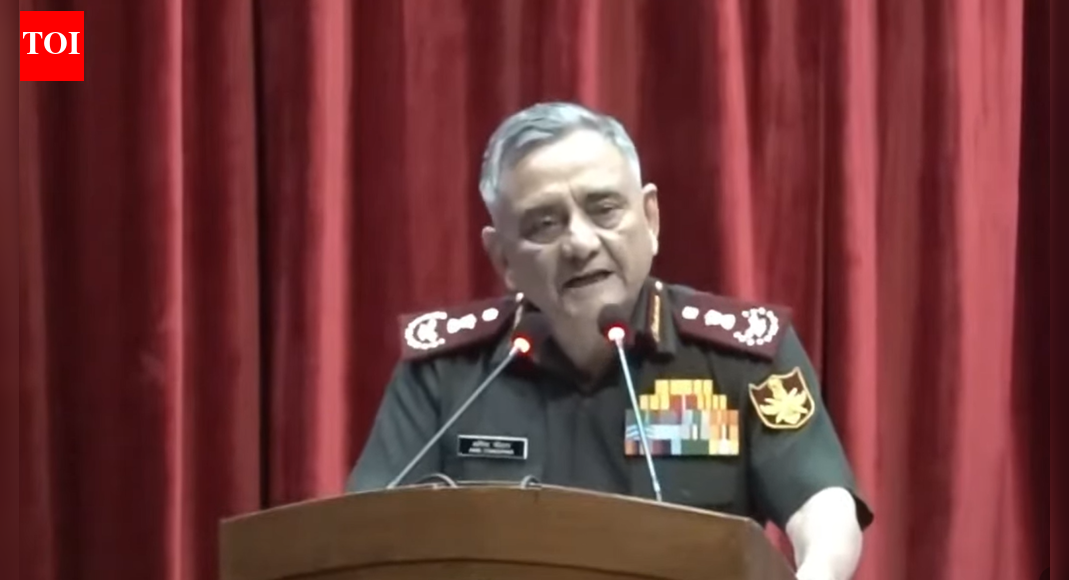
NEW DELHI: Chief of Defence Staff (CDS) General Anil Chauhan on Tuesday called for a three-pronged approach to deter terrorism.According to General Chauhan, who was speaking at an IIT Bombay event, India must prepare itself for short but intense conflicts, longer land-centric conflicts, and create an “asymmetry with the weaker adversary,” a reference to Pakistan.
“The question is what kind of threats and challenges India should be prepared for. I think this should be based on two major facts. One, both our adversaries—one is a nuclear weapon state and the other is a nuclear-armed state. Hence, we should not allow that level (nuclear) of deterrence to be breached,” he said.The country’s senior-most military officer was referring to China and Pakistan, respectively.“Hence, in my view, we should be prepared to fight short-duration, high-intensity conflicts to deter terrorism—something like Operation Sindoor. Second, we should be prepared for a land-centric, long-duration conflict because we have land disputes, though we should try and avoid it,” he added.Elaborating on the third approach, General Chauhan remarked, “We must exploit new domains and create asymmetry with our weaker adversary, while ensuring these asymmetries are not exploited by other nations. Terrorism will remain a threat and will require both defensive and offensive responses.”The CDS further observed that modern warfare is becoming shorter, yet “faster and smarter,” citing Operation Sindoor as an example.“Warfare in the new domains is faster and smarter. It is also shorter in duration, and the tempo of such warfare is very, very high. Decisions are compressed in time, and the effects of war are felt almost instantly. This was clearly visible in Operation Sindoor, a conflict that lasted only about four days and gave India a decisive victory,” he noted.Arch-rivals India and Pakistan were engaged in a brief but intense conflict from May 7 to 10 following Operation Sindoor, under which the Indian armed forces targeted nine terror camps in Pakistan and Pakistan-occupied Kashmir. The operation came in retaliation for the April 22 Pahalgam terror attack, in which 26 civilians were killed by Pakistan-backed terrorists.The hostilities ended on May 10, with a ceasefire declared following a request from Islamabad.


