
Biological gold: The 46-million-year-old mosquito caught red-handed with a belly full of blood

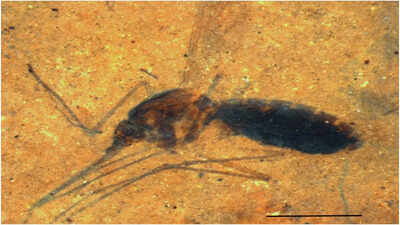
For decades, the notion of a prehistoric mosquito entombed in a chunk of amber has colored our perception of the past, largely due to the allure of resurrecting these creatures that Hollywood has concocted for us. However, true science frequently manages to come up with a few surprises that might seem very down to earth while still being awe-inspiring nonetheless. Deep within a secluded corner of northwest Montana, a group of scientists stumbled upon something so remarkable that it seems as if it came straight out of science fiction. They found a fossilised mosquito that had its last meal intact inside it.It was not preserved in amber, the resin exuded by a tree. Rather, the insect had been perfectly preserved within layers of shale formed some 46 million years ago in the Middle Eocene Epoch. While the drama of a spectacularly preserved insect in amber evokes wonder and fascination, this particular specimen remained undisturbed by such fanfare. It was discovered in the Kishenehn Formation, a site famous for its extraordinary fossilisation capabilities. Here then lies the significance of the discovery in that it gives physical proof that blood-sucking by mosquitoes was a trait developed ages ago.The chemistry of a prehistoric dinnerWhile the insect itself is fascinating, the contents of its abdomen make the story extraordinary. During the initial study, the team of scientists observed a dark, opaque substance contained within its belly. It was not mere soil or mineral discolouration. To prove what they had discovered, they conducted thorough chemical tests on the composition of the fossil material.A major study published in the Proceedings of the National Academy of Sciences detailed how the team found high levels of iron and organic molecules known as porphyrins. These are specifically derived from haemoglobin, the protein in blood that carries oxygen. The presence of these chemicals proved that the mosquito had indeed taken a final meal just before it was swept into a lake and buried under sediment. It is a literal snapshot of a moment in time, frozen for 46 million years.
This fossil provides direct proof of blood-sucking by mosquitoes millions of years ago. The discovery offers a rare glimpse into prehistoric life and evolution.
This fact is important as it goes beyond the usual bones. Usually, fossils are restricted to those hard materials. Discovering soft tissues or remains of prey in a meal is extremely rare. One other very important research in Zootaxa enabled us to classify the discovered insect into its proper family. After analysing its physical features, the researchers concluded that the insect belonged to the genus Culiseta, which continues living today. In this way, despite the dramatic changes that occurred over millions of years, the basic instincts of these creatures remain unchanged.A glimpse into the pastImagine what Montana looked like about 46 million years ago. It certainly didn’t resemble the current view of jagged rocks and mountains. It was a subtropical region with numerous lakes and forests. The insect probably flew across its humid canopy and probably fed on an extinct bird or mammal.The preservation of this creature can be likened to a miracle of geology. The conditions for a blood-filled mosquito to fossilise would have needed perfect alignment. Most likely, the mosquito settled on the surface of a lake that was relatively calm, and then sank down below the surface. Here, a layer of silty sediment would have buried the insect in what amounted to an anaerobic environment, preventing decomposition from occurring. In the many millions of years since, the pressures exerted by additional layers of sediment turned this silt into stone.While this discovery is incredible, it doesn’t mean we are one step closer to building a prehistoric theme park. DNA is a fragile molecule that breaks down relatively quickly, even under perfect conditions. Even though the haemoglobin derivatives survived, the actual genetic code of the creature the mosquito fed upon is long gone. However, what we gain instead is a deeper understanding of evolution. We can see how nature perfected the “blood-sucking” design early on and stayed with it.This tiny fossil serves as a humble testament to the great amounts of Earth’s history that exist right below our feet. It is a connection between our present-day environment and an ancient past that is still very much out of reach. Every piece of evidence that comes to light brings us closer to understanding the full story of life on Earth.


