
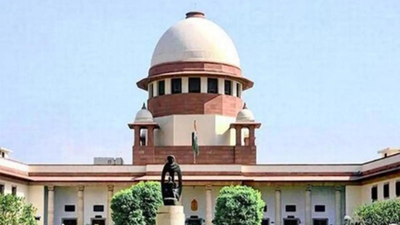
ANI file photo NEW DELHI: Travancore Devaswom Board (TDB) on Wednesday asked a nine-judge bench of the Supreme Court that despite the Constitution making every religious denomination subject to ‘public order, health and morality’ and nudity in public being an offence, can the courts ban public appearance of naked sadhus of Jainism’s Digambar sect?This response from senior advocate A M Singhvi, on behalf of TDB, was to persistent questions from a nine-judge bench led by Chief Justice Surya Kant – why the courts cannot test whether a custom or tenet is part of an essential religious practice to be immune from judicial scrutiny and whether judicial test should be confined to the constitutional parameters of ‘public order, health and morality’ under Article 25.Singhvi said even certain extreme examples do not come under the ambit of judicial scrutiny. Citing the example of a significant Jain sect of ‘Dagambars’, he said, “There is no doubt that nudity is abhorrent to normal canons of civilized behaviour in most societies. Yet, since Digambar Jain practices, including nude existence and nude movement in public, are undeniably accepted as a core part of a well-known religion, it would not be liable to be struck down under Article 25.”Solicitor general Tushar Mehta joined Singhvi and cited the example of ‘Naga Sadhus’, who roam naked. Interestingly, the Nepal Supreme Court in last September had dismissed a petition, which had sought a ban on entry of Naga Sadhus at Pashupatinath temple during Mahashivaratri festival claiming that obscenity due to their public nudity disturbed other devotees.The Nepal SC had ruled that nudity mandated by religion cannot be regarded as obscene and dismissed a public interest petition. The apex court of the neighbouring country had said, “Nudity is simply a physical state, usually referring to the exposure of sexual organs or body parts. However, obscenity means something that arouses sexual desire or is socially and culturally considered shameful or offensive. Therefore, not all instances of nudity can be considered obscene.”“For example, nudity expressed in artistic imagination, for religious purposes, or for medical/therapeutic use, cannot be regarded as obscene. Similarly, ancient sculptures of deities with decorative art in temples, or nude paintings/statues displayed in museums, cannot automatically be labelled as obscene,” the Nepal SC had said, adding that since the tradition of Naga Sadhus visiting the temple is centuries-old, “prohibiting their entry would violate religious faith at both national and international levels.”Singhvi said, ” Crucially and significantly, an external adjudicator like a Court of Law cannot and should not sit in judgment over what is considered the belief or practice of a religion. It is reiterated that the bona fide albeit subjective belief of the community is crucial and dispositive for determining the belief or practice of a religion. The Court is required to accept the practice and belief of the community which is determined by the community itself.”End of ArticleFollow Us On Social MediaVideosCongress Slams Delimitation Bill As “Attack On Federalism” | Venugopal Targets CentreWomen’s Reservation Bill: Amit Shah, Akhilesh Yadav Face Off Over Demands For Quota Within BillOpposition vs Centre Over Delimitation: Fears of Imbalance, Govt Rejects ClaimsTCS Nashik BPO Shut Amid Shocking Sexual Abuse Storm, Staff Shifted To Work From HomeIMF Says India Growing Twice As Fast As World Economy, Signals Strength Amid Global SlowdownIndia May Face Oil Supply Pressure As US Ends Russian Crude Waiver, Says Bessent’India In Talks With Many Countries Over Hormuz’: MEA Amid US’ Naval BlockadeTamil Nadu elections 2026: Freebies war heats up between DMK, AIADMK & rivals’Not Shehbaz Sharif’: Ex-Minister Fawad Chaudhry Calls Asim Munir ‘De Facto Leader Of Pakistan’TCS Row Explodes: Horrific Details Of Sexual Abuse, Conversion Claims Rock India’s Corporate123PhotostoriesYour body adapts faster than your habits: Why old health advice stops working and what to do instead5 things you should never discuss at workWhat color bangles should women wear according to their birth dateThe 12 Jyotirlingas where Shiva is believed to still reside; here’s how to visit them10 boundaries you should start setting for a happier lifeFrom marigold to chrysanthemum: 5 flowering plants that can help get rid of lizards at home5 simple things to look for while picking right muskmelon and 3 simple ways to enjoy it during summerTCS Nashik scandal deepens: NCW orders probe, multiple FIRs, staff on WFHChopping board to aluminium foil: 6 common kitchen items to throw out immediately and whyP. V. Sindhu’s elegant Hyderabad home combines minimalist interiors, family-centric spaces, and breathtaking hilltop views123Hot PicksIran warDisney layoffsPurple cap winnerOrange cap winnerIPL Points TablePublic holidays April 2026Bank Holidays AprilTop TrendingTCS NashikPune Harassment NewsVaranasi Woman DeathLucknow Vikas Nagar Fire IncidentChandigarh Bomb ThreatsUP Beggar MurderBengaluru Businessman NewsGurgaon Student SuicideJ&K Drug Racket BustJaisalmer Murder

NEW DELHI: Travancore Devaswom Board (TDB) on Wednesday asked a nine-judge bench of the Supreme Court that despite the Constitution making every religious denomination subject to ‘public order, health and morality’ and nudity in public being an offence, can the courts ban public appearance of naked sadhus of Jainism’s Digambar sect?This response from senior advocate A M Singhvi, on behalf of TDB, was to persistent questions from a nine-judge bench led by Chief Justice Surya Kant – why the courts cannot test whether a custom or tenet is part of an essential religious practice to be immune from judicial scrutiny and whether judicial test should be confined to the constitutional parameters of ‘public order, health and morality’ under Article 25.Singhvi said even certain extreme examples do not come under the ambit of judicial scrutiny. Citing the example of a significant Jain sect of ‘Dagambars’, he said, “There is no doubt that nudity is abhorrent to normal canons of civilized behaviour in most societies. Yet, since Digambar Jain practices, including nude existence and nude movement in public, are undeniably accepted as a core part of a well-known religion, it would not be liable to be struck down under Article 25.”Solicitor general Tushar Mehta joined Singhvi and cited the example of ‘Naga Sadhus’, who roam naked. Interestingly, the Nepal Supreme Court in last September had dismissed a petition, which had sought a ban on entry of Naga Sadhus at Pashupatinath temple during Mahashivaratri festival claiming that obscenity due to their public nudity disturbed other devotees.The Nepal SC had ruled that nudity mandated by religion cannot be regarded as obscene and dismissed a public interest petition. The apex court of the neighbouring country had said, “Nudity is simply a physical state, usually referring to the exposure of sexual organs or body parts. However, obscenity means something that arouses sexual desire or is socially and culturally considered shameful or offensive. Therefore, not all instances of nudity can be considered obscene.”“For example, nudity expressed in artistic imagination, for religious purposes, or for medical/therapeutic use, cannot be regarded as obscene. Similarly, ancient sculptures of deities with decorative art in temples, or nude paintings/statues displayed in museums, cannot automatically be labelled as obscene,” the Nepal SC had said, adding that since the tradition of Naga Sadhus visiting the temple is centuries-old, “prohibiting their entry would violate religious faith at both national and international levels.”Singhvi said, ” Crucially and significantly, an external adjudicator like a Court of Law cannot and should not sit in judgment over what is considered the belief or practice of a religion. It is reiterated that the bona fide albeit subjective belief of the community is crucial and dispositive for determining the belief or practice of a religion. The Court is required to accept the practice and belief of the community which is determined by the community itself.“


