
Amid the recurring debate over whether northern states could gain at the expense of the South in any future Lok Sabha expansion, the historical record tells a more complicated story. Between 1951 and 1977, when parliamentary seats were periodically reallocated after Census exercises, both the Hindi belt and the southern states saw their share of Lok Sabha seats decline. But the Hindi belt’s share fell by far more — 3.1 percentage points, against a 1.2-point decline for the South.The main reason was not a gain for the South over the North, or vice versa, but the growing representation of Union Territories and the rising share of western and eastern states. The comparison also needs to be read with caution: India’s map looked very different in 1951, before the linguistic reorganisation of states. By 1956, states were more or less in their present form, but several UTs either had little or no Lok Sabha representation at the time. Taken together, the data shows that changes in parliamentary representation were shaped not just by the North-South balance, but also by state reorganisation, UT representation, and the evolving federal map of India.► The 1951 election was held before the linguistic reorganisation of states, so state boundaries were very different from today’s ► After the 1956 reorganisation, states were broadly in their present form, but several Union Territories still had little or no Lok Sabha representation ► The fall in share was driven partly by the growing representation of UTs and by gains by western and eastern states ► Even in 1977, the last election in this analysis since Lok Sabha seats have not been reallocated after that, Daman & Diu did not exist as a separate UT ► This comparison tracks share of total Lok Sabha seats, not voter population per Member of Parliament or constituency size ►For 1951 and 1957, the figures refer to seats, not constituencies, because some constituencies then elected two membersEnd of ArticleFollow Us On Social MediaVideos’Never Be Forgiven’: PM Modi Dares Opposition On Women Quota Bill, Priyanka Gandhi Questions Timing‘Won’t Reduce South’s Share’: Amit Shah Clarifies On Delimitation, Calls Oppn Claims ‘Misleading’Hal’s Light Utility Helicopter Explained: Specs, Altitude Edge And Why It Matters‘PM Modi Only Flag Bearer Of Feminism’: Kangana Ranaut Targets Congress Over Women Quota Bill In Lok SabhaPM Modi, French President Macron Stress Urgent Need To Restore Hormuz Safety During Phone Call’If Chanakya Were Alive…’: Priyanka Gandhi’s Swipe At Amit Shah Over Delimitation, Women QuotaNo More Russian Oil Waiver: What The US Decision Means For India’s Energy Needs Amid West Asia CrisisAustria’s Chancellor Calls India Key Partner, Pushes India-EU Trade Deal Amid Global TurmoilLok Sabha Erupts As Sawant Names Sengar, Brij Bhushan; Dubey Hits Back With Aaditya Thackeray Claim‘Not A Backdoor Exercise’: Tejasvi Surya Counters Opposition On Delimitation, Flags Representation Risks123Photostories8 rare baby boy names that start with the letter ‘K’Exclusive – Kiku Sharda opens up about his kids’ reaction to his female roles, Sunil Grover’s talent, and his bond with Kapil Sharma5 Japanese food rituals that could fix your eating habits instantly5 Signs of high emotional intelligence that instantly set you apart from others5 things couples do before calling it quitsWhy your heirloom Kanjeevaram saree feels so different from a modern silk shirt8 most unusual monkeys in the world: From capuchins to mandrillsStep inside Chris Gayle’s ₹20 crore lavish Jamaica mansion with private nightclub, infinity pools and unbelievable ocean views!‘Are we eating all our mangoes’: Why despite being the largest producer of mangoes, India is able to export just 1 percentGold vs lab-grown diamonds: What should you really buy this Akshaya Tritiya?123Hot PicksIran warWipro buyback planPurple cap winnerOrange cap winnerIPL Points TablePublic holidays April 2026Bank Holidays AprilTop TrendingTCS NashikTrump-Modi callSouth Delimitation ImpactAmit ShahPriyanka GandhiUK Flea Treatment RulesAlex ManningerCody RhodesCharlie Kirk ControversyTiger Woods

Amid the recurring debate over whether northern states could gain at the expense of the South in any future Lok Sabha expansion, the historical record tells a more complicated story. Between 1951 and 1977, when parliamentary seats were periodically reallocated after Census exercises, both the Hindi belt and the southern states saw their share of Lok Sabha seats decline. But the Hindi belt’s share fell by far more — 3.1 percentage points, against a 1.2-point decline for the South.The main reason was not a gain for the South over the North, or vice versa, but the growing representation of Union Territories and the rising share of western and eastern states. The comparison also needs to be read with caution: India’s map looked very different in 1951, before the linguistic reorganisation of states. By 1956, states were more or less in their present form, but several UTs either had little or no Lok Sabha representation at the time.
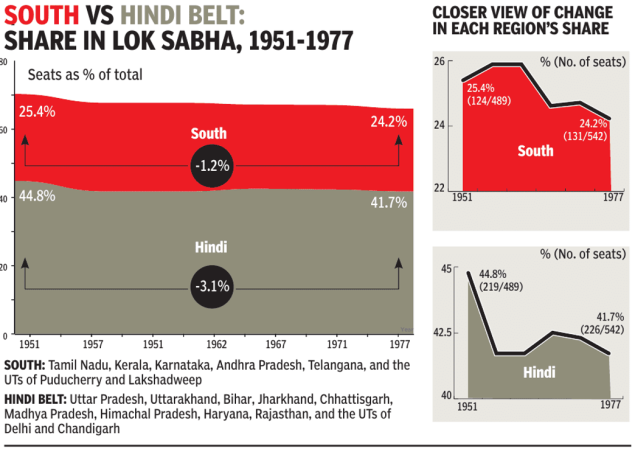
Taken together, the data shows that changes in parliamentary representation were shaped not just by the North-South balance, but also by state reorganisation, UT representation, and the evolving federal map of India.► The 1951 election was held before the linguistic reorganisation of states, so state boundaries were very different from today’s ► After the 1956 reorganisation, states were broadly in their present form, but several Union Territories still had little or no Lok Sabha representation ► The fall in share was driven partly by the growing representation of UTs and by gains by western and eastern states ► Even in 1977, the last election in this analysis since Lok Sabha seats have not been reallocated after that, Daman & Diu did not exist as a separate UT ► This comparison tracks share of total Lok Sabha seats, not voter population per Member of Parliament or constituency size ►For 1951 and 1957, the figures refer to seats, not constituencies, because some constituencies then elected two members


