
AI-generated image (For representative purposes only) What kind of politics makes people die for their leaders?In Tamil Nadu, that is not rhetorical.It has happened repeatedly — in moments of grief, in moments of defeat, and, as seen last week during Vijay’s frantic government-formation talks, even in anticipation of power.But this is not a new story. Tamil Nadu has seen this before.It is December 1987, and Tamil Nadu is collapsing into grief.The streets are flooded with mourners. Men cry openly outside party offices. Some supporters drink poison. Others set themselves on fire. Across the state, sorrow turns fatal as news spreads that MG Ramachandran is dead.He was the founder of All India Anna Dravida Munnetra Kazhagam (AIADMK), a Tamil cinema legend and the state’s first actor-chief minister. But to millions, he was something far larger than any office he held. He was ‘Puratchi Thalaivar’, the revolutionary leader, the man who had stepped off the silver screen and into their lives as protector, provider and hero. MGR at a public rally in Tamil NaduFor more than a decade, MGR had ruled Tamil Nadu, winning three consecutive terms before dying while still in office. His death did not just mark the end of a chief minister. For many, it felt like the loss of someone far more intimate — a guardian, almost family.It would not be the last time Tamil Nadu witnessed grief spill into tragedy.The pattern returned, again and again, each time reminding the state that its politics was never merely electoral.In 2001, when J Jayalalithaa was forced to step down after a corruption conviction, her supporters took their own lives. In 2014, when she was jailed once more, the state saw another wave of mourning — suicides, self-immolations and heart attacks attributed to shock.After her death in 2016, AIADMK claimed that at least 470 supporters had died grieving the loss of the woman they fondly called ‘Amma’.Then came Vijay.In September 2025, lakhs converged on Karur to catch a glimpse of Tamil cinema’s reigning superstar as he edged closer to political power. People stood for hours under a punishing sun, waiting for the man many already saw as their next saviour. By the time the gathering ended, 41 people were dead.For a state that has long blurred the line between screen idol and political messiah, Vijay’s rise was not an exception. It was the latest chapter in a familiar script. Karur stampede aftermath (Credit: PTI)Voting for the underdog?Tamil Nadu’s voting behaviour often reflects a distinctive political logic where identity is acknowledged but not always politically foregrounded. While the state has deep social stratification, with Scheduled Castes making up around 20% of the population and broader SC/ST/OBC groups forming over 75%, electoral appeal frequently shifts away from narrow caste or religious consolidation toward figures who project a more universalised identity of suffering and uplift. Religious demographics further underline this complexity, with Hindus forming 87.58%, Muslims 5.86%, and Christians 6.12%, yet electoral mobilisation rarely maps neatly onto these categories. Instead, political legitimacy is often constructed through narratives of deprivation, struggle, and moral protection, allowing leaders to transcend identity boundaries without fully abandoning them. This is where the ‘underdog’ or ‘saviour-from-within’ template becomes politically powerful. Leaders such as MG Ramachandran and Karunanidhi exemplified this shift. Their political identity was built less on elite authority and more on autobiographical suffering, poverty, hunger, and lived hardship, which they explicitly translated into policy imagination. In fact, MGR’s first question to his cabinet about “who had experienced childhood poverty” was not merely symbolic, it reinforced a governing ethic rooted in empathy-as-experience. Welfare schemes for schoolchildren and marginalised communities further institutionalised this ethos, while his delegation of administrative control to trusted officials allowed emotional leadership to coexist with technocratic governance. In this framework, figures like Vijay, from socially identified but politically transcendent backgrounds such as the Velalar Christian community, can be read as inheritors of a longer pattern where leaders do not reject identity, but strategically dilute it into a broader language of shared deprivation and moral universality. How cinema became political training in Tamil NaduIn Tamil Nadu, the transition from cinema to politics is not an exception to the system; it is integral to how the system itself evolved. The foundation was laid when CN Annadurai and M Karunanidhi turned theatre and screenwriting into political tools. Karunanidhi’s long career, from scriptwriter to five-time chief minister, established a precedent that narrative skill could translate into political authority. But MG Ramachandran transformed that relationship into a mass political structure. Already a dominant film star, MGR carried his on-screen persona of the benevolent protector directly into electoral politics, founding the AIADMK and becoming chief minister in 1977. His image as the “man of the masses” made the boundary between character and leader increasingly irrelevant for large sections of voters.That model was consolidated and intensified by J Jayalalithaa. After a successful film career, she entered politics under MGR’s mentorship and later built her own political identity as “Amma”, anchoring authority in personal symbolism and welfare distribution. Together, MGR and Jayalalithaa turned actor-led leadership into a durable governing structure rather than a temporary political experiment.Fan clubs become organisedOver time, this pattern stopped being about isolated figures and became a repeatable political template. Tamil Nadu politics began to treat cinematic visibility as a form of pre-political legitimacy. The actor was not just a candidate, he or she was already a public figure with emotional access to large audiences.This was reinforced by the Dravidian political tradition itself, which had long used cinema as a communication medium. As academic studies of Tamil cinema note, the boundary between cinema and politics in the state became structurally blurred, with film functioning as a carrier of ideological messaging as much as entertainment.Within this ecosystem, fan cultures played a critical role. Fan clubs for stars like MGR and later Rajinikanth functioned as organised social networks, often involved in welfare activities and local mobilisation. These structures later became informal political infrastructure, capable of being activated during elections.The durability of this model is visible in how consistently it reappears across generations. After MGR and Jayalalithaa, later figures attempted to replicate the pathway with varying success, including Vijayakanth and, more recently, the anticipation around Rajinikanth, whose political entry was widely expected but ultimately did not materialise.Yet the underlying structure remained intact: Tamil Nadu continues to produce political environments where cinematic identity is treated as a form of credibility, and where mass recognition often precedes organisational politics. Vijay’s pre-poll rally‘Amma, Thalapathy’: When leaders get titles from fansIn Tamil Nadu politics, leaders are rarely treated as distant office-holders. They are folded into the vocabulary of family itself. Titles like ‘Thalaivar’ and ‘Amma’ are not stylistic choices — they are political signals that replace institutional distance with emotional proximity. Once that shift happens, the relationship between leader and follower stops being transactional and becomes personal.This form of attachment predates social media and survives it. Long before digital fandoms, Tamil cinema had already built a system of parasocial bonding where audiences formed one-sided emotional relationships with stars who appeared repeatedly as protectors, providers and moral anchors on screen. In a state where cinema is deeply embedded in everyday life — from street posters to festival soundtracks — these screen identities easily spill into political perception.The Dravidian political tradition amplified this structure. Welfare politics reinforced the idea that the leader is not just a decision-maker but a direct source of material dignity. For large sections of voters, access to rice, subsidies, housing or public services became symbolically linked to the leader’s personal commitment. Over time, political support became tied not only to ideology, but to the feeling of being seen and provided for. Jayalalithaa’s funeral procession (Credit: ANI)It is within this framework that figures like MG Ramachandran and J Jayalalithaa were transformed into emotional institutions. MGR’s on-screen image as a benevolent saviour and Jayalalithaa’s carefully constructed persona as “Amma” turned political loyalty into something closer to familial dependence than civic choice.The same emotional architecture is visible in the rise of Vijay. Known to his fan base as “Thalapathy”, Vijay enters politics with an already established emotional economy built over decades of cinema. His films repeatedly position him as protector, mediator and moral force — roles that do not end at the theatre exit in a context where screen identities are continuously circulated in public life.What this produces is not simply popularity, but an emotional contract. Supporters do not merely evaluate performance or policy; they invest identity, dignity and aspiration into a figure who symbolically carries their social presence. In such a system, political allegiance is less about persuasion in the conventional sense and more about belonging — to a leader who is experienced not as a representative, but as an extension of the self.Why Vijay’s victory was not a surprise but a continuation of this cultureTVK chief Vijay won 110 seats and became the single largest party in Tamil Nadu elections. However, no exit polls had predicted this level of sweep. But it was inevitable.Within this historical context, the emergence of Vijay and his party TVK fits into a long-established pattern rather than breaking it. His transition reflects the same structural conditions that shaped earlier actor-politicians: a pre-existing fan base, emotional identification with screen roles, and a political culture that already recognises cinematic popularity as legitimacy.What has changed is scale and immediacy. By the time Vijay formally entered politics in the mid-2020s, Tamil Nadu already had half a century of precedent in converting cinematic stardom into electoral mobilisation. His entry signals not the invention of a new model, but the continuation of an old one, adapted to a newer media environment and a larger, more organised fan ecosystem.About the AuthorAastha JhaAastha Jha is a writer at The Times of India, covering politics. She also writes on business, global affairs, social issues, with a focus on policy, governance and their impact on everyday lives. Her work brings together reportage and analysis, tracking developments in India and abroad while examining the broader social and economic currents shaping public discourse.Read MoreEnd of ArticleFollow Us On Social MediaVideosUdhayanidhi Stalin’s Fresh ‘Eradicate Sanatan Dharma’ Remark Triggers Massive BJP Backlash In TNNTA Scraps NEET UG 2026 Over ‘Guess Paper’ Leak, Re-Exam Dates To Be Announced | WatchFIR Filed Against SP MP Ajendra Singh Lodhi Over Alleged Remarks Against PM ModiCBI Takes Over Probe Into Murder Of Suvendu Adhikari’s Aide Chandranath Rath, Forms 7-Member SITAIADMK Faces Biggest Split Since Jayalalithaa Era As Rebel Faction Extends Support To Vijay’s TVKTamil Nadu CM Vijay Orders Shutdown Of 717 TASMAC Shops Near Temples, Schools And Bus StandsCongress Expands Kerala CM Consultations As Satheesan-Venugopal Battle IntensifiesTarn Taran BJP Office Attacked: Youths Vandalise Premises, Fire Shots In Air; Probe OnRahul Gandhi Targets Centre Over NEET Leak Allegations As Rajasthan SOG Expands ProbeFormer TMC Minister Sujit Bose Arrested By ED In Municipality Recruitment ‘Scam’123PhotostoriesHair oil or hair conditioner: Which is better to stop hair fall in summersCricketer Nitish Kumar Reddy’s ₹3 crore Visakhapatnam home is a perfect picture of success, family bond and coastal calmSuccess quote of the day by Confucius: “Success depends upon…”Your expensive skincare may not work until you fix your gut: Doctors explain the surprising skin-digestion connection5 simple remedies to keep silverfish away and protect your favourite books and clothes before it’s too late!Personality test: Pick a tree and see what it reveals about what makes you feel safe, happy, and calmFrom snake fruit to jabuticaba; 10 unique fruit trees around the world and where travellers can find them10 countries with the most mosquitoes, does India figure in the list?How Vijay Thalapathy, Rajinikanth, Kamal Haasan looked DECADES ago; Superstars’ then and now picturesBMI vs Belly Fat: Which is a better predictor of heart attack risk (and why)123Hot PicksCBSE class 12 resultModi on buying goldOil prices todayPune child rape-murder casePerambur election resultIndia-New Zealand FTASugarcane price hikeTop TrendingTamil Nadu CMBhagwant Mann CousinIPL Points TableFifa World Cup 2026 ScheduleVijay AstrologerHimanta Biswa SarmaIPL Orange Cap 2026AIADMK splitHighway Toll DuesBhuvneshwar Kumar

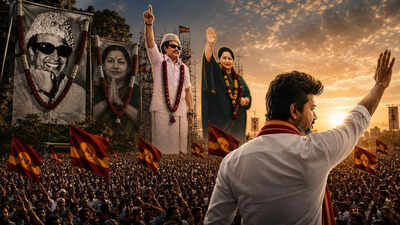
What kind of politics makes people die for their leaders?In Tamil Nadu, that is not rhetorical.It has happened repeatedly — in moments of grief, in moments of defeat, and, as seen last week during Vijay’s frantic government-formation talks, even in anticipation of power.But this is not a new story. Tamil Nadu has seen this before.It is December 1987, and Tamil Nadu is collapsing into grief.The streets are flooded with mourners. Men cry openly outside party offices. Some supporters drink poison. Others set themselves on fire. Across the state, sorrow turns fatal as news spreads that MG Ramachandran is dead.He was the founder of All India Anna Dravida Munnetra Kazhagam (AIADMK), a Tamil cinema legend and the state’s first actor-chief minister. But to millions, he was something far larger than any office he held. He was ‘Puratchi Thalaivar’, the revolutionary leader, the man who had stepped off the silver screen and into their lives as protector, provider and hero.
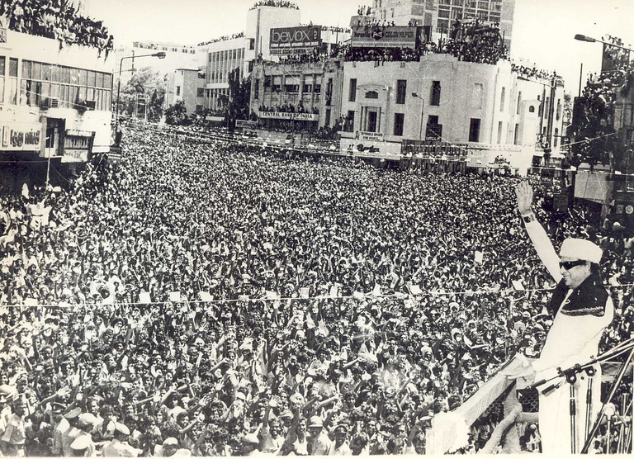
MGR at a public rally in Tamil Nadu
For more than a decade, MGR had ruled Tamil Nadu, winning three consecutive terms before dying while still in office. His death did not just mark the end of a chief minister. For many, it felt like the loss of someone far more intimate — a guardian, almost family.It would not be the last time Tamil Nadu witnessed grief spill into tragedy.The pattern returned, again and again, each time reminding the state that its politics was never merely electoral.In 2001, when J Jayalalithaa was forced to step down after a corruption conviction, her supporters took their own lives. In 2014, when she was jailed once more, the state saw another wave of mourning — suicides, self-immolations and heart attacks attributed to shock.After her death in 2016, AIADMK claimed that at least 470 supporters had died grieving the loss of the woman they fondly called ‘Amma’.Then came Vijay.In September 2025, lakhs converged on Karur to catch a glimpse of Tamil cinema’s reigning superstar as he edged closer to political power. People stood for hours under a punishing sun, waiting for the man many already saw as their next saviour. By the time the gathering ended, 41 people were dead.For a state that has long blurred the line between screen idol and political messiah, Vijay’s rise was not an exception. It was the latest chapter in a familiar script.
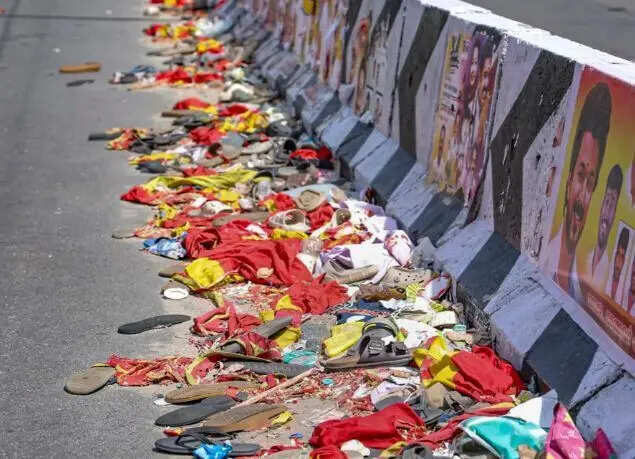
Karur stampede aftermath (Credit: PTI)
Voting for the underdog?
Tamil Nadu’s voting behaviour often reflects a distinctive political logic where identity is acknowledged but not always politically foregrounded. While the state has deep social stratification, with Scheduled Castes making up around 20% of the population and broader SC/ST/OBC groups forming over 75%, electoral appeal frequently shifts away from narrow caste or religious consolidation toward figures who project a more universalised identity of suffering and uplift. Religious demographics further underline this complexity, with Hindus forming 87.58%, Muslims 5.86%, and Christians 6.12%, yet electoral mobilisation rarely maps neatly onto these categories. Instead, political legitimacy is often constructed through narratives of deprivation, struggle, and moral protection, allowing leaders to transcend identity boundaries without fully abandoning them. This is where the ‘underdog’ or ‘saviour-from-within’ template becomes politically powerful. Leaders such as MG Ramachandran and Karunanidhi exemplified this shift. Their political identity was built less on elite authority and more on autobiographical suffering, poverty, hunger, and lived hardship, which they explicitly translated into policy imagination. In fact, MGR’s first question to his cabinet about “who had experienced childhood poverty” was not merely symbolic, it reinforced a governing ethic rooted in empathy-as-experience. Welfare schemes for schoolchildren and marginalised communities further institutionalised this ethos, while his delegation of administrative control to trusted officials allowed emotional leadership to coexist with technocratic governance. In this framework, figures like Vijay, from socially identified but politically transcendent backgrounds such as the Velalar Christian community, can be read as inheritors of a longer pattern where leaders do not reject identity, but strategically dilute it into a broader language of shared deprivation and moral universality.
How cinema became political training in Tamil Nadu
In Tamil Nadu, the transition from cinema to politics is not an exception to the system; it is integral to how the system itself evolved. The foundation was laid when CN Annadurai and M Karunanidhi turned theatre and screenwriting into political tools. Karunanidhi’s long career, from scriptwriter to five-time chief minister, established a precedent that narrative skill could translate into political authority.
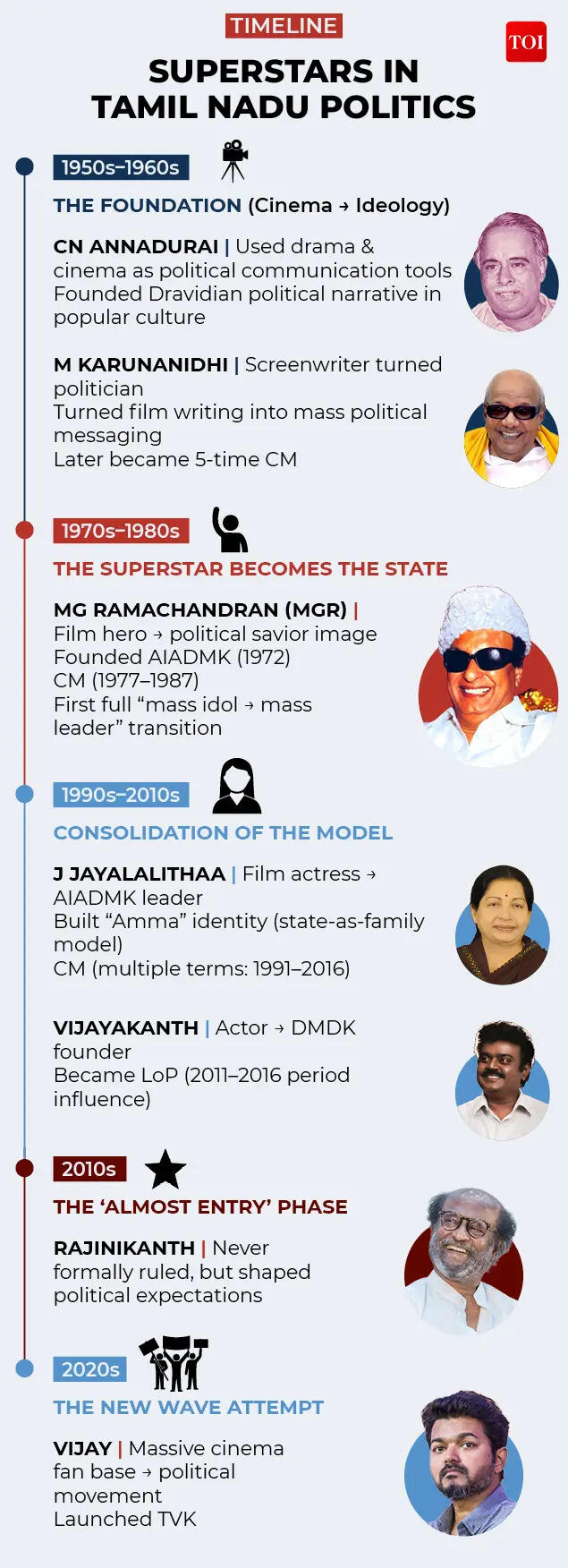
But MG Ramachandran transformed that relationship into a mass political structure. Already a dominant film star, MGR carried his on-screen persona of the benevolent protector directly into electoral politics, founding the AIADMK and becoming chief minister in 1977. His image as the “man of the masses” made the boundary between character and leader increasingly irrelevant for large sections of voters.That model was consolidated and intensified by J Jayalalithaa. After a successful film career, she entered politics under MGR’s mentorship and later built her own political identity as “Amma”, anchoring authority in personal symbolism and welfare distribution. Together, MGR and Jayalalithaa turned actor-led leadership into a durable governing structure rather than a temporary political experiment.
Fan clubs become organised
Over time, this pattern stopped being about isolated figures and became a repeatable political template. Tamil Nadu politics began to treat cinematic visibility as a form of pre-political legitimacy. The actor was not just a candidate, he or she was already a public figure with emotional access to large audiences.This was reinforced by the Dravidian political tradition itself, which had long used cinema as a communication medium. As academic studies of Tamil cinema note, the boundary between cinema and politics in the state became structurally blurred, with film functioning as a carrier of ideological messaging as much as entertainment.Within this ecosystem, fan cultures played a critical role. Fan clubs for stars like MGR and later Rajinikanth functioned as organised social networks, often involved in welfare activities and local mobilisation. These structures later became informal political infrastructure, capable of being activated during elections.The durability of this model is visible in how consistently it reappears across generations. After MGR and Jayalalithaa, later figures attempted to replicate the pathway with varying success, including Vijayakanth and, more recently, the anticipation around Rajinikanth, whose political entry was widely expected but ultimately did not materialise.Yet the underlying structure remained intact: Tamil Nadu continues to produce political environments where cinematic identity is treated as a form of credibility, and where mass recognition often precedes organisational politics.
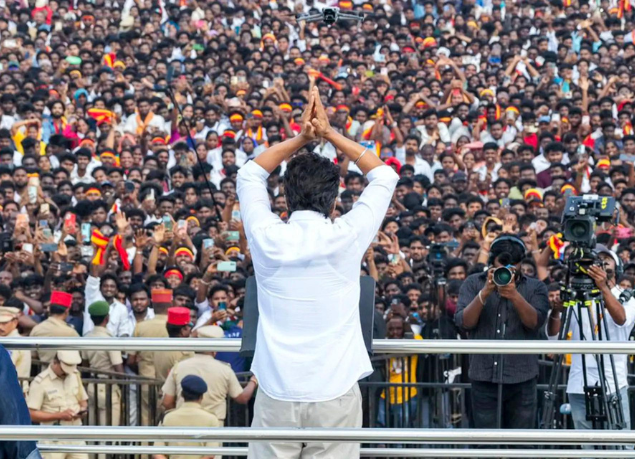
Vijay’s pre-poll rally
‘Amma, Thalapathy ’: When leaders get titles from fans
In Tamil Nadu politics, leaders are rarely treated as distant office-holders. They are folded into the vocabulary of family itself. Titles like ‘Thalaivar’ and ‘Amma’ are not stylistic choices — they are political signals that replace institutional distance with emotional proximity. Once that shift happens, the relationship between leader and follower stops being transactional and becomes personal.This form of attachment predates social media and survives it. Long before digital fandoms, Tamil cinema had already built a system of parasocial bonding where audiences formed one-sided emotional relationships with stars who appeared repeatedly as protectors, providers and moral anchors on screen. In a state where cinema is deeply embedded in everyday life — from street posters to festival soundtracks — these screen identities easily spill into political perception.The Dravidian political tradition amplified this structure. Welfare politics reinforced the idea that the leader is not just a decision-maker but a direct source of material dignity. For large sections of voters, access to rice, subsidies, housing or public services became symbolically linked to the leader’s personal commitment. Over time, political support became tied not only to ideology, but to the feeling of being seen and provided for.
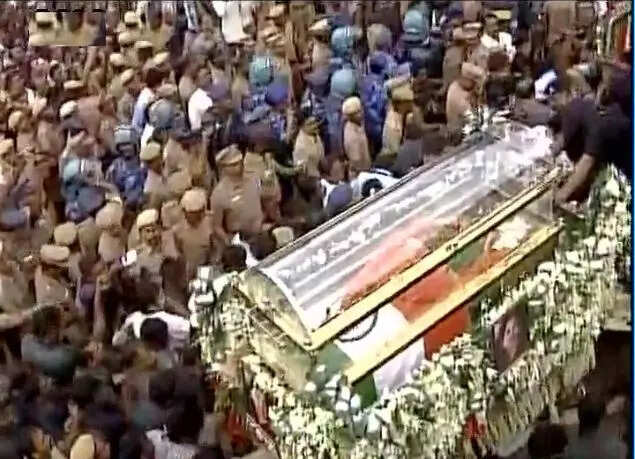
Jayalalithaa’s funeral procession (Credit: ANI)
It is within this framework that figures like MG Ramachandran and J Jayalalithaa were transformed into emotional institutions. MGR’s on-screen image as a benevolent saviour and Jayalalithaa’s carefully constructed persona as “Amma” turned political loyalty into something closer to familial dependence than civic choice.The same emotional architecture is visible in the rise of Vijay. Known to his fan base as “Thalapathy”, Vijay enters politics with an already established emotional economy built over decades of cinema. His films repeatedly position him as protector, mediator and moral force — roles that do not end at the theatre exit in a context where screen identities are continuously circulated in public life.What this produces is not simply popularity, but an emotional contract. Supporters do not merely evaluate performance or policy; they invest identity, dignity and aspiration into a figure who symbolically carries their social presence. In such a system, political allegiance is less about persuasion in the conventional sense and more about belonging — to a leader who is experienced not as a representative, but as an extension of the self.
Why Vijay’s victory was not a surprise but a continuation of this culture
TVK chief Vijay won 110 seats and became the single largest party in Tamil Nadu elections. However, no exit polls had predicted this level of sweep. But it was inevitable.Within this historical context, the emergence of Vijay and his party TVK fits into a long-established pattern rather than breaking it. His transition reflects the same structural conditions that shaped earlier actor-politicians: a pre-existing fan base, emotional identification with screen roles, and a political culture that already recognises cinematic popularity as legitimacy.What has changed is scale and immediacy. By the time Vijay formally entered politics in the mid-2020s, Tamil Nadu already had half a century of precedent in converting cinematic stardom into electoral mobilisation. His entry signals not the invention of a new model, but the continuation of an old one, adapted to a newer media environment and a larger, more organised fan ecosystem.


