
NEW DELHI:After three years of abuse by her affluent employers in Gurgaon — who made her sleep in a toilet on their terrace — 13-year-old Manisha (name changed), a tribal girl from Godda, was rescued after her father sent an SOS that triggered a joint operation led by Jharkhand Bhawan’s Integrated Research and Rehabilitation Cell (IRRC). Lodged in a children’s home in Delhi since late Nov, she now waits to return to the village she was taken from at age 10 by a trafficker who promised a better life.Eight-year-old Nisha left Khunti with her parents, unaware she would soon be abandoned on a train with only a mobile phone. Found at Anand Vihar station six months ago, she has been in a children’s home while authorities traced her family. The inquiry led to her grandmother, who is eager to take her back despite her own hardship. Israel Iran WarUS-Israel-Iran War Live Updates: Third US carrier on way as Israel launches ‘extensive strikes’ on IranFresh Food Airlifted Into UAE: LuLu flies 80,000 kg of Indian produce; more imports planned‘Xi’s world order died with Khamenei’: The good, the bad, and ugly of US-Iran war for ChinaNisha will return once officials finalise a rehabilitation plan and enrol her in a residential school.In Jan, Rashi and 17 other children boarded a train from Ranchi, lured by a woman trafficker who promised a fun trip to Delhi and work to ease their families’ poverty. Before they reached the Capital, an alert from Jharkhand Police led to their rescue at a Delhi station. Four of them — including Rashi — were shown as adults after the trafficker produced birth certificates. With no long-term support for those just above 18, Rashi was sent back to the home she had earlier fled.These cases of girls aged 8 to 18 illustrate a growing pattern— of minors falling prey to unsafe migration routes or organised trafficking networks. Children reported missing in village police stations often resurface in NCR, trapped by placement agencies, intermediaries or employers who treat them as bonded workers. Salaries are diverted to agents posing as relatives, and the girls are denied phones, mobility and contact with their families.On the eve of Women’s Day, TOI visited the IRRC facility run by Jharkhand Bhavan, where case files and counselling reports reveal how traffickers continue to expand their networks despite tighter enforcement. They routinely forge Aadhaar and birth certificates to avoid arrest. Since 2015, the IRRC has restored 1,077 Jharkhand children to their families or to institutional care in tribal districts. Nodal officer Nachiketa said that in the current financial year (2025-26), 122 children have been returned so far. Of all repatriations since inception, 98% are girls. Each year, 20–25 children from other source states such as Chhattisgarh, Odisha, Assam and Nepal are also rescued. Most rescues take place across NCR — Gurgaon, Faridabad, Noida and Ghaziabad — though teams have travelled to UP, Haryana, Punjab and even Telangana, where six children were recently recovered from a biscuit factory. Working out of a facility in Vasant Kunj, the team keeps a ready space for children brought directly from households before they are escorted to their villages. The 24×7 unit responds to calls from district administrations, police and citizens on its helpline 10582.”Case after case shows that social vulnerabilities push children into trafficking,” Nachiketa said. “It’s not just poverty — single-parent homes, children left with siblings while parents migrate for work, or families where survival needs overshadow childcare make them easy targets.” The trafficking chain, she said, is layered to avoid detection. Each trafficker through the chain of intermediaries from the stage of acquiring the child to placing the child through agents in a home as a househelp probably makes around Rs 1 lakh from one child over a year,” she added. “The children get nothing—their wages go to traffickers, they have no phones, no freedom, and are kept like bonded labour,” Nachiketa said.After restoration, the IRRC monitors each child for three months, ensuring access to schooling, skilling and state-sponsored support. But girls who turn 18 before or during repatriation often fall through systemic gaps. “We need support beyond shelter homes for young women who are legally adults but still extremely vulnerable,” Nachiketa said.The National Commission for Protection of Child Rights, in its 2018 SOP on repatriation of trafficked children, acknowledged the central role state bhawans can play in Delhi-NCR rescues — a responsibility Jharkhand Bhawan has carried out since 2015.For the IRRC team, Women’s Day brings no pause. “For us, these cases aren’t numbers,” Nachiketa said. “Each rescue is a life reclaimed — a step towards empowering a girl and her family against the trafficking network.”End of ArticleFollow Us On Social MediaVideosIndia To Operationalise Integrated Theatre Commands Before CDS General Chauhan Retires: Reports”Oil Imports in Full Flow” Hardeep Puri Amid Rising Middle East TensionsWest Bengal MP Mahua Moitra Slams President Murmu Allegations, Defends State GovtPolitical Storm in Bengal: PM Modi Targets TMC, Mamata Banerjee Hits Back Over Murmu RowTMC, BJP Engage In War Of Words Over Change In Governor Ahead of Assembly ElectionsTMC RS Nominee Menaka Guruswamy Declares: ‘Shall Fight EC in Every Court’ in Fiery First SpeechNishant Kumar Will Make Political Debut On March 8, To Formally Join JD(U) After Nitish’s RS Move‘What Went Through The Administration’s Mind?’ Droupadi Murmu Flags Lapse, Mentions Mamata BanerjeeThe Khamenei’s Killer: Israeli Missile Family India Is Quietly Acquiring | WatchBJP Blasts TMC MP Kalyan Banerjee’s Shocking Remark Against CEC Gyanesh Kumar123PhotostoriesStruggling with slow metabolism? Doctors reveal 8 everyday foods that can naturally boost digestion and burn more caloriesAll you need to know about Ricky Martin: The global icon who will perform at the T20 World Cup closing ceremonyR Madhavan swears by this desi breakfast which keeps him fit at 55 and it can be made under just 5 minutes!Top 5 war dramas to stream on Hulu: ‘The Pacific’, ‘Band of Brothers’, and more10 bizarre luxury car features you probably didn’t know existed6 roadside dhabas that became cult legends7 moments when karma is said to lose its power10 traditional breakfast dishes from small-town India that beat modern brunchTop 8 posh localities in Mumbai dominating the luxury real estate market’This is my final drive’: YouTuber Anurag Dobhal crashes SUV during livestream at 140 kmph; had spoken of ‘suicidal thoughts’ days earlier123Hot PicksMiddle East Oil RisksIran Mobile Missile LauncersDwarka ExpresswayUttam Nagar murderIncome Tax CalculatorPublic holidays March 2026Bank Holidays MarchTop TrendingFortnite Wild Weeks Power Hour EventDaksh ChaudharyUPSC ResultsMiddle East ConflictNoida AirportCody RhodesWWE Smackdown HighlightsUCEED ResultBombay High CourtWhere to watch ind vs nz t20


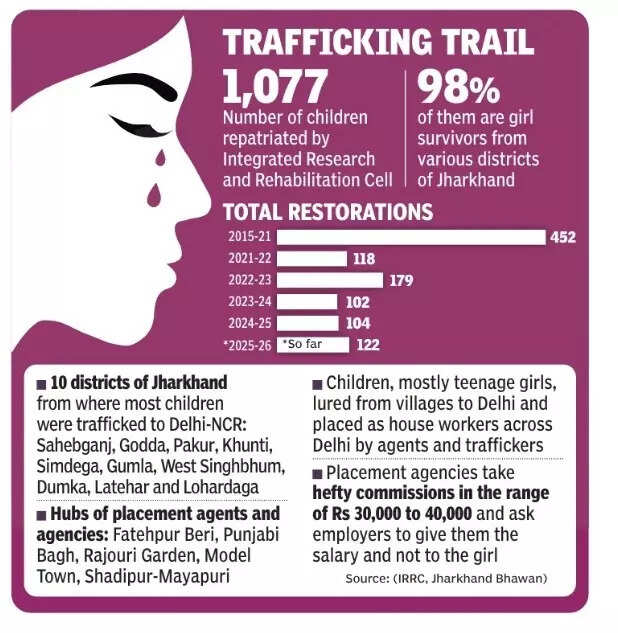
NEW DELHI:After three years of abuse by her affluent employers in Gurgaon — who made her sleep in a toilet on their terrace — 13-year-old Manisha (name changed), a tribal girl from Godda, was rescued after her father sent an SOS that triggered a joint operation led by Jharkhand Bhawan’s Integrated Research and Rehabilitation Cell (IRRC). Lodged in a children’s home in Delhi since late Nov, she now waits to return to the village she was taken from at age 10 by a trafficker who promised a better life.Eight-year-old Nisha left Khunti with her parents, unaware she would soon be abandoned on a train with only a mobile phone. Found at Anand Vihar station six months ago, she has been in a children’s home while authorities traced her family. The inquiry led to her grandmother, who is eager to take her back despite her own hardship. Nisha will return once officials finalise a rehabilitation plan and enrol her in a residential school.In Jan, Rashi and 17 other children boarded a train from Ranchi, lured by a woman trafficker who promised a fun trip to Delhi and work to ease their families’ poverty. Before they reached the Capital, an alert from Jharkhand Police led to their rescue at a Delhi station. Four of them — including Rashi — were shown as adults after the trafficker produced birth certificates. With no long-term support for those just above 18, Rashi was sent back to the home she had earlier fled.These cases of girls aged 8 to 18 illustrate a growing pattern— of minors falling prey to unsafe migration routes or organised trafficking networks. Children reported missing in village police stations often resurface in NCR, trapped by placement agencies, intermediaries or employers who treat them as bonded workers. Salaries are diverted to agents posing as relatives, and the girls are denied phones, mobility and contact with their families.On the eve of Women’s Day, TOI visited the IRRC facility run by Jharkhand Bhavan, where case files and counselling reports reveal how traffickers continue to expand their networks despite tighter enforcement. They routinely forge Aadhaar and birth certificates to avoid arrest. Since 2015, the IRRC has restored 1,077 Jharkhand children to their families or to institutional care in tribal districts. Nodal officer Nachiketa said that in the current financial year (2025-26), 122 children have been returned so far. Of all repatriations since inception, 98% are girls. Each year, 20–25 children from other source states such as Chhattisgarh, Odisha, Assam and Nepal are also rescued. Most rescues take place across NCR — Gurgaon, Faridabad, Noida and Ghaziabad — though teams have travelled to UP, Haryana, Punjab and even Telangana, where six children were recently recovered from a biscuit factory.
Working out of a facility in Vasant Kunj, the team keeps a ready space for children brought directly from households before they are escorted to their villages. The 24×7 unit responds to calls from district administrations, police and citizens on its helpline 10582.“Case after case shows that social vulnerabilities push children into trafficking,” Nachiketa said. “It’s not just poverty — single-parent homes, children left with siblings while parents migrate for work, or families where survival needs overshadow childcare make them easy targets.” The trafficking chain, she said, is layered to avoid detection. Each trafficker through the chain of intermediaries from the stage of acquiring the child to placing the child through agents in a home as a househelp probably makes around Rs 1 lakh from one child over a year,” she added. “The children get nothing—their wages go to traffickers, they have no phones, no freedom, and are kept like bonded labour,” Nachiketa said.After restoration, the IRRC monitors each child for three months, ensuring access to schooling, skilling and state-sponsored support. But girls who turn 18 before or during repatriation often fall through systemic gaps. “We need support beyond shelter homes for young women who are legally adults but still extremely vulnerable,” Nachiketa said.The National Commission for Protection of Child Rights, in its 2018 SOP on repatriation of trafficked children, acknowledged the central role state bhawans can play in Delhi-NCR rescues — a responsibility Jharkhand Bhawan has carried out since 2015.For the IRRC team, Women’s Day brings no pause. “For us, these cases aren’t numbers,” Nachiketa said. “Each rescue is a life reclaimed — a step towards empowering a girl and her family against the trafficking network.”


