
(Representative image): CISF will carry out access-control and screening measures, including frisking with X-ray baggage screening machines and Door Frame Metal Detectors (DFMDs). NEW DELHI: The National Testing Agency (NTA) has tightened security around its examination work with 39 CISF personnel deployed at its New Delhi office. The force will monitor confidential areas, control access and screen staff and visitors. The move follows repeated questions over paper leaks and administrative lapses, including the handling of sensitive examination material.The CISF personnel have been deployed at entry and exit points of the confidential areas at the Government of India Press Building on Minto Road. They will carry out access-control and screening measures, including frisking with X-ray baggage screening machines and Door Frame Metal Detectors (DFMDs).The NTA has also demarcated confidential areas within its new premises. Movement and operations in these areas will be closely monitored as part of efforts to prevent unauthorised access to examination material.”Confidential areas have been demarcated in the building where the movement and operations will be strictly monitored to ensure that a foolproof system is in place. The Home Ministry has approved Central Industrial Security Force (CISF) security cover for the premises,” a senior official said.NTA shifts sensitive operations to new officeThe security measures come after the NTA moved its confidential and sensitive operations from its earlier office in Okhla to a new facility on Minto Road.”A dedicated over 55,000 square feet office space has been allotted in the Government of India Press Building on Minto Road. The fifth floor and parts of the fourth and sixth floors of the said building have been allotted to the National Testing Agency. Confidential and sensitive operations have been shifted in the last one month to the newly allotted building,” the official said.Other parts of the Government of India Press Building are already protected by the CISF. The NTA will now have a dedicated security arrangement for its examination-related confidential areas.The agency’s new security framework also includes tighter monitoring of examination-critical technology systems. The NTA is working on strict access controls, encryption standards, immutable logging and tamper-evident storage.”Arrangements are being made in mission mode for establishing strict access controls, encryption standards, immutable logging and tamper-evident storage for all examination-critical workloads.”Cybersecurity measures being strengthenedThe NTA is also reviewing the security of systems used throughout the examination cycle. These include candidate registration, fee payment, admit cards, computer-based testing, OMR processing, result systems and other examination-supporting infrastructure.”Running security readiness reviews of all examination-supporting systems before each examination cycle in coordination with NTA’s technology function and coordinating with NTA’s test-security function on the technical security of examination day workflows — including biometric authentication, face-matching, CCTV systems and live monitoring infrastructure — are among the action items being worked upon,” the official said.The agency is also preparing an examination-specific cyber-incident response system. It plans to have enhanced security operations centre monitoring and rapid-response capabilities on examination days.The NTA has designated a dedicated chief information security officer (CISO) to oversee information security.”The position of general manager and CISO has been advertised, and the selection process is at an advanced stage. Independent third-party cyber-security audits by CERT-In and C-DAC empanelled agencies continue to be undertaken,” the official said.Paper leak exposed gaps in confidential sectionThe latest security measures follow the 2024 NEET-UG paper leak, which triggered nationwide student protests and brought scrutiny on the NTA’s examination processes.A CBI chargesheet identified three subject experts as the primary sources of the leaked paper. According to the chargesheet, experts entering the NTA’s confidential section were not checked or frisked during entry or exit.The experts were allegedly able to take briefs from the question papers on small chits made from plain sheets provided to them for rough work and translation.The CBI also noted that the NTA did not have a dedicated CCTV live-feed monitoring control room in its Delhi office. This meant the activities of the three accused experts went unnoticed.The NTA was established in 2017 under the Ministry of Education to conduct fair, transparent and standardised examinations.Earlier reforms and fresh scrutinyThe 2024 NEET paper leak had also led to the setting up of a high-level committee headed by former ISRO chairman K Radhakrishnan. The panel recommended stronger security controls across the examination process.Its recommendations covered question paper systems, candidate registration, fee payment, admit cards, computer-based testing platforms, OMR processing, normalisation engines and result systems.Join conversationView All Comments →Share your thoughts in the commentsInsightfulAgreeDisagreeSkepticalConcerningPromisingWorth ReadingBig DevelopmentPost CommentBe respectful · TOI community guidelinesA separate high-powered task force headed by Infosys co-founder Nandan Nilekani was also announced to recommend reforms to make the examination system leakproof. The panel was set up after the controversy and is yet to submit its report.Following the 2026 paper leak, the Supreme Court reprimanded the NTA, saying “it has not learnt its lessons”.The latest security overhaul therefore extends beyond physical protection of confidential material. The agency is now combining CISF security, tighter access controls, CCTV and live monitoring with cybersecurity audits and technical safeguards across its examination systems.Get the latest India News and Live updates. Download the TOI app.About the AuthorVijaya SrivastavaVijaya Srivastava is a journalist and feature writer whose expertise lies in covering human-centred developments. Her stories explore how policy, technology, economic shifts and social change influence people’s everyday lives. Her work also focuses on bringing depth, context and a human perspective to complex issues. Her reports primarily cover society, healthcare, safety, public policy and emerging trends, alongside other political developments.Read MoreEnd of ArticleFollow Us On Social MediaVideosViolence Erupts at Punjab’s LPU As Students Protest Over Alleged Rape Case, Police File FIR‘Tried To Drag Me Out Of My Car’: TMC MLA Kunal Ghosh Alleges Second Attack In 24 Hours, Accuses BJP‘Go, Protest In Kerala’: Bengal CM Suvendu Attacks Mamata Banerjee, Rahul Gandhi Over SIR-EC Row‘Tried To Normalise Terrorism’: Jaishankar Hits Back At Pakistan PM Shehbaz Sharif In UNGA SpeechAlbanese Hails Modi’s Energy Push: ‘India Gave More People Access Than Anywhere In History’Delhi Skeleton Mystery: Skeleton-Like Structure Found During BJP Cleanliness Drive | Watch‘Padma Bhushan Is Small, Make Him PM’: Pawan Khera Mocks BJP’s Praise For Gyanesh KumarSkyStriker, HIMARS, Apache: India, US Showcase Firepower At Yudh Abhyas 2026 | WatchTibet Govt-in-Exile Reprimands Activist Sonam Wangchuk, Calls Comparison ‘Misplaced and Inaccurate’India’s Savage ‘Osama’ Reply To Pak PM’s UN Bluster; ‘Repeating Lies Won’t Make It True’123Hot PicksAsian Games India ScheduleBank strikeCJP ProtestIndian Medallists EarningOctober 2026 School HolidaysNaman DhirPunjab school holidayGoogle’s birthdayDr MonishCBSE Date SheetTop TrendingChess OlympiadRahul GandhiPowerball JackpotDelhi Hit and RunUP EncounterDonald TrumpPM ModiNaomi OsakaJoe ThomasSupreme Court

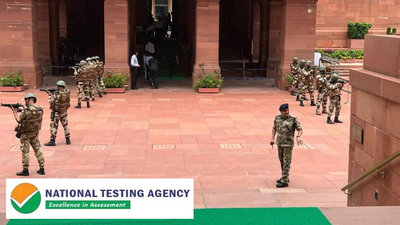
NEW DELHI: The National Testing Agency (NTA) has tightened security around its examination work with 39 CISF personnel deployed at its New Delhi office. The force will monitor confidential areas, control access and screen staff and visitors. The move follows repeated questions over paper leaks and administrative lapses, including the handling of sensitive examination material.The CISF personnel have been deployed at entry and exit points of the confidential areas at the Government of India Press Building on Minto Road. They will carry out access-control and screening measures, including frisking with X-ray baggage screening machines and Door Frame Metal Detectors (DFMDs).The NTA has also demarcated confidential areas within its new premises. Movement and operations in these areas will be closely monitored as part of efforts to prevent unauthorised access to examination material.“Confidential areas have been demarcated in the building where the movement and operations will be strictly monitored to ensure that a foolproof system is in place. The Home Ministry has approved Central Industrial Security Force (CISF) security cover for the premises,” a senior official said.
NTA shifts sensitive operations to new office
The security measures come after the NTA moved its confidential and sensitive operations from its earlier office in Okhla to a new facility on Minto Road.“A dedicated over 55,000 square feet office space has been allotted in the Government of India Press Building on Minto Road. The fifth floor and parts of the fourth and sixth floors of the said building have been allotted to the National Testing Agency. Confidential and sensitive operations have been shifted in the last one month to the newly allotted building,” the official said.Other parts of the Government of India Press Building are already protected by the CISF. The NTA will now have a dedicated security arrangement for its examination-related confidential areas.The agency’s new security framework also includes tighter monitoring of examination-critical technology systems. The NTA is working on strict access controls, encryption standards, immutable logging and tamper-evident storage.“Arrangements are being made in mission mode for establishing strict access controls, encryption standards, immutable logging and tamper-evident storage for all examination-critical workloads.”
Cybersecurity measures being strengthened
The NTA is also reviewing the security of systems used throughout the examination cycle. These include candidate registration, fee payment, admit cards, computer-based testing, OMR processing, result systems and other examination-supporting infrastructure.“Running security readiness reviews of all examination-supporting systems before each examination cycle in coordination with NTA’s technology function and coordinating with NTA’s test-security function on the technical security of examination day workflows — including biometric authentication, face-matching, CCTV systems and live monitoring infrastructure — are among the action items being worked upon,” the official said.The agency is also preparing an examination-specific cyber-incident response system. It plans to have enhanced security operations centre monitoring and rapid-response capabilities on examination days.The NTA has designated a dedicated chief information security officer (CISO) to oversee information security.“The position of general manager and CISO has been advertised, and the selection process is at an advanced stage. Independent third-party cyber-security audits by CERT-In and C-DAC empanelled agencies continue to be undertaken,” the official said.
Paper leak exposed gaps in confidential section
The latest security measures follow the 2024 NEET-UG paper leak, which triggered nationwide student protests and brought scrutiny on the NTA’s examination processes.A CBI chargesheet identified three subject experts as the primary sources of the leaked paper. According to the chargesheet, experts entering the NTA’s confidential section were not checked or frisked during entry or exit.The experts were allegedly able to take briefs from the question papers on small chits made from plain sheets provided to them for rough work and translation.The CBI also noted that the NTA did not have a dedicated CCTV live-feed monitoring control room in its Delhi office. This meant the activities of the three accused experts went unnoticed.The NTA was established in 2017 under the Ministry of Education to conduct fair, transparent and standardised examinations.
Earlier reforms and fresh scrutiny
The 2024 NEET paper leak had also led to the setting up of a high-level committee headed by former ISRO chairman K Radhakrishnan. The panel recommended stronger security controls across the examination process.Its recommendations covered question paper systems, candidate registration, fee payment, admit cards, computer-based testing platforms, OMR processing, normalisation engines and result systems.
Share your thoughts in the comments
Be respectful · TOI community guidelines
A separate high-powered task force headed by Infosys co-founder Nandan Nilekani was also announced to recommend reforms to make the examination system leakproof. The panel was set up after the controversy and is yet to submit its report.Following the 2026 paper leak, the Supreme Court reprimanded the NTA, saying “it has not learnt its lessons”.The latest security overhaul therefore extends beyond physical protection of confidential material. The agency is now combining CISF security, tighter access controls, CCTV and live monitoring with cybersecurity audits and technical safeguards across its examination systems.


