
As Trump hugs Xi and plugs Sharif, India feels the squeeze

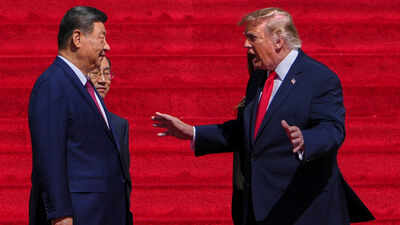
TOI correspondent from Washington: The clearest sign yet of a widening US-India diplomatic rift came this weekend from the White House and the United Nations, where India was denouncing Pakistan for what it called a litany of “falsehoods” and “deceit,” even as US President Donald Trump appeared to give those very claims a presidential imprimatur.Pakistan Prime Minister Shehbaz Sharif had used his UN General Assembly address to revive Islamabad’s account of the 2025 India-Pakistan conflict, crediting Trump with a “timely intervention” that, he said, prevented a wider war. On Friday night, shortly after China’s President Xi Jinping had departed for Beijing, Trump posted an 87-second excerpt of Sharif’s speech on Truth Social without comment. The clip included Sharif’s praise of Trump and Pakistan Army chief Asim Munir.The timing was striking. India had just exercised its Right of Reply, with First Secretary Petal Gahlot accusing Islamabad of peddling “falsehoods” and “deceit” and describing Pakistan as a “puppet” regime. New Delhi has also rejected Trump’s repeated assertion that he mediated the cessation of hostilities in May 2025, saying the fighting was halted after direct military-to-military communication between India and Pakistan.For India, however, the larger concern may be less about one Truth Social post than about a pattern. The Xi visit to Washington this week appeared to underscore how dramatically the strategic geometry of US foreign policy has shifted. Rather than organizing its Asia policy principally around building India as a counterweight to China – a two-decade old Washington objective that resulting in an “Indo-Pacific” focused QUAD – the Trump White House increasingly appears willing to deal with Beijing as a peer whose cooperation is indispensable, and whose confrontation carries costs Trump is reluctant to incur.Following the Xi visit, Washington and Beijing extended their trade truce and agreed on tariff reductions covering $30 billion of less-sensitive goods in each direction, according reports in the Chinese media. They also operationalized bilateral boards on trade and investment and agreed to pursue an artificial-intelligence dialogue.Analysts say none of this amounts to a formal US-China condominium, and deep disagreements over Taiwan, technology, trade and strategic competition remain. But the emerging arrangement has prompted comparisons with a de facto G-2: Washington and Beijing managing their rivalry directly while other powers, including India, find themselves having to adjust to decisions made in a room in which they are not present.“One totally unsurprising consequence of this US-China trade truce is that Trump is not even thinking about implementing the Lindsey Graham Russia sanctions legislation he just signed, which would have required penalizing China’s support for Russia’s war machine,” Tom Malinowski a former New Jersey lawmaker noted, even as Republicans close to Trump have been champing at the bit to punish New Delhi. The Graham bill, signed by Trump on Sept. 18, gives the president authority to impose tariffs of up to 100% on countries that continue buying Russian crude or natural gas under specified conditions. The law specifically covers countries among the five largest Russian oil or gas importers that make new purchases, as well as countries identified among the top facilitators of sanctions evasion.India is plainly exposed to that provision, as is China. Yet the contrast in Trump’s handling of the two relationships has become difficult for New Delhi to ignore: Beijing is being courted into a new economic accommodation even as India faces the prospect of punitive trade action.The message was reinforced this week by a senior State Department official who said the Graham law gives Trump “a new tool in his toolbox,” while emphasizing that its use is not automatic. The official pointed to a broad national-security waiver but added that Washington expects India to help the US end the Ukraine war.More revealing was the official’s description of what Washington now wants from India: not necessarily strategic alignment against China, but access to the enormous Indian energy market. “We are looking to also become a huge source of India’s energy needs,” the official was quoted as saying, pointing to expanding US hydrocarbon exports and urging faster diversification away from Russian supplies.All this is consequential because for two decades the bipartisan American strategy had been to help India acquire the economic, military and technological heft to balance China’s rise. As recently as May, Secretary of State Marco Rubio, who will be back in New Delhi in October, was describing India as one of America’s most important strategic partners, while US officials continued to characterize New Delhi as a critical Indo-Pacific counterweight.
Share your thoughts in the comments
Be respectful · TOI community guidelines
The language now coming from Washington is noticeably more transactional.For New Delhi, the resulting unease is not simply about tariffs or Pakistan. It is about whether a strategic partnership painstakingly built across successive administrations is being replaced by a transactional relationship in which China is too powerful to punish, Pakistan is useful to cultivate, and India is expected to accommodate. And as New Delhi watched Washington kiss up to Beijing as an indispensable peer and embrace a country New Delhi views as a terrorism sponsor, the strategic space India once occupied in the American imagination appeared to be shrinking.


