
In 2019, California researchers used 1,500 volunteers to count seals and sea lions from drone images; 11 repeated counts improved accuracy

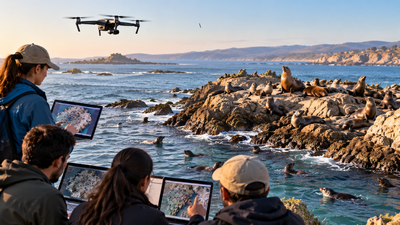
More than 1,500 people helped researchers count seals and sea lions on California’s Año Nuevo Island by studying thousands of drone photographs. The citizen science project ran for 212 days, with volunteers counting about 94,000 image tiles. Researchers then compared the volunteer counts with counts made by experts. According to the study published in Plos One, titled ‘Accuracy and precision of citizen scientist animal counts from drone imagery’, for seals, there was a 5% proportional error during the breeding seasons, while the figure for sea lions was 9%. The researchers also found that repeated counts improved accuracy, with around 11 citizen scientists per image helping to reduce errors. However, processing the photographs still took weeks.
How did researchers use drones to count seals and sea lions
The research team conducted drone flights over Año Nuevo Island roughly every two weeks between July 2017 and July 2019. They completed 60 flights, although some flights were affected by rain, wind and swell conditions. Two consumer-level drones, the Phantom 3 Advanced and Mavic 2 Zoom, were used, with flights carried out from the mainland across the less-than-one-kilometre channel to the island.The researchers typically flew early in the morning, when cooler conditions meant more animals were present on the beaches. Photographs were taken approximately every two seconds along a standardised flight path. The team then processed the images into mosaics and divided them into smaller 700-by-700-pixel photographs for the citizen science project. Each flight produced roughly 700 to 1,000 image tiles after processing.
More than 1,500 volunteers count seals and sea lions on Zooniverse
The researchers created a custom project on Zooniverse and provided volunteers with tutorials and a field guide. Participants were asked to identify animals as either seals or sea lions and click once on each visible animal’s head. The instructions were also designed to prevent the same animal from being counted twice in adjacent photographs by requiring its head to be visible.For the full validation study, the researchers uploaded 4,074 photograph tiles from five drone flights covering winter and summer conditions. Volunteers counted the images in random order, while the researchers later compared their results with expert counts. The study notes that the project received substantial public participation, with more than 1,500 volunteers counting about 94,000 tiles between August 7, 2019 and March 7, 2020.
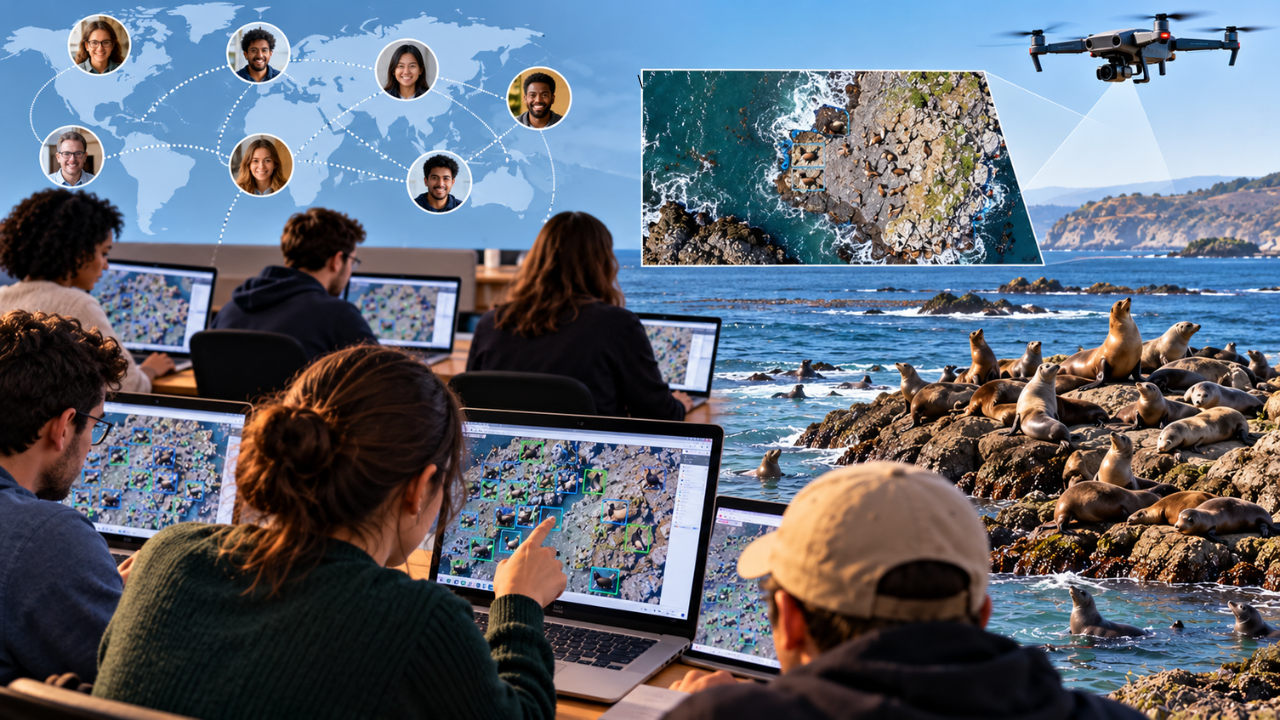
Image AI generated
How accurate were citizen scientist counts of seals and sea lions
The researchers found that citizen scientist counts could be relatively close to expert counts under some conditions. In the study’s abstract, they reported that proportional error was 5% for seals during the breeding seasons and 9% for sea lions. The researchers also stated that the error improved with repeated sampling.The detailed results showed that accuracy varied according to season and species. When the counts from all dates were combined, the reported error was 9% for sea lions and 46% for seals. For seals, the researchers recorded 6% error during both winter flights, compared with higher error during the summer flights, which they associated with sea lions being present and sometimes being misidentified as seals.
11 volunteer counts per image improved accuracy
The study found that repeated volunteer counts reduced error. The researchers reported that accuracy improved with increasing numbers of counters, with the relationship reaching an asymptote at around 11 citizen scientists. In their discussion, they stated that repeat counts involving 11 or more counters per image were necessary to improve accuracy.However, the researchers also found that repeated counting made the citizen science approach slow. Their abstract states that more than 12 volunteers were required to reduce error sufficiently, while estimating animals from a single drone flight covering 25 acres took an average of six weeks. The researchers therefore described the repeated-count requirement as prohibitively slow for the project.The researchers concluded that citizen science could be combined with drone imagery when projects were carefully designed and validated. They wrote that “drones could substantially reduce the time and labor required for population surveys” when citizen scientists can accurately complete the counting task. The study also emphasised the importance of validating citizen science results against expert counts before using the approach for wildlife surveys.


