
In May 2024, residents of the high-rise Supertech Ecovillage 2 in Greater Noida took to the streets late at night to protest against ongoing power outages. The country was reeling under record heat, with temperatures touching 50°C, and families described “immense hardship due to frequent power outages and inadequate supply.” The episode underscores a growing national risk: as heatwaves intensify and demand surges, India’s grid is being pushed to the edge.That problem is the focus of a new startup, Pravāh, an AI grid intelligence startup now backed by top-tier investors including Khosla Ventures, Pear VC and Conviction. The company was started by co-founders Mohak Mangal, Dhruv Suri, and Aman Gupta on the Stanford campus. They decided to focus their energies on one of India’s most critical problems and gave it a Sanskrit name: Pravāh or “flow.”Their timing is critical. India’s power sector stands at a crossroads with growing demand. However, the country’s discoms (state-run distribution companies) operate with forecasting tools built for a different century. Many rely on spreadsheets and simple statistical models, adequate on ordinary days but deeply blind to a late monsoon or to a burst of rooftop solar.When forecasts fail, outcomes are painful: outages and, at times frantic, expensive purchases on the spot market, costs that eventually find their way into government deficits or the monthly electricity bill of a family.“Indian discoms cannot afford to operate with yesterday’s information, at a time when energy independence is critical and the discoms are a huge burden to the taxpayer”, said Mohak Mangal, Pravāh’s co-founder. Pravāh’s answer is an “AI native” decision support engine that is built specifically for this new environment. The company combines machine learning models for demand forecasting with high-resolution weather modelling that pinpoint how much purchases discoms should make and how they can reduce their AT&C losses. The company is already working with companies in the US, Germany, and India. A crucial layer of the company’s ambition rests on weather itself. In a recent paper, the team with a Stanford professor, Aditi Sheshadri, examined top AI weather models against real Indian observations and found an unsettling pattern: many systems underestimate extreme rainfall and misjudge cyclone paths. In a monsoon country, those errors can be existential. These findings now inform Pravāh’s India-specific forecasting architecture, built on the premise that global models rarely understand local weather dynamics. These maps show peak-summer temperatures in Gujarat and compare them with forecasts from the world’s leading AI weather models. Research done by Pravāh’s team with a Stanford professor shows that even the best global models are noticeably off for India, especially during heatwaves. If the models were perfect, the maps would be white (not blue or red). That is why Pravāh is building India-specific, locally corrected weather forecasts.Dhruv Suri, who recently completed his PhD from Stanford in Energy Science, says, “Machine learning architectures give operators something they have never had before: foresight into the next hour, the next day, and the next extreme event. That is the difference between reacting to a crisis and preventing one.”The founding team behind Pravāh brings an unusual blend of deep technical expertise. Mohak has worked with the World Bank and MIT’s Poverty Action Lab across India and Myanmar. Dhruv has published research on renewable integration, built real-time grid tools at Google X, and co-founded a social enterprise delivering clean energy to rural communities. Aman, with a PhD from NYU Courant and research stints at LMU Munich and Stanford, has co-developed climate-foundation models with NASA and IBM and has written widely on monsoon dynamics.For the founders, their mission is about preventing exactly what families in Greater Noida endured that night. If India can forecast its next thunderstorm and peak electricity demand with precision, then no parent in Supertech Ecovillage 2 will have to carry their children into the streets at midnight just to demand the most basic right in a modern economy: reliable electricity.End of ArticleFollow Us On Social MediaVideosOperation Sindoor 2.0 Talk Rises As Expert Says India Must Hit Pak But Fix White Collar Terror TooIn Fiery UK Conclave Speech, Suhel Seth Says India Has Evolved Beyond 1947, Now Shapes Global PowerShashi Tharoor Says The UN Cannot Be Abandoned Despite Gaza And Ukraine At Desmond Tutu LecturePiyush Goyal Says India And Israel Are Emotionally Close, Recalls Pahalgam And Delhi Terror Attacks’Eternally Grateful’: Sheikh Hasina’s Son Thanks PM Modi For Saving Her Mother’s Life, Slams YunusIndia And Israel Launch FTA Talks; Piyush Goyal, Nir Barkat Sign Terms Of ReferenceDelhi’s Pollution Forces Australian Foreign Minister Penny Wong To Cough, Stop Her Speech MidwayJaishankar Meets Afghan Commerce Minister Azizi In Delhi; Trade, Connectivity DiscussedMEA Outlines Agenda For PM Modi’s South Africa Visit For G20 Summit In JohannesburgPenny Wong’s Cricket Banter With Jaishankar Highlights Warm, Confident India-Australia Partnership123PhotostoriesAllu Arha birthday special: Adorable social media moments shared by Allu Arjun and Sneha ReddyWho are Smriti Mandhana’s parents? The quiet strength behind the cricket starTravel inspiration of the day: 5 green getaways in India for a breath of fresh airAkshaye Khanna, Tabu, Salman Khan: Actors who never married, chose singlehoodHelen birthday special: From ‘Piya Tu’ to ‘Yeh Mera Dil’, her most iconic dance numbers and film rolesMicro-cheating in relationships: 7 red flags that feel “normal” but aren’tHow to manage hemorrhoids during pregnancy: FAQs answered here10 Indian etiquette every child should learnReplace this with avocado: 7 local fruits that provide the same nutrients for less5 Japanese mindset shifts for a happier, lighter, less stressful life123Hot PicksDelhi AQI TodayBihar Minister List 2025Bihar CM Oath CeremonyGold rate todaySilver rate todayPublic Holidays NovemberBank Holidays NovemberTop TrendingBest Rockstar Games to Play for GTA 6Savannah JamesGiannis AntetokounmpoTrevon DiggsDelhi School Suicide CaseKolkata EarthquakeCandace OwensGavin BrindleySophie CunninghamMLB Trade Rumors
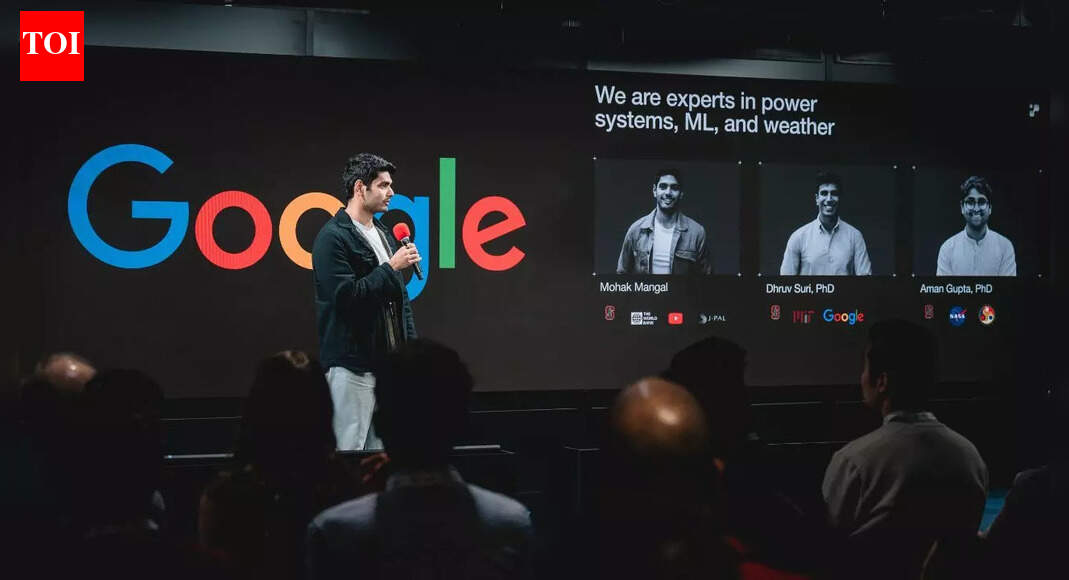

In May 2024, residents of the high-rise Supertech Ecovillage 2 in Greater Noida took to the streets late at night to protest against ongoing power outages. The country was reeling under record heat, with temperatures touching 50°C, and families described “immense hardship due to frequent power outages and inadequate supply.” The episode underscores a growing national risk: as heatwaves intensify and demand surges, India’s grid is being pushed to the edge.That problem is the focus of a new startup, Pravāh, an AI grid intelligence startup now backed by top-tier investors including Khosla Ventures, Pear VC and Conviction. The company was started by co-founders Mohak Mangal, Dhruv Suri, and Aman Gupta on the Stanford campus. They decided to focus their energies on one of India’s most critical problems and gave it a Sanskrit name: Pravāh or “flow.”Their timing is critical. India’s power sector stands at a crossroads with growing demand. However, the country’s discoms (state-run distribution companies) operate with forecasting tools built for a different century. Many rely on spreadsheets and simple statistical models, adequate on ordinary days but deeply blind to a late monsoon or to a burst of rooftop solar.When forecasts fail, outcomes are painful: outages and, at times frantic, expensive purchases on the spot market, costs that eventually find their way into government deficits or the monthly electricity bill of a family.“Indian discoms cannot afford to operate with yesterday’s information, at a time when energy independence is critical and the discoms are a huge burden to the taxpayer”, said Mohak Mangal, Pravāh’s co-founder. Pravāh’s answer is an “AI native” decision support engine that is built specifically for this new environment. The company combines machine learning models for demand forecasting with high-resolution weather modelling that pinpoint how much purchases discoms should make and how they can reduce their AT&C losses. The company is already working with companies in the US, Germany, and India. A crucial layer of the company’s ambition rests on weather itself. In a recent paper, the team with a Stanford professor, Aditi Sheshadri, examined top AI weather models against real Indian observations and found an unsettling pattern: many systems underestimate extreme rainfall and misjudge cyclone paths. In a monsoon country, those errors can be existential. These findings now inform Pravāh’s India-specific forecasting architecture, built on the premise that global models rarely understand local weather dynamics.
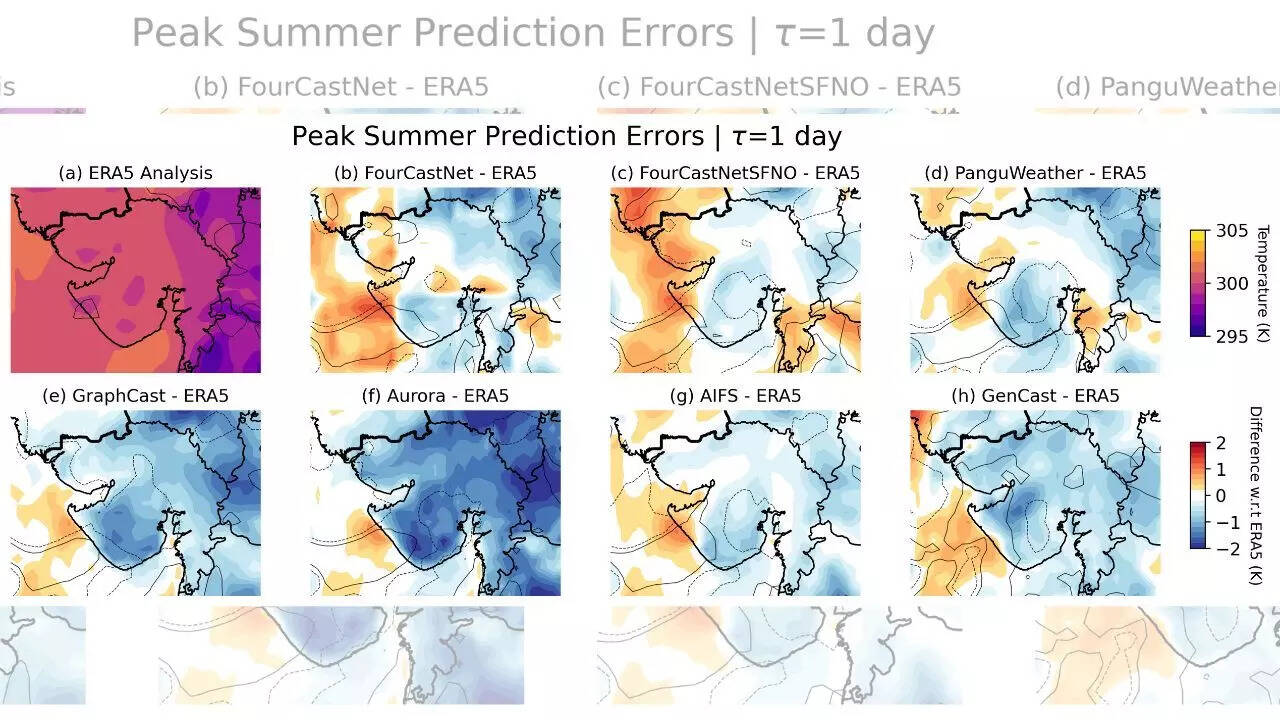
These maps show peak-summer temperatures in Gujarat and compare them with forecasts from the world’s leading AI weather models. Research done by Pravāh’s team with a Stanford professor shows that even the best global models are noticeably off for India, especially during heatwaves. If the models were perfect, the maps would be white (not blue or red). That is why Pravāh is building India-specific, locally corrected weather forecasts.
Dhruv Suri, who recently completed his PhD from Stanford in Energy Science, says, “Machine learning architectures give operators something they have never had before: foresight into the next hour, the next day, and the next extreme event. That is the difference between reacting to a crisis and preventing one.”The founding team behind Pravāh brings an unusual blend of deep technical expertise. Mohak has worked with the World Bank and MIT’s Poverty Action Lab across India and Myanmar. Dhruv has published research on renewable integration, built real-time grid tools at Google X, and co-founded a social enterprise delivering clean energy to rural communities. Aman, with a PhD from NYU Courant and research stints at LMU Munich and Stanford, has co-developed climate-foundation models with NASA and IBM and has written widely on monsoon dynamics.For the founders, their mission is about preventing exactly what families in Greater Noida endured that night. If India can forecast its next thunderstorm and peak electricity demand with precision, then no parent in Supertech Ecovillage 2 will have to carry their children into the streets at midnight just to demand the most basic right in a modern economy: reliable electricity.


