
A decade after its implementation, India’s juvenile justice system is failing children in conflict with the law. A new study reveals massive case backlogs, widespread vacancies in Juvenile Justice Boards, and a shocking lack of essential facilities, leaving thousands of children in limbo and facing prolonged institutionalization. NEW DELHI: Ten years after the Juvenile Justice (Care and Protection of Children) Act, 2015 came into force, a new study by the India Justice Report has exposed how the country’s juvenile justice system is crumbling under the same ills that plague adult courts – massive delays, crippling vacancies and shocking opacity. Children in conflict with the law, the very group the Act swore to protect in their “best interest”, are paying the heaviest price.As of Oct 31, 2023, more than 55,000 children were waiting for their cases to be decided, with 55% of the total cases pending before Juvenile Justice Boards (JJBs) across 18 states and two Union Territories. Out of 1,00,904 cases that came up before 362 JJBs in the year ending Oct 2023 (including 50,627 carried over from previous years), only 45,097 – a mere 45% – were disposed of. In Odisha the pendency rate touched a staggering 83%, while Karnataka managed to keep it at 35%. Nationally, the picture is grim: nearly one in every two cases simply rolls over to the next year.The report, titled “Juvenile Justice and Children in Conflict with the Law: A Study of Capacity at the Frontlines”, is based on parliamentary answers, a year-long RTI inquiry and data from states (Nov 2022 to Oct 2023) . It reveals that one in every four JJBs – 24% or 111 out of 470 boards that responded – is functioning without the mandatory full bench of a principal magistrate and two social worker members. Only three states and Union Territories – Odisha, Sikkim and Jammu & Kashmir – have 100% fully constituted benches. With an average of 154 pending cases per board, the incomplete benches mean slower hearings, less child-sensitive decisions and prolonged institutionalisation of children.Perhaps the most alarming finding is that only 11 districts across the entire country meet the basic minimum standards required to deliver justice in a child’s best interest. Out of 292 districts that provided usable data on seven critical parameters – presence of a JJB, child welfare institution, special juvenile police unit, legal aid clinic, probation officer, staff strength and manageable pendency – just 11 cleared the bar. Eight of these are in Mizoram.Residential infrastructure for children in conflict with the law is equally dismal. Fourteen states, including large ones like Maharashtra, Gujarat, Madhya Pradesh, West Bengal, Punjab, Andhra Pradesh and Telangana, have not established even a single “Place of Safety” for 16 -18-year-olds accused of heinous offences – a mandatory requirement under the Act. Facilities for girls are particularly scarce: only 40 homes nationwide can accommodate girls in conflict with the law, including those that house both genders.The study warns that the absence of proper facilities forces children to be shifted far from their families, making access to guardians and legal representation difficult and sometimes leading to unsafe mixing of age groups and offence categories – the very evils the 2015 Act was meant to end.Ten years on, the report concludes, India still cannot produce routine, public, time-series data to prove that its juvenile justice system is working optimally for the child. Instead, thousands of children remain trapped in limbo, bearing the brunt of a system that looks disturbingly similar to the broken adult criminal justice machinery it was supposed to be different from.End of ArticleFollow Us On Social MediaVideosIndia And Israel Launch FTA Talks; Piyush Goyal, Nir Barkat Sign Terms Of ReferenceDelhi’s Pollution Forces Australian Foreign Minister Penny Wong To Cough, Stop Her Speech MidwayJaishankar Meets Afghan Commerce Minister Azizi In Delhi; Trade, Connectivity DiscussedMEA Outlines Agenda For PM Modi’s South Africa Visit For G20 Summit In JohannesburgPenny Wong’s Cricket Banter With Jaishankar Highlights Warm, Confident India-Australia PartnershipJaishankar, Penny Wong Send A Strong India-Australia Message To China And The World on Indo-PacificIFFI 2025 Opens With A Surprise As Korean Minister Sings Vande Mataram And Wins Standing OvationPiyush Goyal’s 10 D’s Pitch in Israel Recasts India As Future-Ready for Worldwide InvestmentsDelhi Student Suicide Case: Massive Protest Outside School After Note Alleges Harassment By TeachersPiyush Goyal Links India, Israel Through Shared Adversities, Predicts 7% Percent GDP Growth For FY26123PhotostoriesHow top Bollywood actresses are embracing a life changing new lifestyleFrom better brain function to stronger heart: 5 reasons why backward walking is excellent for youPrincess Diana finally enters the Grévin Wax Museum and yes, she’s wearing the iconic ‘Revenge Dress’Dipika Kakar breaks down after meeting her oncologist amid liver cancer treatment; says, ‘The reports are normal, but there is a constant fear and anxiety’Peripheral Artery Disease: 5 major causes, and ways to prevent it9 must-try street foods in Udaipur5 expert-approved best foods to control diabetes5 spectacular animals with the biggest horns on their heads10 father-son duos who left a mark on cricket historyHyderabad Metro’s big upgrade: Six-coach trains, faster rides to end commuter chaos soon123Hot PicksDelhi AQI TodayBihar Minister List 2025Bihar CM Oath CeremonyGold rate todaySilver rate todayPublic Holidays NovemberBank Holidays NovemberTop TrendingJoel EmbiidSavannah JamesGiannis AntetokounmpoTrevon DiggsKris KnoblauchAdin RossCandace OwensKona TakahashiKatie JohnsonOlivia Dunne


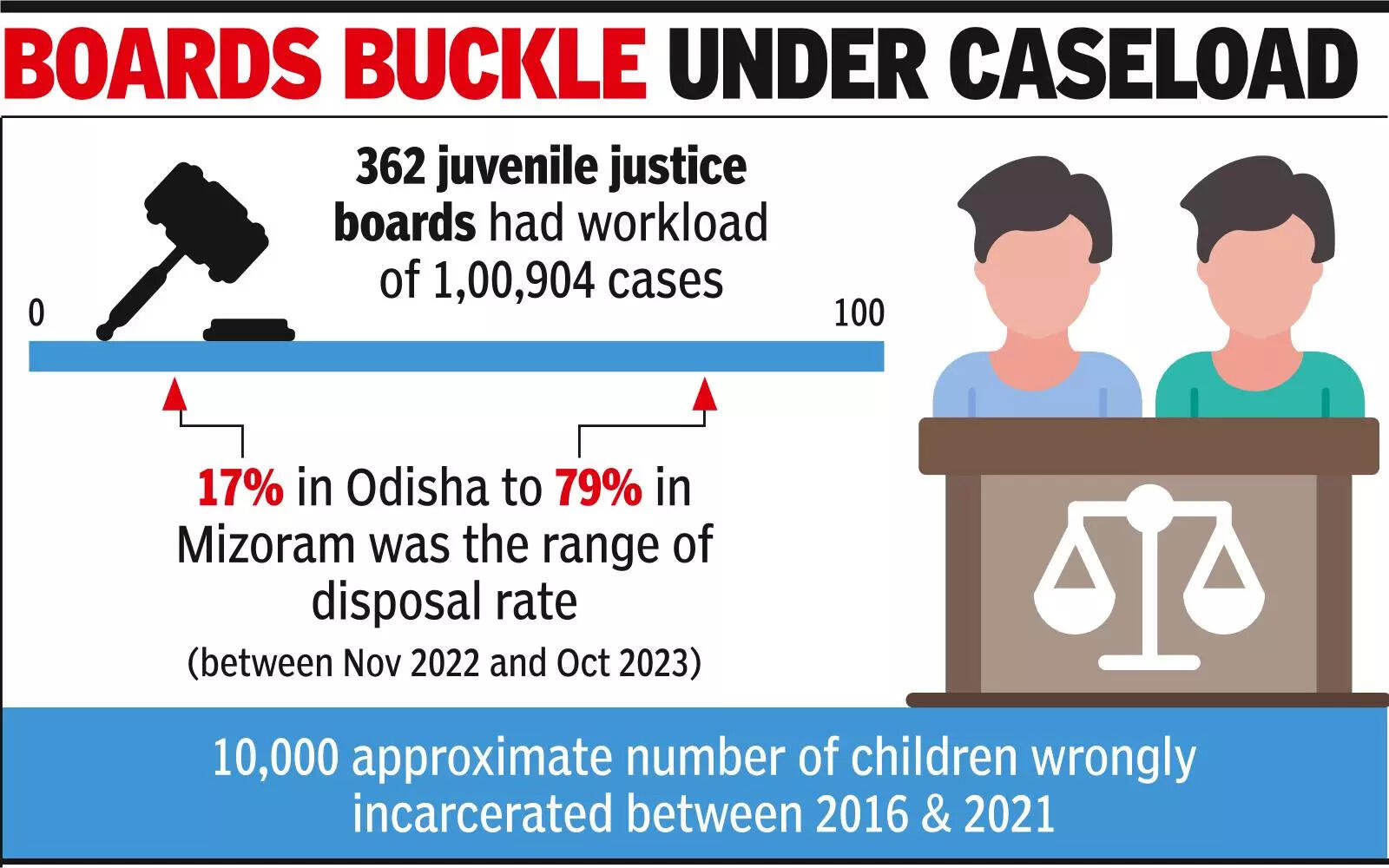
NEW DELHI: Ten years after the Juvenile Justice (Care and Protection of Children) Act, 2015 came into force, a new study by the India Justice Report has exposed how the country’s juvenile justice system is crumbling under the same ills that plague adult courts – massive delays, crippling vacancies and shocking opacity. Children in conflict with the law, the very group the Act swore to protect in their “best interest”, are paying the heaviest price.As of Oct 31, 2023, more than 55,000 children were waiting for their cases to be decided, with 55% of the total cases pending before Juvenile Justice Boards (JJBs) across 18 states and two Union Territories. Out of 1,00,904 cases that came up before 362 JJBs in the year ending Oct 2023 (including 50,627 carried over from previous years), only 45,097 – a mere 45% – were disposed of. In Odisha the pendency rate touched a staggering 83%, while Karnataka managed to keep it at 35%. Nationally, the picture is grim: nearly one in every two cases simply rolls over to the next year.
The report, titled “Juvenile Justice and Children in Conflict with the Law: A Study of Capacity at the Frontlines”, is based on parliamentary answers, a year-long RTI inquiry and data from states (Nov 2022 to Oct 2023) . It reveals that one in every four JJBs – 24% or 111 out of 470 boards that responded – is functioning without the mandatory full bench of a principal magistrate and two social worker members. Only three states and Union Territories – Odisha, Sikkim and Jammu & Kashmir – have 100% fully constituted benches. With an average of 154 pending cases per board, the incomplete benches mean slower hearings, less child-sensitive decisions and prolonged institutionalisation of children.Perhaps the most alarming finding is that only 11 districts across the entire country meet the basic minimum standards required to deliver justice in a child’s best interest. Out of 292 districts that provided usable data on seven critical parameters – presence of a JJB, child welfare institution, special juvenile police unit, legal aid clinic, probation officer, staff strength and manageable pendency – just 11 cleared the bar. Eight of these are in Mizoram.Residential infrastructure for children in conflict with the law is equally dismal. Fourteen states, including large ones like Maharashtra, Gujarat, Madhya Pradesh, West Bengal, Punjab, Andhra Pradesh and Telangana, have not established even a single “Place of Safety” for 16 -18-year-olds accused of heinous offences – a mandatory requirement under the Act. Facilities for girls are particularly scarce: only 40 homes nationwide can accommodate girls in conflict with the law, including those that house both genders.The study warns that the absence of proper facilities forces children to be shifted far from their families, making access to guardians and legal representation difficult and sometimes leading to unsafe mixing of age groups and offence categories – the very evils the 2015 Act was meant to end.Ten years on, the report concludes, India still cannot produce routine, public, time-series data to prove that its juvenile justice system is working optimally for the child. Instead, thousands of children remain trapped in limbo, bearing the brunt of a system that looks disturbingly similar to the broken adult criminal justice machinery it was supposed to be different from.


