
In 2003, Nasa researchers found freshwater snails mated and reproduced in space, with gravity-sensing statoconia 50% larger by volume than ground controls

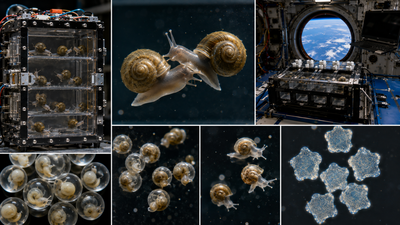
In 2003, Nasa researchers reported that freshwater snails carried into orbit aboard the Space Shuttle had mated and reproduced during their mission, allowing their gravity-sensing organs to develop entirely under microgravity. According to the study published in PubMed, tittled ‘Otoliths developed in microgravity’ formed part of the results of the STS-90 Neurolab Spacelab mission, a flight dedicated to neuroscience research. On examination after landing, the snails’ statoconia, dense calcium carbonate stones that rest on sensory hairs and signal the direction of gravity to the nervous system, were found to have grown substantially larger than those of size-matched snails reared in identical equipment on Earth, with total statoconia volume increasing by roughly 50%. Swordtail fish flown on the same missions showed a related but more limited effect, with larvae, but not older juveniles, developing enlarged otoliths in space.
How did freshwater snails reproduce in space
Their study, was published in 2003 as part of the collected results of the STS-90 Neurolab Spacelab mission, a Shuttle flight dedicated to neuroscience research. Most animals rely on organs that use dense stones, known as otoliths or statoconia, which rest on sensitive hairs of specialised gravity- and motion-sensing cells; the weight of the stones bends the hairs in the direction of gravitational pull, and the cells then relay a signal to the central nervous system. The researchers noted that earlier work on a marine mollusc, the sea hare Aplysia californica, had shown that when its eggs or larvae were raised on a centrifuge, the size of these stones shrank in proportion to how much the gravity field was increased, pointing to some mechanism that adjusts the stones toward a target weight.To test whether the reverse held true in weightlessness, the team studied freshwater snails and swordtail fish after spaceflight. Pre-mated adult female swordtail fish were flown aboard the Shuttle, and their larvae were collected after landing; separate juvenile fish, whose development had already taken place on the ground, were also flown for comparison. The freshwater snails, meanwhile, mated in orbit, meaning their statoconia developed entirely under microgravity conditions.
PC:Canva
What happened to snail statoconia in microgravity
The result for the snails was substantial. According to the Nasa Technical Reports, the snails that developed in space grew a total statoconia volume “50% greater” than size-matched snails reared in identical equipment on the ground. The abstract describes how, in the statocyst of the freshwater pond snail Biomphalaria glabrata reared in space aboard the Closed Equilibrated Biological Aquatic System (CEBAS), both the number and total volume of statoconia rose by roughly 50% relative to the ground-reared control group.
How did microgravity affect swordtail fish otoliths
The record states that for later-stage larvae, otolith growth was significantly greater in fish reared in flight than in those reared on the ground. However, juvenile fish, whose gravity-sensing structures had already formed before launch showed no significant difference in otolith size between the flight and ground groups. The researchers concluded that this pointed to a critical period during early development in which altered gravity can affect the size of the gravity-sensing stones, since only the larval, not the juvenile, fish showed the change.The researchers framed the results as support for the idea that the growth of otoliths and statoconia is not fixed but is instead regulated to reach an appropriate functional weight. In gravity-reduced conditions, both snails and fish larvae appeared to compensate for the lower effective weight of the stones by producing larger ones. The PubMed abstract also situates the finding alongside other spaceflight and centrifuge studies: statoconia volume was reduced in a graded manner in Aplysia californica larvae reared at two to five times normal gravity, while other researchers had found the utricular otolith of space-reared Xenopus frogs to be 30% larger than in ground controls, and cichlid fish reared on a centrifuge developed smaller saccular otoliths than 1-g controls.


