
In 1989, UK researchers turned 50 tonnes of coal-fired power station waste into an underwater reef; lobsters and crabs arrived within 3 weeks

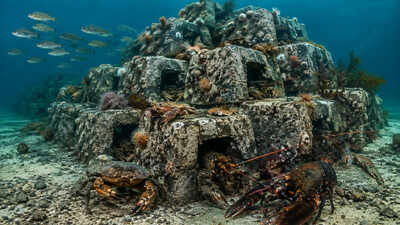
What happens when waste from a coal-fired power station is placed beneath the sea? In 1989, researchers in the UK built an experimental artificial reef from 50 tons of stabilised coal-fired power station waste, and marine life began moving in almost immediately. The unusual experiment took place in Poole Bay, off the coast of Dorset, where researchers created a reef from blocks made primarily of pulverised fuel ash, or PFA, and gypsum. The structure was designed to investigate whether a material normally treated as waste could be safely used to create habitat on the seabed. The findings were later published in the Bulletin of Marine Science in a study titled “Colonisation and Fishery Potential of a Coal-Ash Artificial Reef, Poole Bay, United Kingdom.” The research, led by A. C. Jensen and colleagues, found that adult European lobsters and edible crabs from nearby natural reefs reached the artificial structure within just three weeks.
Building a reef from waste
The experimental reef was deployed in June 1989 on a flat, sandy seabed in Poole Bay. It was positioned about 3 kilometres from natural rocky outcrops, giving researchers a useful setting to study whether marine organisms would colonise a structure made from industrial waste. The 50 tonnes of material were formed into blocks measuring approximately 40 by 20 by 20 centimetres, using mixtures of pulverised fuel ash, gypsum and other materials. Researchers arranged them into eight cone-shaped reef units, each about 1 metre high and 4 metres across, spread over an area of seabed measuring 30 by 10 metres. The blocks were not made from untreated ash. They used stabilised mixtures containing pulverised fuel ash and gypsum, with cement and gravel also included in different formulations. Researchers created three PFA/gypsum mixtures and compared them with concrete control structures. The goal was not simply to dump waste underwater. Scientists wanted to test whether coal-fired power station by-products could become a useful construction material for artificial reefs while also examining their environmental acceptability.
Marine life arrived quickly
The reef did not remain an empty collection of blocks for long. According to the study, adult European lobsters (Homarus gammarus) and edible crabs (Cancer pagurus) from nearby natural reefs were recruited to the artificial reef within three weeks of its deployment. That early arrival was one of the clearest signs that the structure was functioning as more than an inert pile of industrial material. Researchers monitored the reef through direct observations, underwater photography, tagging and fishing studies. Over time, the surfaces became increasingly covered by marine organisms.Within the first year, the block surfaces became extensively covered by marine organisms. The developing community included groups such as hydroids, bryozoans, barnacles, ascidians, tube worms, sponges and algae. The researchers also found that the community gradually matured toward the types of organisms found on nearby natural reefs.
A habitat for fish too
Lobsters and crabs were not the only animals using the structure. The reef attracted schools of pouting, a small fish species related to cod. Researchers commonly estimated around 200 pouting per reef unit, and some fish species were observed reproducing at the site. The study also recorded reproduction by several other species, including corkwing wrasse, lobsters, spider crabs, velvet swimming crabs, hermit crabs, whelks and nudibranchs. Some lobsters also appeared to treat the artificial reef as a long-term home. Tagging studies found that certain individuals showed considerable site loyalty, with one recorded residence time reaching 368 days. These observations gave researchers a way to examine not only whether animals would visit the reef, but whether the structure could support a functioning marine community over time.
Did the material make a difference?
One important finding was that researchers did not detect substantial or consistent differences in the biological communities developing on the different PFA/gypsum mixtures. They also found no clear differences between the organisms colonising the coal-ash mixtures and those colonising the concrete control structures.The project was also designed to investigate potential environmental concerns, including heavy metals associated with coal ash and changes to organisms living in the surrounding seabed. That made the experiment significant beyond its unusual construction material. Researchers were testing whether a large quantity of industrial by-product could be stabilised and incorporated into an artificial marine habitat without producing obvious ecological problems.
From waste to habitat
The Poole Bay experiment was part of a broader effort to explore whether industrial waste materials could be put to productive use instead of being sent to landfill or dumped at sea. More than three decades later, the experiment remains an intriguing example of how artificial structures can alter marine habitats. The reef demonstrated that a structure made from stabilised coal-fired power station waste could quickly attract marine animals and become covered by a diverse community of organisms. What began as an experiment involving 50 tonnes of coal-related waste ultimately became a small underwater ecosystem, showing how quickly marine life can begin occupying a newly created hard surface in an otherwise sandy environment.


