
A Florida clock survived nearly a century outdoors; one clockmaker has now spent about 700 hours restoring its 95-year-old hands, dial and metalwork

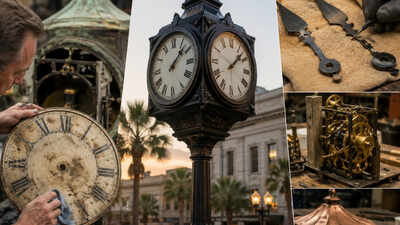
For nearly a century, a four-faced clock stood over a busy corner in downtown Clearwater, Florida, quietly marking the passing hours as the city around it changed. Years of Florida weather eventually left their mark on the historic timepiece, but instead of letting it disappear with age, a clockmaker took it apart piece by piece and spent roughly 700 hours bringing it back to life. The historic Peoples Bank clock, also known as the four-faced McClintock clock, has now returned to Cleveland Street after months of painstaking restoration. At the centre of the project was master horologist and second-generation clockmaker David H. Boyd, whose family has been working with clocks for generations. According to the Cleveland Street Alliance, Boyd and his team spent five to six months restoring the landmark, putting approximately 700 hours into preserving its original dial, hands and metalwork while adding modern GPS-regulated clockworks.
A clock built for another era
The clock had watched over Cleveland Street for generations. By the time it reached Boyd Clocks in Tampa, however, nearly a century of exposure to Florida weather had taken a toll on its components. The restoration required the clock to be dismantled rather than simply repaired in place. Its heavy steel frame was taken apart, while its copper roof, original dial and hands were removed and examined separately. Among the most important pieces were the original clock hands. According to the Cleveland Street Alliance, Boyd pointed out that the hands were still the originals and were approximately 95 years old. Rather than replacing these historic elements with new replicas, Boyd and his team restored them so that they could continue to form part of the clock’s original appearance.
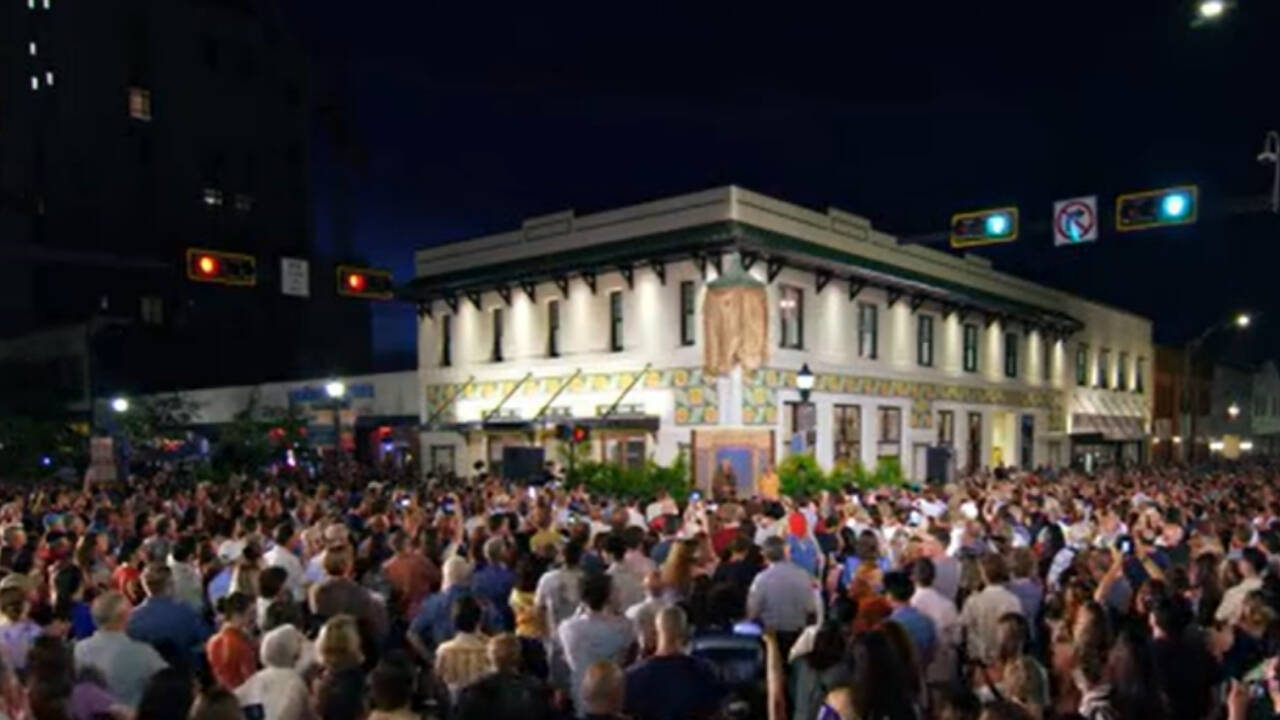
Clock unveiling ceremony on July 25, 2026 (Image Credit: Cleveland Street Alliance)
700 hours of restoration
The project ultimately required approximately 700 hours of work. That time was spent restoring the clock’s original components while also making it capable of functioning reliably in the present day. The team preserved the original dial and hands and restored the clock’s metalwork. New stained-glass panels were also created, adding another layer of craftsmanship to the restoration.But preserving a historic clock does not necessarily mean leaving every part untouched. Behind its restored exterior, the timepiece received modern GPS-regulated clockworks. The combination gives the historic clock a modern mechanism while preserving the appearance and character that made it a familiar part of Cleveland Street. The result is a restoration that does not simply reproduce an old clock. Instead, it combines original historic materials with modern technology, allowing the landmark to continue serving a practical purpose.
A family craft
For Boyd, the project also carries a personal connection to clockmaking. He learned the trade from his father, David N. Boyd Sr., who began repairing clocks when he was 14. David H. Boyd grew up accompanying his father on service calls and helping with the removal of weights and pendulums from grandfather clocks. By the age of 16, he was making house calls himself.The younger Boyd has since spent nearly four decades repairing and restoring timepieces. His approach to the profession is notably practical. In the Cleveland Street Alliance’s account, Boyd describes himself less as a horologist than as a mechanic whose speciality happens to be clocks.
Back where it belongs
After months in the workshop, the restored clock was returned to the corner of Cleveland Street and Fort Harrison Avenue. Its public unveiling on July 25 drew more than 3,000 people. For residents and visitors, the return meant more than seeing an old clock repaired. It marked the return of a familiar piece of the city’s streetscape. Boyd described historic public clocks as objects that can become part of a community’s daily life. People see them repeatedly over many years, eventually associating them with a particular place and period of their lives. That may be the most significant part of this restoration. The clock’s value is not limited to its age, its mechanical workings or the 700 hours invested in repairing it. It is also a physical link to Clearwater’s past. After surviving nearly a century outdoors, the 95-year-old hands and original dial are once again above Cleveland Street, keeping time for another generation.


