
As death toll in heatwave-hit Europe crosses 30,000; scientists suggest companies to push this almost 20-year old portable gadget in their offices

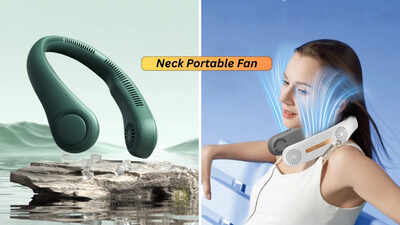
As the death toll from Europe’s ongoing heatwave climbs past 30,000, scientists are urging companies to consider unconventional cooling solutions for their offices. Among them: wearable neck fans, a nearly 20-year-old gadget which has long struggled to gain mainstream acceptance due to its ‘dork factor’. According to a report by Popular Science, a recent study in the journal E3S Web of Conferences found that portable neck and face fans performed nearly as well as bladeless desk fans in keeping office workers cool. While not as powerful as traditional bladed fans, they offered key advantages: lower energy use, less disruption to coworkers, and targeted cooling for thermosensitive areas like the neck and face.
What the study found
In controlled testing, portable neck and face fans performed roughly as well as bladeless desk fans at keeping office workers comfortable. They fell short of matching traditional bladed desk fans in raw cooling power, but came with two practical advantages: they don’t blow large gusts of air toward nearby coworkers who might prefer a warmer setting, and they use considerably less energy than either desktop alternative.Mohamed Ouf, an engineering professor at Concordia University in Canada and co-author of the study, said in a statement that these fans offer a way to keep a centralized HVAC system running while using less energy overall — a detail that matters directly to employers looking to cut cooling costs.
How the experiment worked
Researchers tested four devices — a neck fan, a face fan, a bladed desktop fan, and a bladeless desk fan — each evaluated at both low and high speed settings. To avoid the subjectivity of asking human subjects how comfortable they felt, the team removed humans from the experiment entirely. Instead, they directed airflow from each device toward a life-sized, 23-segment thermal manikin modeled after an average Scandinavian man. The manikin was outfitted with sensors that continuously track skin temperature, heat loss, and predicted thermal comfort across different regions of the body, allowing researchers to measure precisely how quickly its surface cooled and returned to a comfortable baseline.The manikin was dressed in standard summer office attire — a short-sleeve shirt, pants, and sneakers — and placed in a test room designed to mimic a typical office cubicle, with the thermostat set to 77 degrees Fahrenheit, a temperature warm enough to cause noticeable discomfort without being extreme.
Why a small breeze can cool the whole body
The neck fan performed nearly as well as the bladeless desk fan overall. Despite producing a much smaller, more localized breeze than a desktop fan, the wearable device delivered whole-body comfort in the data, a result researchers attribute to how thermosensitive the neck and face are. That region accounts for only about 5.5% of a person’s total body surface area, but plays an outsized role in overall temperature regulation and perceived comfort.Neither wearable device could match the sheer output of a traditional bladed desk fan, but both offered meaningful trade-offs: they take up far less desk space, use less energy, and direct airflow only at the wearer — avoiding the common office annoyance of a desk fan blasting air into a neighbouring cubicle.
Why offices without reliable AC are the best candidates
The findings may seem irrelevant to workers in buildings with dependable central air conditioning running by default, but researchers note that this assumption doesn’t hold everywhere. Many offices outside the United States still don’t rely on air conditioning at all. Even in buildings that do, the shift to hybrid work is changing incentives — with fewer employees occupying large office floors on any given day, cost-conscious building owners may see less value in fully cooling entire spaces. Faced with that math, some employers may opt to raise the thermostat and instead point employees toward a personal wearable fan as a cheaper alternative to full building-wide cooling.


