
How a Chinese company is using Blue Light to fight mosquitoes, claims 30 kills per second: Scans the area, locks on in 3 milliseconds and…

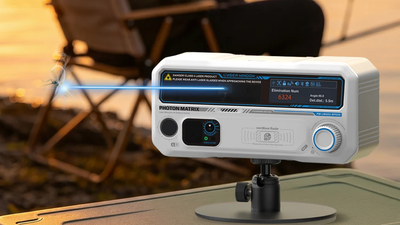
Mosquitoes kill roughly 700,000 people a year, which makes them the deadliest animal on the planet by a wide margin. Our defences have not changed much in a century: nets, coils, sprays, and a rolled-up newspaper. A startup in Changzhou, in eastern China, thinks the next step is a laser turret that sits on your patio and shoots the insects out of the air.Photon Matrix has opened preorders for its blue laser mosquito air defense system at $1,088, roughly Rs 95,000, after starting mass production in August. The company says the device locks onto a mosquito in three milliseconds and can take down up to 30 of them a second, in complete darkness, without chemicals and without noise. Those are the company’s own numbers, and nobody outside the company has verified them yet.
How the Photon Matrix laser mosquito killer finds a 2mm target in the dark
The unit scans a flat fan of light across the space in front of it and continuously measures how far away the background is. When something small crosses that plane, the distance reading changes. The system then checks the size, and if it matches a mosquito, between 2mm and 20mm moving slower than a metre per second, an internal galvo mirror points the laser down the same optical path the LiDAR just used and burns the wings. Coverage is a six-metre radius across a 90-degree arc, and a rotating base spins the device for something closer to full coverage. A companion app logs kills, plots a mosquito heat map, sets on-off schedules and, for reasons known only to the marketing team, ranks you on a global leaderboard.
The blue laser mosquito zapper’s safety case has no independent testing behind it
The obvious question about a laser strong enough to disable an insect is what happens when it misses. Photon Matrix’s answer is a background check: the laser fires only when it detects a solid surface within range, and shuts off when it cannot find one. The company says the system has cleared certifications covering people, pets and birds, and that it ignores butterflies and other larger insects. It has also promised to publish more testing and safety data. Until an independent reviewer gets a unit on a table, buyers are taking that on trust, and the comment sections under every video of this thing are full of people asking about eyes.
The mosquito laser is a 20-year-old idea that finally shipped
There are two versions. The outdoor blue laser model at $1,088 flashes visibly each time it fires. The indoor infrared model, at $988 or about Rs 87,000, uses a 976nm invisible beam pitched at bedrooms and hotel rooms. Both come with a rotating base, a 12-month warranty and a 20,000mAh power bank good for around four hours off mains. Delivery is quoted at roughly 120 days.The project raised $2.7 million on Indiegogo against a $20,000 target, with over 4,000 backers paying about $630 each, then slipped repeatedly on sensor calibration and safety approvals. The concept itself dates to 2006, when an astrophysicist who worked on Reagan-era missile defence pitched it at a brainstorming session. A prototype turret with a 50-metre range was demonstrated in 2010 and never found a buyer.So the century-old arsenal gets a new entry, and it works out to about a thousand dollars for the privilege of watching mosquitoes fall.


