
‘Like a movie scene’: Chain of events that led to Nepal floods that killed over 600

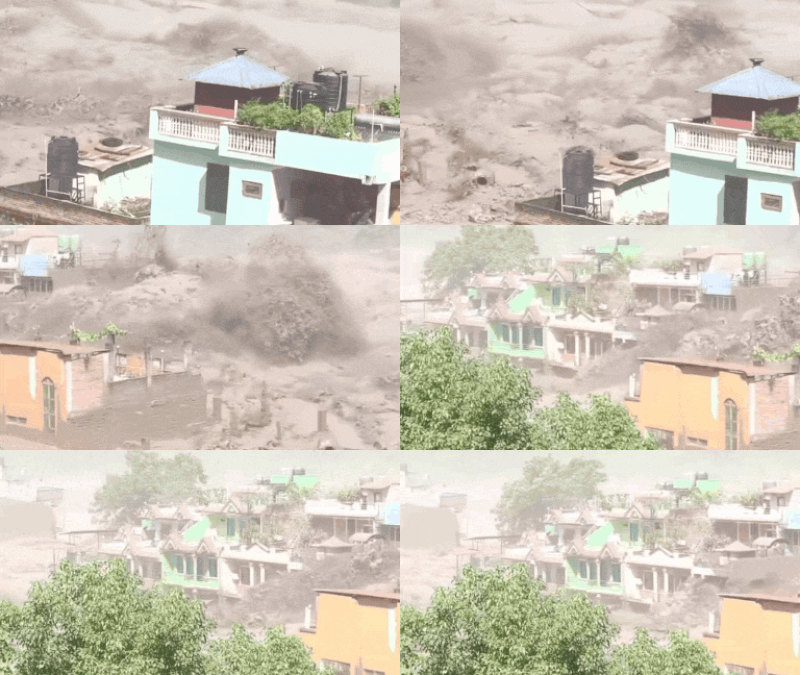
A massive glacier and rock collapse high in Nepal’s Himalayas appears to have set off a chain of events that culminated in one of the country’s deadliest flash floods in years, killing over 600 people and leaving thousands missing in Nepal and neighbouring Tibet.The disaster began high in the mountains on Wednesday when a huge section of glacier and rock collapsed into the Lhende Khola valley near the Nepal-China border. The falling mass blocked the river before a surge of water, ice and debris burst through the valley, sweeping downstream into the Bhotekoshi and Trishuli river systems.The scale of the destruction has since become clearer. Bodies have been recovered hundreds of kilometres downstream in Nuwakot, Dhading, Chitwan, Gorkha, Tanahun and both East and West Nawalparasi, according to Nepal Police, tracing the path of the flood through the country’s major river systems.
From glacier collapse to a wall of water
Initial reports suggested that an earthquake may have triggered an avalanche and blocked the Lhende Khola, creating a temporary dam that later burst. The US Geological Survey initially linked the flooding to a magnitude 4.4 earthquake recorded in the area.Satellite imagery, however, offered a different explanation. Images analysed after the disaster showed that a section of glacier and underlying rock, roughly 600 metres (2,000 feet) wide, had collapsed from an altitude of about 5,200 metres. The mass plunged around 1,200 metres into the valley below.The USGS later revised its assessment, concluding that the collapse itself produced a seismic signal equivalent to a magnitude 5.2 earthquake.Scientists cited in earlier reports said the enormous amount of ice stored at such a height would have carried immense potential energy as it fell. The impact pulverised ice and rock, sending a mixture of water and debris towards the Lhende Khola and then into the Bhotekoshi River.Nepal’s Department of Hydrology and Meteorology reached a similar conclusion after examining satellite imagery provided by China. Binod Parajuli, a senior divisional hydrologist, said the evidence pointed to a combination of an ice avalanche, permafrost movement and a rockslide.“The avalanche originated on Nepali territory, but after it came down it crossed the Nepal-China border, causing extensive damage on both sides,” Parajuli told The Kathmandu Post.The exact sequence and contribution of each factor are still being assessed.
Flood races downstream as new lake raises fresh fears
The initial surge flattened settlements, roads, bridges and hydropower infrastructure on both sides of the border. In Nepal’s Rasuwa district, soldiers were deployed to rescue people trapped inside a tunnel at the Upper Trishuli-1 hydropower project, where thick mud made it difficult to locate the entrances and exits.By Friday, Nepal’s disaster-management authority had reported 579 deaths, while Nepal Police put the toll at 553. More than 3,700 people had been rescued and 1,924 remained unaccounted for. China reported seven deaths and 554 missing.The disaster also created a new danger. A lake formed upstream after the glacier collapse and began overflowing, prompting warnings that another surge could hit communities downstream. Rescue teams were temporarily ordered to stop advancing while authorities assessed the threat. Chinese monitoring data later showed the lake’s water level had fallen by about 10 metres from its peak.The disaster has also raised wider concerns about a rapidly warming Himalaya, where glaciers are retreating and mountain communities face increasing risks from landslides, glacial floods and unstable permafrost.For survivors, however, the disaster unfolded in seconds. Karbir Gaire, a customs officer in the border village of Timure, told reporters that he felt the ground shake before seeing what he described as a “black storm” racing towards the settlement.He and others ran uphill, escaping moments before the torrent struck.“It was like a Hollywood movie scene,” Gaire told news agency AP. “I don’t call it a flood. It was a tsunami.”


