
Meet the IIT Madras graduate named among TIME’s 100 most influential people in AI: Her work can predict weather thousands of times faster

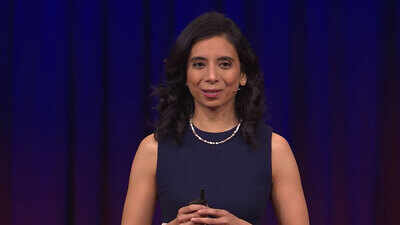
Artificial intelligence can write essays, generate videos and answer questions. But what if AI could also understand the physical world—predicting extreme weather, improving semiconductor manufacturing, accelerating scientific simulations and helping researchers design new technologies?That question has shaped much of Professor Anima Anandkumar’s career. The IIT Madras graduate, Cornell PhD and Caltech professor has now been named among TIME’s 100 most influential people in AI, recognition that comes as she begins a new chapter with her AI-for-science company, Accelerated Understanding.TIME described Anandkumar as a researcher whose work is helping AI model physical processes at extraordinary speeds. Her algorithms have been applied to weather forecasting, medical-device design, quantum computing components, semiconductor manufacturing and nuclear fusion research.
From IIT Madras to the frontiers of AI and science
Anandkumar’s academic journey began at the Indian Institute of Technology Madras, where she studied Electrical Engineering. She went on to earn her PhD from Cornell University and conducted postdoctoral research at MIT.Her career has since taken her through some of the world’s biggest technology and research organisations. She previously worked as a Principal Scientist at Amazon Web Services and later became Senior Director of AI Research at NVIDIA, while continuing her academic work at Caltech.Today, she is the Bren Professor of Computing at the California Institute of Technology, where her research focuses on using AI and machine learning to accelerate scientific discovery.
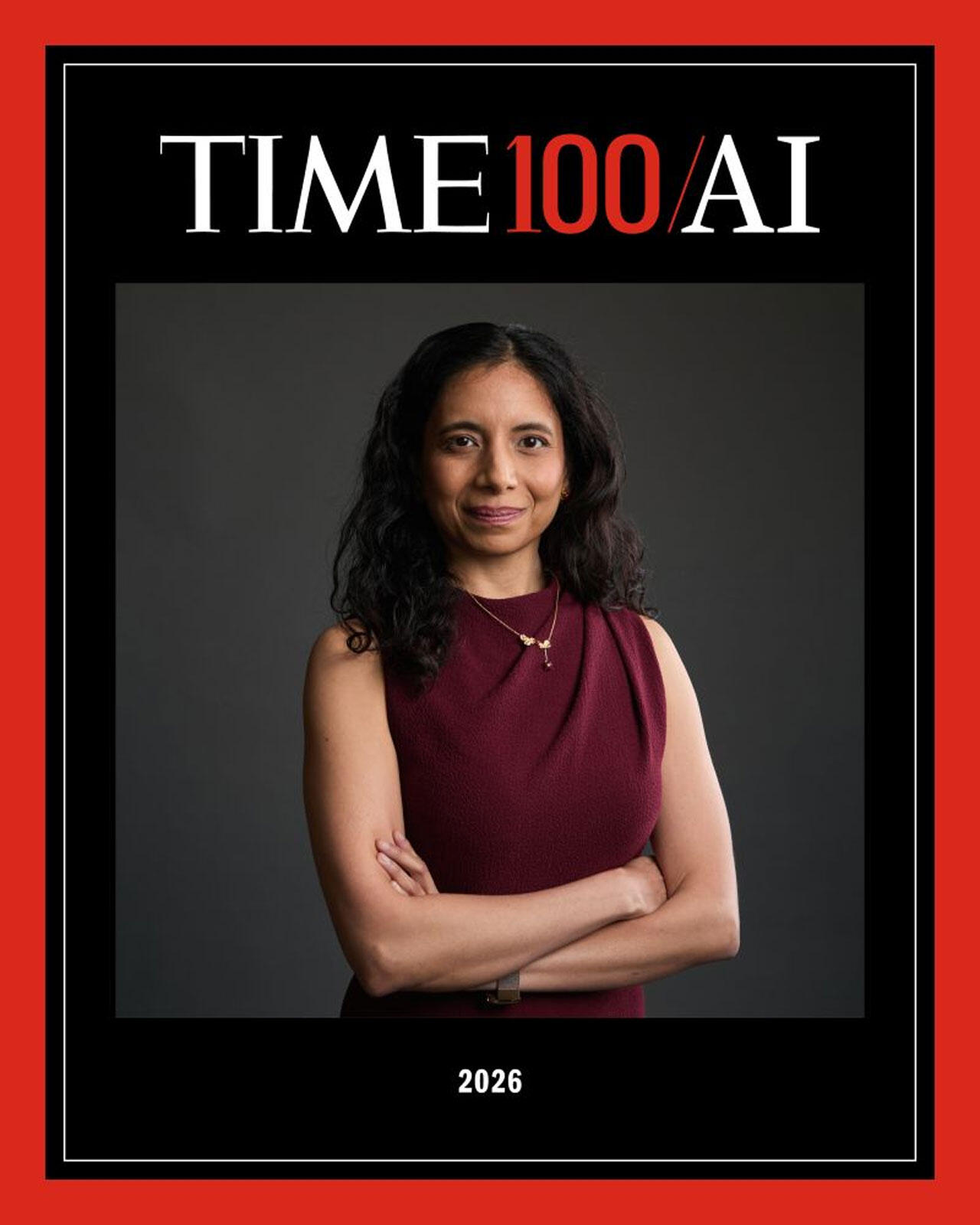
Can AI understand the physical world? Meet the IIT Madras graduate named among TIME’s 100 most influential people in AI. (Photo: LinkedIn)
The idea that changed how AI could study physics
One of Anandkumar’s most influential contributions has been the development of Neural Operators.Traditional AI models are generally trained to recognise patterns in data. Neural Operators take the idea further by learning relationships that govern physical systems, including processes described by mathematical equations.In simple terms, instead of waiting for a conventional scientific simulation to calculate every step, AI can learn to approximate complex physical behaviour far more quickly.The technology has applications across fluid dynamics, materials science, climate modelling and engineering design.
The AI that could forecast weather at remarkable speed
One of the best-known outcomes of this work is FourCastNet, an AI-based global weather forecasting model developed with collaborators.According to research published through Caltech, FourCastNet can generate medium-range global weather forecasts five orders of magnitude faster than conventional numerical weather prediction systems while approaching state-of-the-art accuracy.The model’s speed could be particularly valuable when scientists need to run many possible weather scenarios to assess risks from extreme events such as cyclones and heat waves. Anandkumar’s Caltech research group has described its AI-based weather forecasting work as tens of thousands of times faster than conventional approaches.
From NVIDIA to a new company modelling the physical world
Anandkumar recently co-founded Accelerated Understanding, a company focused on building AI systems capable of modelling and understanding physical phenomena.According to a recent Reuters report, the company has developed a physics-focused AI model capable of processing extremely large amounts of information in a single prompt. Unlike conventional large language models built primarily around text, the company’s technology uses neural-operator-based approaches to model physical systems.Potential applications include chip design, robotics, weather prediction and energy exploration.In a post announcing her TIME100 AI recognition, Anandkumar wrote that bringing together AI and science had been the focus of her work for the past decade.Her larger ambition is to reduce one of science and engineering’s biggest bottlenecks: the time required to run simulations and conduct repeated laboratory experiments.
Now helping shape the global conversation on AI
In 2026, Anandkumar was also appointed to the UN Secretary-General’s Scientific Advisory Board, joining a group of international experts advising on developments in science and technology.The UN formally welcomed her as one of its newly appointed board members in June 2026.For students, Anandkumar’s journey offers a striking example of where an engineering education can lead. Her career has moved from electrical engineering at IIT Madras to some of the world’s most advanced research in artificial intelligence.But unlike much of today’s AI race, her work is not primarily focused on making machines better at generating text.It is focused on something much bigger: using AI to understand the laws that govern the physical world—and, perhaps, helping humans discover faster ways to change it.Disclaimer: This article is based on publicly available information, including research publications, institutional records and statements shared by Prof. Anima Anandkumar and other cited sources. TOI Education has not independently verified every technical performance claim or future application mentioned by the company or researchers.


