
‘Hijab on their heads, not minds’: Owaisi calls Allahabad HC ruling ‘attack on Islam’

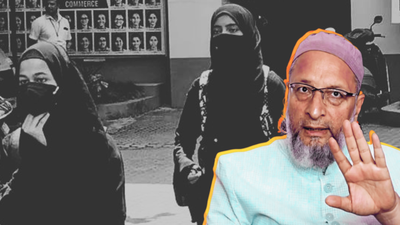
NEW DELHI: AIMIM president Asaduddin Owaisi on Tuesday criticised the Allahabad High Court’s dismissal of a minor student’s petition seeking permission to wear a hijab with her prescribed school uniform in Prayagraj. Calling the ruling an “attack on Islam”, Owaisi questioned the court’s authority to determine what is essential to the religion.Addressing the Jalsa-e-Rahmatul-lil-Alameen gathering at the AIMIM headquarters in Darussalam, Hyderabad, Owaisi said the ruling was inconsistent with the constitutional protections of religious freedom and freedom of expression. He also pointed to the ongoing Sabarimala case before the Supreme Court, where a nine-judge bench is examining questions surrounding essential religious practices.The AIMIM chief said, “A judgment came from the Allahabad high court. A girl was wearing a hijab to school, and the Court ruled that one cannot wear a hijab. I disagree with this High Court judgment; I do not concur with it. The Sabarimala case is already before the Supreme Court, where nine judges are deciding what is essential. Today’s verdict violates Articles 25 and 19 of the Indian Constitution. Who are you to decide what is essential to Islam? Girls are wearing hijab on their heads, not on their minds. It is an attack on Islam.”The remarks came after a division bench of Justices JJ Munir and Indrajit Shukla dismissed the student’s petition challenging the school’s refusal to allow her to wear a scarf over her uniform.The court observed that the petitioner had not produced religious scriptures or other material establishing that wearing a scarf was an “essential” part of her religion, such that its absence would affect her faith. It also noted that photographs submitted before the court showed other students from the same religious community attending the school without scarves.The bench held that where a dress code is uniform, non-discriminatory, adopted in good faith and intended to maintain discipline and institutional identity, determining the uniform primarily falls within the school’s jurisdiction.
Share your thoughts in the comments
Be respectful · TOI community guidelines
The court further said that the student’s previous practice of wearing a scarf in lower classes without objection did not create a permanent or enforceable right to require the school to alter its uniform policy. It clarified that the school was not curtailing her freedom of faith but was enforcing institutional discipline, with the uniform forming an essential part of that discipline.The student had completed Class 10 at the same school and sought admission to Class 11. She told the court that she had worn a scarf over her school uniform since Class 6 and that the school had never objected to it.However, when she sought admission to Class 11, the school management informed her that wearing a scarf violated its dress code and refused admission on that ground.


