
5 reasons why people sprinkle vinegar at their front door and home entrance

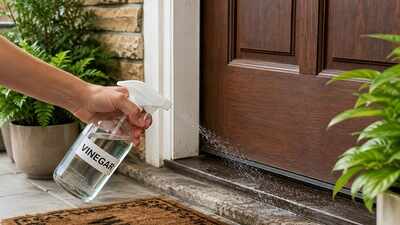
Walk past enough doorsteps and you might notice a faint, sharp smell that has nothing to do with cooking: a light spritz of vinegar, sprayed right where guests step in. What started as an old-fashioned kitchen cleaning staple has quietly turned into a genuine doorstep habit for a lot of households, part pest control, part odour management, and for some, part ritual entirely unrelated to either. The reasons people give for doing it range from straightforward pest science to something closer to a small daily practice for resetting the mood of a home. Here are five of the most common ones.
To disrupt ant scent trails
This is the most scientifically grounded reason behind the habit, and it comes down to how ants actually navigate. Ants lay down pheromone trails to guide the rest of their colony toward a food source and back to the nest, and vinegar’s strong, acidic smell genuinely interferes with their ability to detect and follow that trail. Spraying it around a doorstep, threshold, and nearby skirting boards doesn’t harm the ants directly, but it does make the path far more confusing for them to navigate, which is often enough to redirect a small trail before it turns into a full infestation.
To deter spiders and other small insects
Ants aren’t the only pests vinegar is used against at an entrance. Its acidic smell is similarly unpleasant to spiders, and in some cases direct contact with concentrated vinegar can actually be harmful to them, though it functions far more reliably as a general deterrent than as a way to eliminate them outright. Cockroaches are sometimes mentioned in this same category too, tending to avoid areas where the scent lingers. It’s a genuinely low-cost, chemical-free option for households that would rather not spray stronger pesticides right at their main entry point.
To prevent mould and mildew at a humid entryway
Beyond pests, vinegar’s natural antibacterial and antifungal properties give it a second practical job at the doorstep. Entrances tend to collect moisture, especially during humid or rainy stretches, and that dampness creates exactly the conditions mould and mildew need to take hold on tiles, mats, and door frames. A regular wipe-down or light spray with diluted vinegar helps keep that buildup in check before it becomes visible, which is part of why some households treat it as routine doorstep maintenance rather than a one-off fix.
To neutralise odours at the entrance
An entryway often ends up as a catch-all for smells that build up over the day, shoes, nearby bins, general foot traffic, and vinegar genuinely helps neutralise rather than just mask these odours. Unlike a scented spray that simply layers a new fragrance over the old smell, vinegar’s acidity actively breaks down some of the compounds causing the odour in the first place. Once the initial sharp smell of the vinegar itself fades, usually within a few minutes, it tends to leave the area smelling genuinely fresher rather than perfumed.
As a symbolic energy-cleansing ritual
Not every reason people do this is about pests or smells at all. In home harmonisation and feng shui traditions, the entrance is sometimes referred to as the point where energy enters a home, and spraying vinegar across the threshold is treated by believers as a way of clearing out stagnant or negative vibrations before they can settle inside. For people who follow this practice, it’s less about measurable results and more about a small, intentional daily habit, a symbolic reset marking the boundary between the outside world and home, regardless of whether pests are even a concern that day.
One habit, several motivations
Whether someone reaches for vinegar purely to keep ants away or as part of a more personal, ritual-like habit, the appeal comes down to the same basic facts: it’s cheap, it’s already sitting in most kitchens, and it doesn’t involve harsh chemicals right where people walk in and out every day. It’s worth keeping expectations realistic, though, since vinegar works best as routine maintenance rather than a fix for a serious pest problem, and prolonged use on certain metal fittings, like untreated brass, can cause corrosion over time.
Disclaimer:
This article is intended for general informational purposes only. Vinegar may help deter minor pest activity and odours but is not a substitute for professional pest control in cases of a significant infestation. Do not use for long periods on untreated metal fittings, and the spiritual or energy cleansing benefits described are based on cultural belief and tradition rather than scientific evidence.


