
Why IAF still needs Sukhoi in the age of Tejas and Rafale

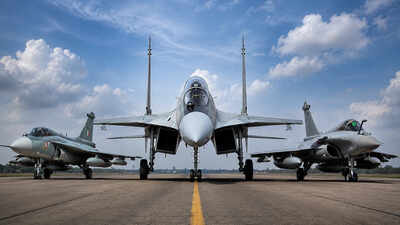
NEW DELHI: Nearly three decades after the Indian Air Force inducted its first Sukhoi fighters, the Su-30MKI remains one of the most important pillars of India’s combat fleet. Its continued relevance comes at a time when the IAF is simultaneously expanding its Rafale fleet, inducting Tejas Mk-1A fighters and preparing for the Tejas Mk-2 and Advanced Medium Combat Aircraft.The Su-30MKI is no longer the newest fighter in India’s inventory. The Rafale brings a newer generation of sensors, electronic warfare systems and networked combat capabilities, while the Tejas represents India’s effort to build a larger indigenous fighter fleet. Yet the Sukhoi occupies a role that neither aircraft can easily replace.The IAF’s requirement is not simply for a collection of technologically advanced fighters. It needs a balanced fleet combining numbers, range, payload, survivability, air superiority and long-range strike capability. In that structure, the Su-30MKI remains the IAF’s principal heavy fighter and provides capabilities that complement rather than duplicate those of Tejas and Rafale.
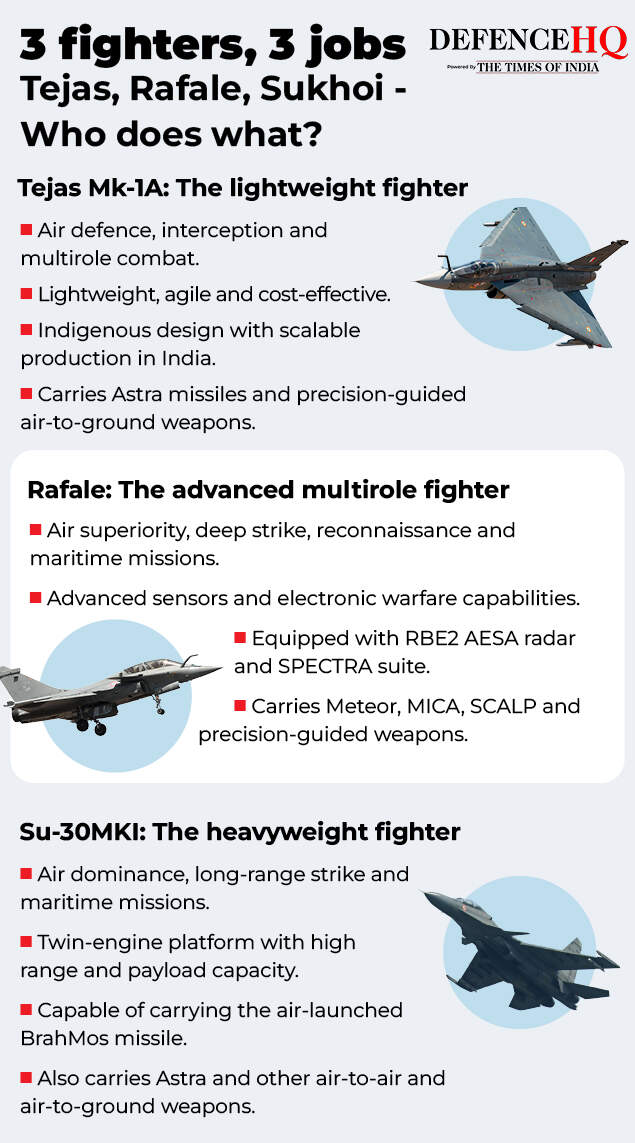
Three fighters, three distinct roles: How Tejas, Rafale and Sukhoi complement the IAF’s combat fleet.
The story of the Sukhoi in India began on June 11, 1997, when the IAF inducted its first eight Su-30K fighters into No. 24 Squadron, “Hawks”, at Air Force Station Lohegaon in Pune. The aircraft subsequently evolved into the Su-30MKI, which became the backbone of India’s fighter fleet.The IAF currently operates around 260 Su-30MKI fighters, while additional aircraft have been ordered to maintain fleet strength. The aircraft is also headed for a major modernisation programme under the proposed Super Sukhoi upgrade, which is expected to keep the platform relevant for decades.
Why India went for Sukhoi
The decision to acquire the Su-30 was shaped by changes in the strategic environment around India.Pakistan had acquired US-made F-16 fighters during the 1980s. India responded by inducting the French Mirage 2000 in 1985 and the Soviet MiG-29 in 1987. But by the early 1990s, another concern was emerging: China’s rapid military modernisation.Indian planners wanted a fighter that could cover long distances, carry a large weapons load and remain airborne for extended missions. The requirement was for a heavy fighter that could perform air-superiority as well as strike missions and complement the lighter fighters already in the IAF.
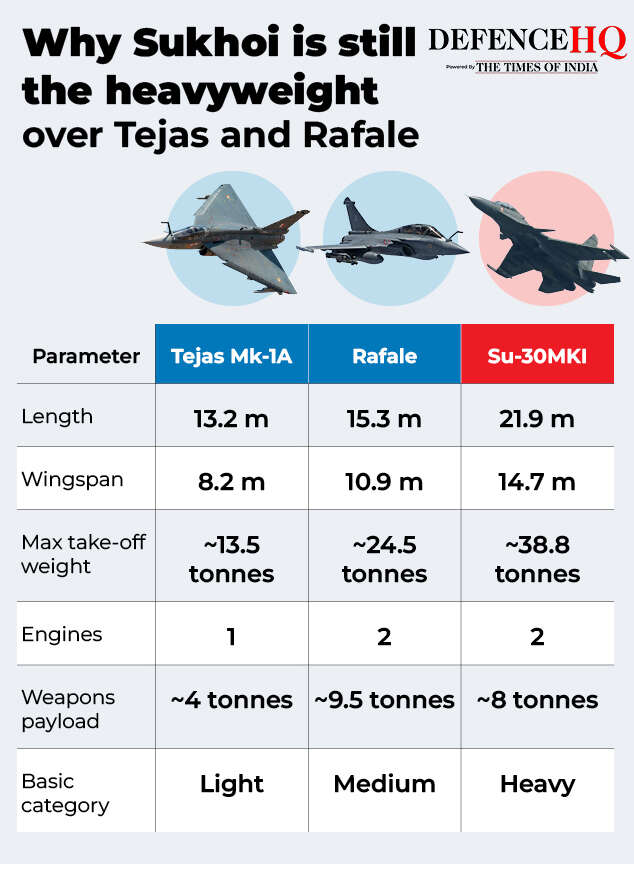
How size, weight and payload set the three fighters apart.
India and Russia signed an agreement on November 30, 1996, for the acquisition of 50 Su-30 aircraft. The programme subsequently evolved into a much larger arrangement involving production in India.In 2000, India and Russia signed an agreement under which Hindustan Aeronautics Limited would manufacture the Su-30MKI in India. Additional orders followed, including 40 aircraft in 2007 and 42 in 2012.This manufacturing relationship eventually transformed the Su-30MKI from an imported aircraft into one of the most extensively operated and supported fighter platforms in India’s inventory.
What makes the Sukhoi different
The fundamental difference between the Su-30MKI and aircraft such as Tejas and Rafale is its size and role.The Su-30MKI is a large twin-engine fighter designed for air dominance and multirole operations. It can carry a substantial weapons load while covering long distances. The aircraft has a two-member crew, with a pilot and a weapon systems operator.It is powered by two AL-31FP thrust-vectoring turbofan engines and can reach speeds of around Mach 2. Its combat radius and endurance allow it to undertake long-range missions without depending entirely on aerial refuelling.The aircraft can carry up to around 8,000 kg of weapons and mission equipment across 12 hardpoints. Its large airframe gives it the capacity to carry a broad combination of air-to-air and air-to-ground weapons.The Su-30MKI also has a role that has become particularly important for India: carrying large and heavy weapons over long distances. The aircraft has been integrated with Indian systems and weapons including the Astra family of air-to-air missiles and the BrahMos supersonic cruise missile.This gives the Sukhoi an important role in India’s long-range strike architecture.Its large airframe also provides room for additional sensors, electronic warfare equipment and weapons as the aircraft is modernised.
Sukhoi versus Tejas is the wrong comparison
The rise of Tejas does not make the Su-30MKI redundant. The two aircraft have different roles and belong to different categories.Tejas is a lightweight, single-engine fighter designed to perform multirole missions. Its importance for India goes beyond the capabilities of an individual aircraft because the programme is intended to provide the foundation for a larger indigenous fighter ecosystem.The Tejas Mk-1A is expected to gradually replace ageing aircraft and help address the IAF’s fighter shortage. The future Tejas Mk-2 is intended to provide a larger and more capable indigenous multirole fighter.The Su-30MKI, by contrast, provides the heavy end of the fighter fleet.In a future IAF formation, Tejas can provide numbers and tactical flexibility while the Su-30MKI provides long-range heavy strike and air-superiority capabilities. The two can therefore operate as complementary components of the same force.This distinction is important because India’s fighter shortage cannot be solved simply by buying or developing one aircraft type.The IAF needs enough fighters to maintain combat readiness across its western and northern fronts while retaining specialised capabilities for long-range strike and air dominance.
Why Rafale does not replace Sukhoi
The Rafale adds another layer to India’s fighter capability, but it does not make the Sukhoi unnecessary.India currently operates 36 Rafales acquired from France, and the government is pursuing a proposal for 114 additional aircraft. If approved and delivered, the acquisition would take the IAF’s Rafale fleet to 150 aircraft.The Rafale is a twin-engine multirole fighter designed for air superiority, interception, ground attack, reconnaissance and maritime strike. It combines an AESA radar, passive infrared sensing, electronic warfare and precision targeting systems.Its Thales RBE2-AESA radar provides the aircraft with a modern electronically scanned radar capability, while the Front Sector Optronics system allows passive detection and tracking using visible and infrared sensors.The SPECTRA electronic warfare suite provides another major advantage. It is designed to detect and identify threats and support the aircraft through electronic countermeasures and other defensive systems.The Rafale can also employ weapons such as the Meteor beyond-visual-range air-to-air missile, MICA missiles, SCALP cruise missiles and precision-guided weapons.These capabilities make Rafale a highly capable multirole platform.But the question is not whether Rafale is technologically superior to an older Su-30MKI configuration. The question is whether the Rafale can perform all the roles provided by the Sukhoi fleet.The answer is more complicated. The Su-30MKI provides a much larger existing fleet and has the range, payload and airframe capacity required for heavy weapons carriage and long-range missions. Replacing hundreds of Sukhois with Rafales would also be financially and operationally impractical. The two aircraft therefore occupy overlapping but distinct positions within the IAF.
The numbers problem
The continued importance of Sukhoi becomes clearer when India’s fighter shortage is considered. The IAF has been operating below its authorised fighter squadron strength for years. At the same time, older platforms are being retired while indigenous fighter programmes take time to reach operational maturity.The Rafale provides a modern solution, but even the proposed acquisition of 114 aircraft would take years to complete. Tejas Mk-1A production is expanding, while the Tejas Mk-2 and AMCA remain future programmes that require development, testing and production before they can contribute at scale.This makes the existing Su-30MKI fleet strategically important. India already has infrastructure, trained personnel, maintenance systems and operational experience around the aircraft. The platform can therefore continue contributing to the IAF while newer fighters are introduced.The issue is not simply how long the airframe can fly. It is how effectively India can modernise the aircraft to keep pace with changing threats. That is where Super Sukhoi becomes important.
Super Sukhoi and the next phase
India’s answer to the ageing problem is not immediate retirement but modernisation. Under the Super Sukhoi programme, the IAF plans to upgrade the Su-30MKI with new sensors, avionics, electronic warfare systems and other technologies. One of the key elements expected in the modernisation is an indigenous AESA radar. The upgrade is also intended to improve the aircraft’s electronic warfare and networking capabilities and integrate newer Indian weapons and systems.
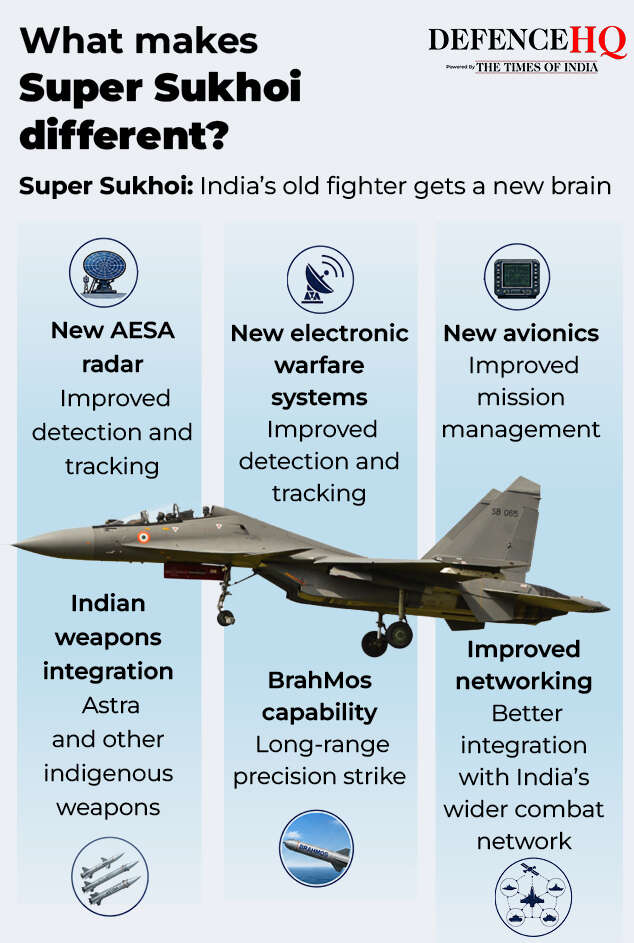
Super Sukhoi is set to upgrade the proven Su-30MKI with new sensors, avionics, weapons and networked combat capabilities.
This approach changes the strategic value of the Su-30MKI. The aircraft that entered IAF service in the late 1990s is not necessarily the same combat platform that India will operate in the 2030s and 2040s. Its airframe provides the foundation, while its sensors, weapons, communications and mission systems can evolve. The large airframe is an advantage in this respect because it offers space and power for additional equipment and weapons.The Super Sukhoi programme is therefore less about preserving an old fighter in its original form and more about extending the usefulness of a proven heavy platform through indigenous modernisation.
The BrahMos factor
One of the clearest examples of the Su-30MKI’s continuing importance is its integration with the BrahMos missile. The Su-30MKI has been modified to carry the air-launched version of BrahMos, giving the IAF a long-range supersonic strike capability.This combination is important because the Sukhoi’s size, range and payload capacity make it well suited to carrying a large stand-off weapon. It also illustrates the broader transformation of the aircraft. The Su-30MKI is a Russian-origin airframe, but its operational capability increasingly depends on a mixture of Indian, Russian and other technologies.The aircraft can carry Indian weapons such as Astra and BrahMos alongside other weapons integrated into the platform. That gives India flexibility to develop its own weapons ecosystem without immediately requiring a completely new fighter for every capability.
Sukhoi as the bridge to AMCA
Perhaps the most important reason the Su-30MKI matters is timing. India’s future combat fleet is expected to increasingly revolve around indigenous platforms. Tejas Mk-1A is already entering service, Tejas Mk-2 is intended to provide a larger indigenous fighter, and AMCA is being developed as India’s next-generation stealth fighter.But developing a fighter is a long process. Design, prototype development, testing, certification, production and induction all take time. Even after the first aircraft enters service, building enough aircraft to replace a large existing fleet requires years.
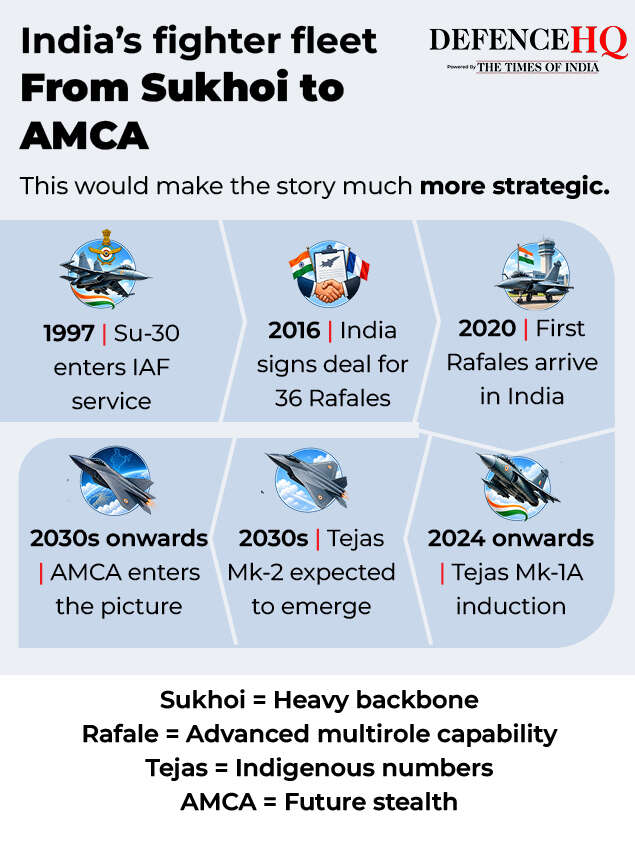
From Sukhoi to AMCA: How India’s fighter fleet is evolving from imported jets to indigenous power
The Su-30MKI therefore serves as a bridge between India’s present fighter fleet and its future one. It provides the heavy-fighter capability while Tejas expands the indigenous light-fighter segment and AMCA moves towards the next generation.This also means that India’s future fighter fleet is unlikely to be built around one aircraft. Instead, it will comprise different platforms performing different roles.Tejas can provide numbers and indigenous manufacturing depth. Rafale provides a modern multirole capability with advanced sensors and weapons. Su-30MKI provides heavy long-range capability. AMCA is intended to eventually add stealth and next-generation combat capabilities.
A changing Indian fighter ecosystem
The proposed acquisition of 114 Rafales also illustrates India’s changing approach to combat aircraft.The proposed programme places far greater emphasis on manufacturing in India than the 2016 acquisition of 36 Rafales.Under the proposal, 18 aircraft would be delivered in fly-away condition while 96 would be assembled in India. The programme is expected to involve Indian companies in manufacturing, systems integration, maintenance and other areas.The proposed technology transfer and industrial participation could strengthen India’s aerospace manufacturing base.But even with a large Rafale acquisition, the IAF would continue to require the Su-30MKI fleet.India’s Rafale inventory, Tejas fleet and Sukhoi fleet should therefore be viewed as parts of a larger transition rather than competing procurement choices.
Why the Sukhoi still matters
The Su-30MKI has been in Indian service for nearly 30 years, but its importance is not simply a result of its age or fleet size.It combines characteristics that remain valuable to the IAF: a heavy airframe, two engines, long range, high weapons capacity and the ability to carry large stand-off weapons.Its integration with Indian weapons and systems has also given India experience in modifying and sustaining a foreign-origin fighter according to its own operational requirements.The proposed Super Sukhoi modernisation could extend that relevance further by bringing new sensors, avionics, electronic warfare systems and weapons to the platform.At the same time, the Rafale provides advanced multirole capabilities and Tejas offers the foundation for India’s indigenous fighter fleet.The strategic question, therefore, is not whether India should choose between Sukhoi, Rafale and Tejas.It is how the IAF can make the three work together while the next generation of Indian fighters comes online.For an air force facing a fighter shortage and two demanding fronts, numbers alone are not enough. Nor is technology alone enough.The IAF needs a combination of both. That is why, even in the era of Tejas and Rafale, the Su-30MKI remains central to India’s air power. It is no longer simply the Russian fighter that transformed the IAF in the 1990s. With modernisation and greater integration of Indian weapons and systems, it is becoming a platform designed to carry India’s heavy-fighter capability into the next phase of its air-power transition.


