
Argentina’s mysterious floating island named ‘EL Ojo’ that appears to rotate on its own in perfect circular motion | World News

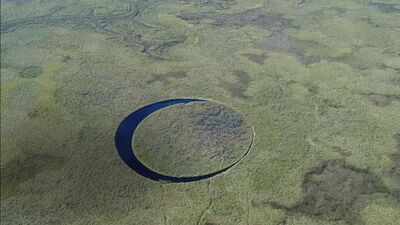
El Ojo, a remarkably circular floating island in Argentina’s Paraná Delta, has become one of the region’s strangest natural sights. Measuring about 120 metres across, the island sits inside an almost perfectly circular body of water and appears to move independently of the surrounding wetlands. From above, the formation resembles a giant eye, which explains the name ‘El Ojo,’ meaning ‘The Eye’ in Spanish. Its unusual appearance has attracted scientists, filmmakers and plenty of speculation about what could be happening beneath the water. Researchers have suggested that a circular water current may be responsible for pushing the floating island around its lake. Yet important questions about its formation, movement and structure remain, making El Ojo an intriguing example of how unusual natural processes can create landscapes that look almost too perfect to be real.
Location of Argentina’s mysterious El Ojo island
El Ojo lies in the Paraná Delta, north of Buenos Aires, in Argentina’s Buenos Aires province. According to BBC Wildlife, the floating formation is approximately 120 metres wide and sits within a circular lake surrounded by wetlands. Its location is remote, and reaching it has not been easy. ‘El Observador’ reported in 2016 that filmmaker Sergio Neuspiller and his team first noticed the unusual formation while using Google Earth to connect several mysterious locations in the Paraná Delta as part of research for a film project. Satellite imagery revealed an almost perfect circular island surrounded by an equally unusual circular stretch of water. The team later travelled to the area, first flying over El Ojo and then making their way towards it on foot. Neuspiller described the journey as difficult, with the team walking for around four hours under strong sunlight before reaching the site.
Why does the island look so perfectly circular
The island itself forms a near-perfect circle, while the water around it creates another circular outline. According to BBC Wildlife, the island is largely made up of matted grass, rushes and decomposed plant material. These layers of organic material are buoyant, allowing the island to float on the water rather than remaining fixed to the bottom. The explanation for its shape may be linked to its movement. Scientists believe that a current circulates around the lake. This current is thought to push El Ojo in a clockwise direction. As the floating island moves, it gradually erodes the vegetated edges around the lake. Over time, that repeated movement could help maintain the remarkably circular shape of both the island and the water surrounding it. This provides a natural explanation for something that initially looks almost artificial. Instead of requiring an extraordinary force, the shape may be the result of water movement acting on floating vegetation over a long period.
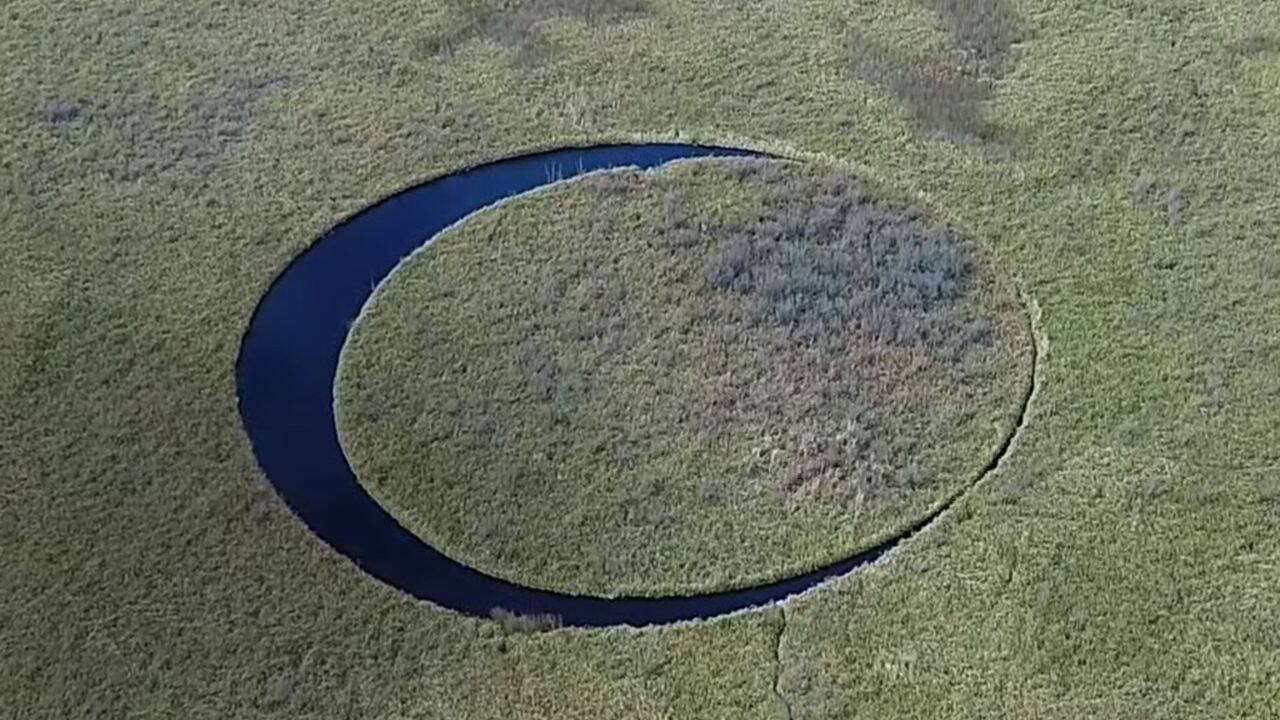
Aerial view of El Ojo floating rotating island in Buenos Aires Province, Argentina. Image Credit: Argentina Government
Does El Ojo really move and rotate
Evidence that the island moves independently has been one of the main reasons for its reputation as a mystery. El Observador reported that Gustavo Sznaider, an agricultural engineer involved in the investigation, examined satellite imagery and found that the island had changed position independently within the circular area over roughly 30 years. That movement is particularly unusual because El Ojo is not simply a fixed piece of land surrounded by water. Its floating structure allows it to respond to the movement of the water beneath and around it. BBC Wildlife explains that the current in the lake is believed to cause the island to rotate clockwise. So, although the island’s behaviour may look mysterious from above, there is a plausible natural mechanism behind it.
What did researchers find when they reached the island
The team’s visit produced observations that added further intrigue to El Ojo. According to El Observador, the water surrounding the island appeared black from above, but the explorers found that it was actually clear, with a dark soil bottom. This was striking because the waterways of the Paraná Delta are generally brown because of their clay-rich bottoms. The explorers also noted the difficulty of investigating the area. The location was described as largely unexplored, and reaching the island required a demanding journey through the wetlands. At the time, the team wanted to investigate the island much more thoroughly. El Observador reported plans involving specialists including a hydraulic engineer, agronomist, geologist and scientific researcher. One proposed investigation involved measuring how frequently the island moved and diving beneath it to examine how its composition changed vertically.
Could El Ojo still have secrets
El Observador reported that El Ojo became associated online with stories about UFOs and paranormal activity. The wider Paraná Delta already had a collection of strange local stories, including supposed UFO sightings, abandoned boats, and claims involving the remains of an ancient cemetery. Despite the proposed explanation for its movement, El Ojo has not been studied extensively. BBC Wildlife notes that limited research makes it difficult to determine exactly what wildlife lives on the island. The surrounding Paraná Delta provides habitat for animals including river otters, broad-snouted caimans, capybaras and marsh deer. The waters also contain fish and amphibians, while insects such as dragonflies and damselflies inhabit the marsh vegetation. In the middle of Argentina’s vast wetlands, a floating circle continues to move across its own lake, creating a landscape that looks almost deliberately designed.


