
Scientists found a mysterious mark inside a 236-million-year-old fossil in Argentina that may reveal ancient mammal relatives gave birth instead of laying eggs


A 236-million-year-old fossil from Argentina may have provided the earliest evidence yet that an animal on the evolutionary lineage leading to mammals gave birth to live young rather than laying eggs. The research study published in the ‘Frontiers’, analysed the bones of ‘Chiniquodon theotonicus,’ a dog-sized carnivorous cynodont that lived during the Late Triassic. Inside its fossilised limb bones, they identified a microscopic growth feature known as a neonatal line, which is associated with the rapid change in bone growth that occurs around birth or hatching. The researchers then estimated the animal’s size at birth and found that its newborn-to-adult body-mass ratio closely resembled that of modern mammals. The findings suggest viviparity may have evolved in the mammalian lineage 90 to 95 million years earlier than previously recognised.
What did scientists find in the ancient mammal fossils of Argentina
The study examined a fossil specimen of Chiniquodon theotonicus from north-western Argentina. The animal was a cynodont, an extinct group that includes the evolutionary lineage leading to mammals, rather than a true mammal itself. It lived approximately 236 million years ago during the Late Triassic. Researchers examined thin sections from its femur and ulna under a microscope and identified a distinctive change in the microscopic structure of the bone. They interpreted this feature as a ‘neonatal line,’ a growth mark associated with the transition from prenatal development to rapid growth after birth or hatching.
Why is the growth mark on the fossil bone important
Neonatal lines are significant because the transition from development inside an egg or the mother’s body to life outside it can trigger a major change in bone growth. The researchers found a microscopic boundary in the Chiniquodon bones consistent with such a transition. However, the line alone cannot establish whether the animal was born alive or hatched from an egg. Neonatal lines can occur in animals that hatch as well as those that are born alive. This is why the researchers combined the bone evidence with an analysis of the animal’s estimated size at birth.
Animal may have been unusually large at birth
Researchers estimated that the Chiniquodon individual weighed approximately ‘12 kilograms’ when it died and around ‘1.7 kilograms’ at birth. Its estimated newborn mass therefore represented about ‘14%’ of its adult body mass. The researchers compared this ratio with data from thousands of living animals, including reptiles, birds, egg-laying monotremes, marsupials and placental mammals. The result placed Chiniquodon closer to the pattern seen in modern mammals, particularly placental mammals, which generally give birth to relatively large young.
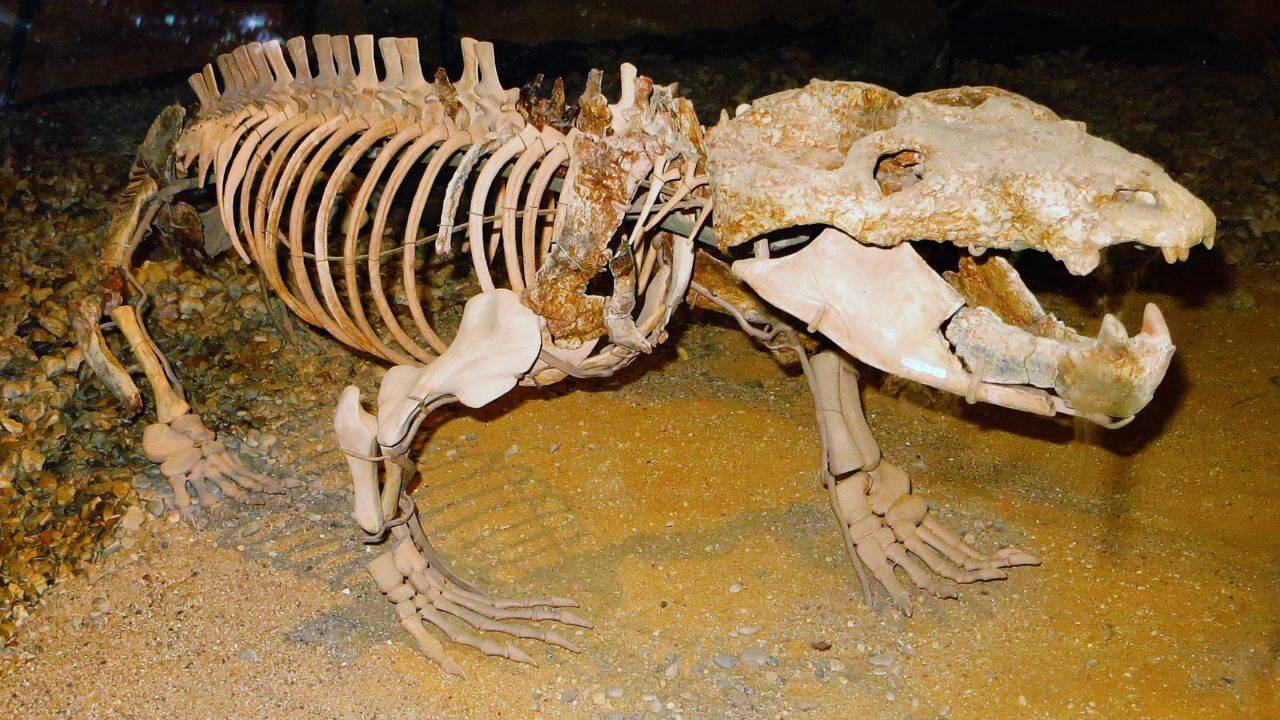
Fossil of C. theotonicus in the Museum of Paleontology, Tuebingen. Image Credit: Ghedoghedo/Wikipedia
Why the comparison with modern mammals important for the study
Different groups of living animals show striking differences in the size of their young when they emerge from eggs or are born. Monotremes such as platypuses and echidnas lay eggs, while marsupials such as kangaroos give birth to extremely small young that continue developing outside the womb. Placental mammals generally give birth to more developed offspring.The estimated newborn-to-adult ratio of Chiniquodon was statistically more consistent with placental mammals than with the reptiles, birds, monotremes or marsupials included in the researchers’ comparison. This does not mean Chiniquodon was a placental mammal. Instead, it suggests that its reproductive pattern may have resembled that of modern live-bearing mammals.
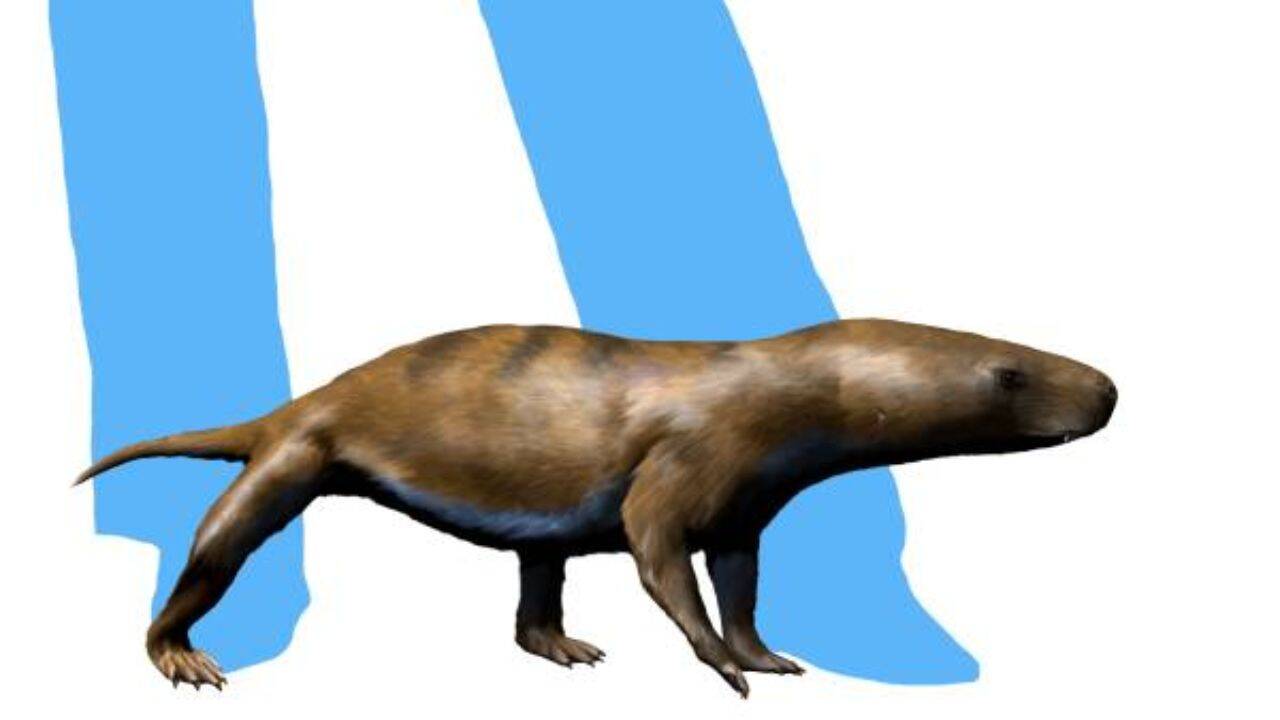
Life reconstruction of C. theotonicus. Image Credit: Nobu Tamura/Wikipedia
Does this fossil prove that the animal gave live birth
Not completely. The researchers argue that the combined evidence supports viviparity, meaning live birth, but the fossil does not preserve a pregnancy, embryo inside the mother or a newborn alongside an adult. The neonatal line could theoretically indicate either birth or hatching. The unusually large estimated newborn size is the additional evidence that makes live birth the more likely interpretation. The authors therefore treat the discovery as evidence that Chiniquodon may have been viviparous rather than as definitive proof that every early cynodont reproduced this way.
Live birth may have appeared 90 to 95 million years earlier
If the interpretation is correct, the finding would significantly change the timeline of reproductive evolution in the mammalian lineage. Previously, viviparity was generally associated with much later therian mammals, the evolutionary group that includes marsupials and placental mammals. The new study suggests that live birth may have appeared among early cynodonts around 236 million years ago, approximately ‘90 to 95 million years earlier’ than previously recognised in the mammalian lineage.
Bigger evolutionary question raised by this discovery
The researchers outline more than one possible explanation for how live birth evolved. One possibility is that egg-laying remained ancestral and viviparity evolved independently in Chiniquodon and later in therian mammals. Another is that viviparity evolved much earlier within the mammalian lineage and was inherited by later groups. If the second scenario is eventually supported, the egg-laying reproduction seen in modern monotremes could represent a secondary evolutionary return to egg-laying. At present, however, the available evidence cannot distinguish conclusively between these scenarios.
What does the tiny mark mean for mammalian evolution
The finding adds reproduction to a growing list of mammal-like characteristics that may have deep evolutionary roots. Researchers have previously investigated the origins of traits associated with mammals among early cynodonts, including aspects of their physiology and anatomy. The new evidence suggests that reproductive changes may also have occurred surprisingly early in this lineage.Importantly, the discovery does not mean that all mammal ancestors were giving birth to live young 236 million years ago. It provides evidence from one species that may indicate an early appearance of viviparity. More fossils will be needed to determine how widespread the reproductive strategy was among early cynodonts. The significance of the discovery comes from how much information researchers were able to extract from a fossil that does not preserve reproduction directly. A microscopic growth mark in the bones, combined with estimates of the animal’s birth and adult size, provided clues about how Chiniquodon may have reproduced more than 236 million years ago.If future fossil discoveries support the interpretation, the origin of live birth in the mammalian lineage could ultimately prove to be much older than previously thought. For now, the study moves the debate deep into the Late Triassic and provides a new piece of evidence for understanding one of the major transitions in mammalian evolution.


