In 1968, two Soviet tortoises circled the Moon and returned alive, completing the journey three months before Apollo 8

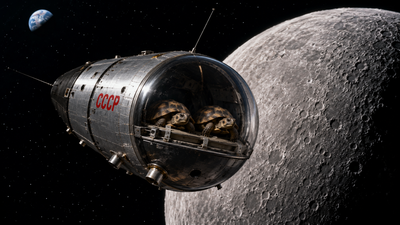
In September 1968, three months before Apollo 8 carried the first humans around the Moon, two Central Asian steppe tortoises had already made the same journey and returned home alive. According to Nasa, the tortoises launched aboard the Soviet Union’s Zond 5 spacecraft from the Baikonur Cosmodrome, travelling alongside wine flies, worms and plants as part of a biological payload designed to test whether living creatures could survive a circumlunar flight.After passing 1,950 kilometres above the lunar far side, the spacecraft turned back towards Earth, though a guidance fault sent it splashing down in the Indian Ocean rather than Soviet territory. Once recovered and flown to Moscow, the tortoises were found to have lost only a little weight and were otherwise in good health, making them the first living organisms confirmed to have circled the Moon. Their success is thought to have pushed Nasa to accelerate its own lunar ambitions with Apollo 8.
The 1968 Zond 5 mission paved the way for Apollo 8’s historic Moon flight
Long before Apollo 8 carried Frank Borman, Jim Lovell and William Anders around the Moon in December 1968, two unassuming passengers had already made the journey and returned home alive. They were Central Asian steppe tortoises, launched aboard the Soviet Union’s Zond 5 spacecraft in September 1968, three months ahead of Nasa’s historic crewed flight.The tortoises travelled alongside wine flies, worms and plants as part of a biological payload designed to test whether living organisms could survive a circumlunar trip. Their week-long journey around the far side of the Moon and back to Earth made them the first living creatures to complete such a mission, quietly settling a question that had loomed over the space race.
Image AI generated
How the Soviet Zond programme aimed to send cosmonauts around the Moon
The Soviet Union pursued two separate paths to a Moon mission during the 1960s. One programme relied on the Saturn V-class N1 rocket to land a single cosmonaut on the lunar surface, while the other, known as the L1 or Zond programme, aimed to send two cosmonauts on a circumlunar flight without attempting a landing. The Zond spacecraft was essentially a modified Soyuz capsule, with its Orbital Module stripped out and replaced by a high-gain antenna and navigation instruments suited to lunar distances.Getting the programme off the ground was not straightforward. According to Nasa, the Soviets endured several failed launch attempts before Zond 4 achieved partial success in March 1968, testing spacecraft systems as far as lunar distance without actually circling the Moon. Navigation faults meant Zond 4 also failed to complete its planned soft landing within Soviet territory. It took several months of troubleshooting before engineers felt ready to try again with Zond 5.
Soviet Zond 5 passed 1,950 kilometres above the lunar far side
Zond 5 lifted off from the Baikonur Cosmodrome in Kazakhstan on 15 September 1968. After a brief spell in low Earth parking orbit, the Proton rocket’s upper stage fired a second time to send the spacecraft on its way to the Moon. Three days later, it passed 1,950 kilometres above the lunar far side before beginning its return leg to Earth. At a distance of roughly 90,000 kilometres, the spacecraft captured photographs of Earth, images that remain some of the earliest views of the planet taken from such a distance during an uncrewed mission.The return to Earth did not go entirely to plan. A guidance system error on 21 September meant Zond 5 could not complete its intended soft landing on Soviet soil, and it splashed down in the Indian Ocean instead. American naval vessels photographed the capsule bobbing in the water before Soviet sailors aboard the Vasily Golovnin recovered it. The spacecraft was later transported to Bombay, now Mumbai, and flown back to Moscow aboard an Antonov-12 cargo aircraft.
Soviet scientists examined the tortoises after their historic circumlunar flight
Once technicians in Moscow removed the biological payload, the results were closely examined. The tortoises had lost a little weight during their journey but were otherwise found to be in good health, making them the first living organisms confirmed to have survived a circumlunar flight. The capsule itself is now on permanent display at the RKK Energiya Museum in Korolev, Russia, alongside other artefacts from the Zond programme.The mission’s success carried consequences beyond biology. Zond 5’s apparent triumph, combined with declassified American reconnaissance images showing an N1 rocket on its Baikonur launch pad, raised concern within the United States that the Soviet Union might be preparing to send cosmonauts around the Moon next. That anxiety is thought to have influenced Nasa’s decision to send Apollo 8 on its own circumlunar mission that December, a move that brought the eventual Moon landing a step closer while ensuring the Soviets would not claim the milestone of crewed lunar flight first.


