
‘Greatest threat’: How India, Pakistan view each other; data lays bare deep animosity

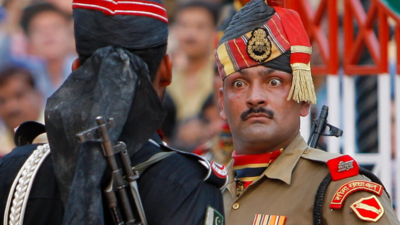
Nearly eight decades after the 1947 Partition of British India gave birth to two independent nations, deep-seated historical trauma, and territorial disputes that have led to multiple military confrontations continue to shape the mindset of citizens on both sides of the border.As the two countries celebrate their independence, a major survey by the Pew Research Center reveals that an overwhelming majority of adults in both nuclear-armed rivals view the other as their single greatest geopolitical threat.Conducted across South Asia between February and May 2026, the findings highlight a persistent, deep-rooted mutual hostility that shows little sign of thawing. These sentiments reflect not merely political disagreements, but deeply entrenched unfavourable opinions among general populations, extending into perceptions of global superpowers, regional allies, and the long-term prospects for bilateral peace.
‘Greatest threat ‘: India and Pakistan point at each other
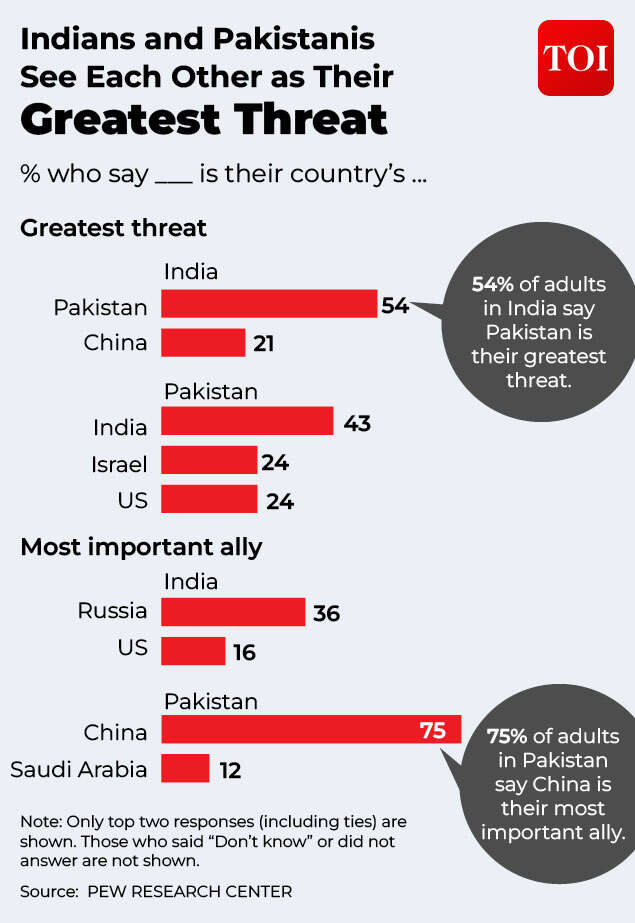
The data paints a stark picture of two neighbours frozen in mutual distrust.In India, 54% of respondents named Pakistan as the greatest threat to their country.Conversely, 43% of Pakistanis identified India as their primary security threat.
The data paints a stark picture of two neighbours frozen in mutual distrust.
For Indians, China is the next most cited threat at 21%. For Pakistanis, Israel and the US each register at 24% as major threats — though still far below India.These threat perceptions align closely with how each public judges the other’s commitment to peace.Most Indians believe their own government and people are committed to good bilateral relations, but a majority say Pakistan’s government and people are not.Pakistanis mirror this: they express confidence in their own side’s commitment but doubt India’s.
Mutual hostility runs deep
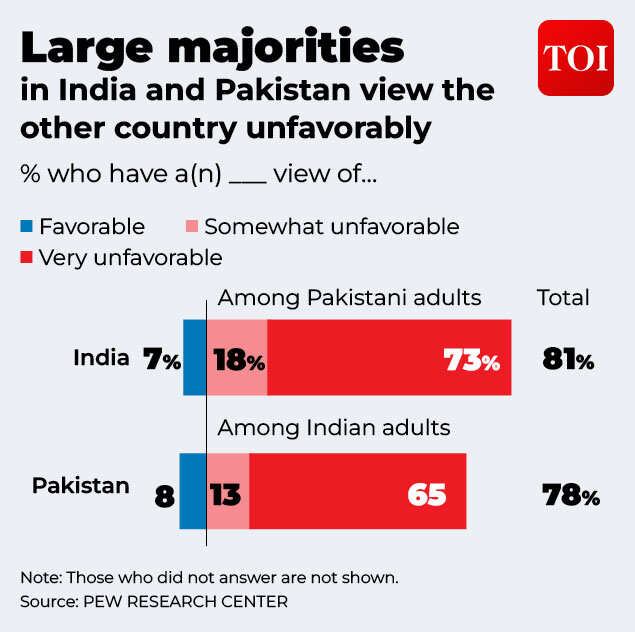
The numbers on bilateral perceptions are stark.Nearly nine in 10 Pakistanis have an unfavourable view of India, with 73% describing their opinion as ‘very unfavourable’. The sentiment cuts across demographic groups, suggesting that hostility toward India is not confined to any particular section of Pakistani society.The picture in India is similarly bleak. As many as 78% of Indians have an unfavourable view of Pakistan, including 65% who hold a very unfavourable opinion. There is, however, a notable internal divide in India. Indian Muslims are somewhat more favorable toward Pakistan (21%) than Indian Hindus (6%), and they are also less likely to name Pakistan as their top threat (34% vs 57% among Hindus).
The numbers on bilateral perceptions are stark.
Pew’s polling also shows that this is not a temporary shift in sentiment.Indian views of Pakistan have remained overwhelmingly negative for more than a decade, with the share expressing a favourable opinion never rising above 20% since 2013.Historical Pew surveys also show that Pakistanis have long held predominantly negative views of India. Pakistani respondents expressing favourable views of India have generally ranged from single digits to around one-third.
Lack of trust
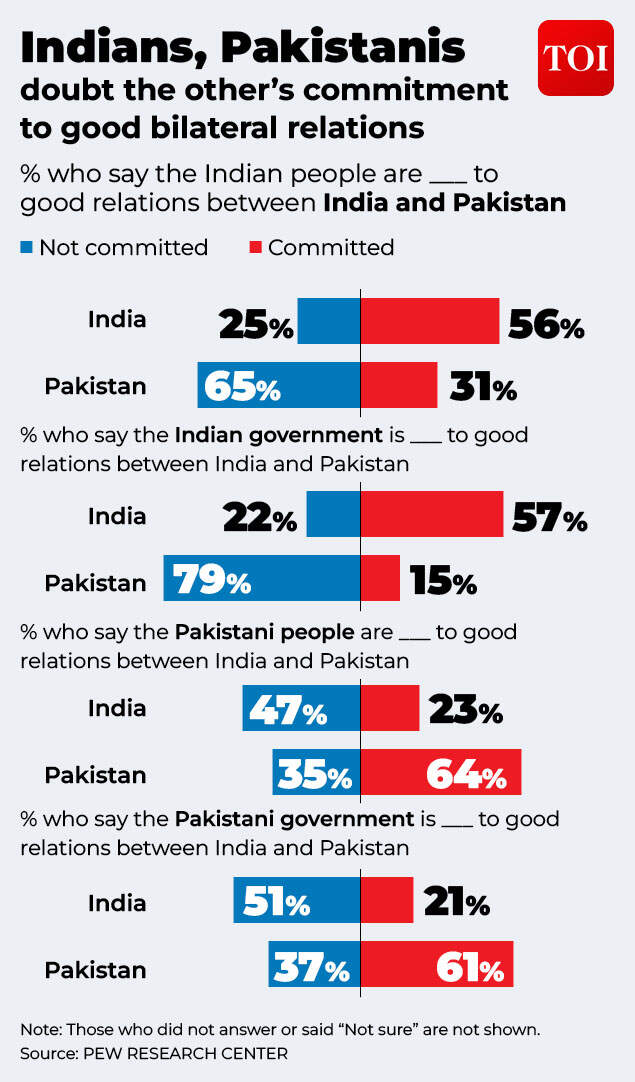
The survey further suggests that hostility is not simply about how Indians and Pakistanis perceive each other. It also extends to whether they believe the other side genuinely wants better relations.A clear pattern emerges: people tend to believe that their own government and population are committed to good bilateral relations, while doubting the intentions of the other side.
When asked whether the Indian and Pakistani governments and people are committed to good relations with each other, the clear pattern is that people only have faith in their own country
Pew Research report
A majority of Indians believe both the Indian government and Indian people are committed to maintaining good relations with Pakistan. But a majority of Pakistanis reject that assessment, saying the Indian government and people are not committed to good relations.The mirror image appears in Pakistan.
Beneath the geopolitical differences lies a more fundamental problem: the absence of trust.
A majority of Pakistanis say their government and people want good relations with India.Most Indians, however, believe Pakistan’s government and people are not committed to improving ties. About a quarter of Indian respondents were unsure.This mutual lack of trust creates a difficult cycle: each side sees itself as willing to improve relations while viewing the other as unwilling to reciprocate.Indian Muslims again stand apart to some degree. Around a third say the Pakistani government and people are committed to good relations, significantly higher than the corresponding share among Indian Hindus.
How Bangladesh, Sri Lanka view the rivals
The Pew findings become even more revealing when India and Pakistan are placed alongside Bangladesh and Sri Lanka.Of the four South Asian countries surveyed, Sri Lanka is the only country that receives more positive than negative ratings from respondents in all three of the others.
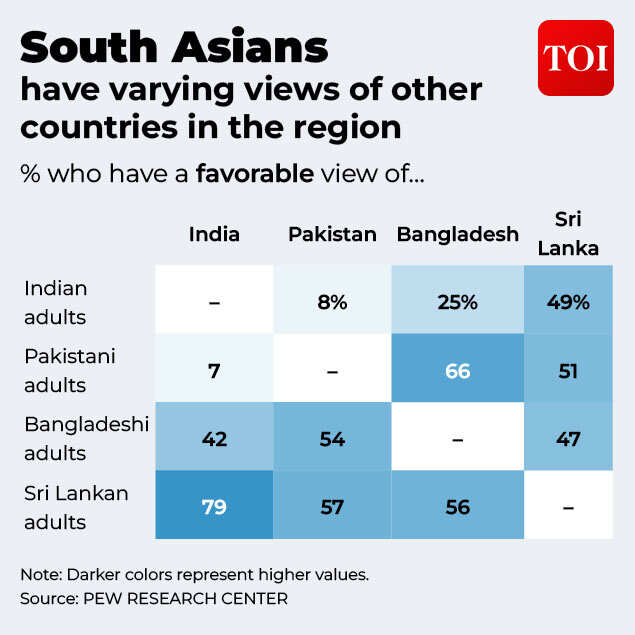
The India-Pakistan divide extends beyond bilateral relations.
India, meanwhile, has the widest range of perceptions.Sri Lankans are overwhelmingly positive toward India, with 79% expressing a favourable opinion. In Bangladesh, 42% view India favourably. In Pakistan, however, the figure plunges to just 7%.India is also seen as Sri Lanka’s most important ally by a clear majority: 63% of Sri Lankan respondents name India.The picture is very different in Bangladesh and Pakistan, where India is most often identified as the greatest threat.Views of Prime Minister Narendra Modi follow a broadly similar pattern. Seventy percent of Sri Lankans express confidence in PM Modi to do the right thing in world affairs, compared with 42% in Bangladesh and 4% in Pakistan.The survey also finds that Pakistan is not universally viewed negatively across South Asia.Fifty-seven percent of Sri Lankans and 54% of Bangladeshis have a favourable opinion of Pakistan, compared with only 8% of Indians.Bangladesh itself receives broadly positive views in Pakistan and Sri Lanka: 66% of Pakistanis and 56% of Sri Lankans express favourable opinions of Bangladesh. Only about a quarter of Indians do so.Sri Lanka emerges as the region’s relative outlier. Around half or more of respondents in India, Pakistan and Bangladesh view the island nation positively, while significantly fewer hold negative views.
Divergent worldviews
The India-Pakistan divide extends beyond bilateral relations to the way each country views the global order.For Indians, Russia remains a particularly important and popular partner. Thirty-six percent identify Russia as India’s most important ally, while 16% name the United States.Russia’s favourable image in India is particularly striking. Fifty-eight percent of Indians have a favourable opinion of Russia, while 51% express confidence in Russian President Vladimir Putin.Pakistanis are considerably less positive: 39% have a favourable view of Russia and only 32% express confidence in Putin.India’s relationship with the United States is also reflected in public opinion. Indians are substantially more favourable toward the US than Pakistanis are and are more likely to express confidence in US President Donald Trump.The picture is almost completely reversed when it comes to China.An overwhelming 90% of Pakistanis have a favourable view of China, while 83% express confidence in Chinese President Xi Jinping. Three-quarters of Pakistanis identify China as their country’s most important ally.Saudi Arabia is a distant second, named by 12%.In India, however, only around a quarter of respondents view China or Xi positively. Even Indian Muslims, who are more favourable toward China than Indian Hindus, remain negative toward both China and its president on balance.
Share your thoughts in the comments
Be respectful · TOI community guidelines
Two countries, two very different worlds
Nearly 80 years after Partition, the survey suggests that the India-Pakistan rivalry remains deeply embedded not only in government policy and military strategy, but also in public perceptions.The most striking finding may therefore not be that Indians and Pakistanis dislike each other. It is that both overwhelmingly believe the other side sees them as the problem.That mutual conviction — reinforced by decades of conflict, competing national narratives and geopolitical rivalry — remains one of the biggest barriers to changing the relationship between the two nuclear-armed neighbours.Yet beneath these geopolitical differences lies a more fundamental problem: the absence of trust.Both populations believe their own side is committed to better relations, while doubting the intentions of the other.


