
A robot traveled to Great Pyramid via hidden path and stopped in front of a door that had remained sealed for 4,500 years; here’s what happened

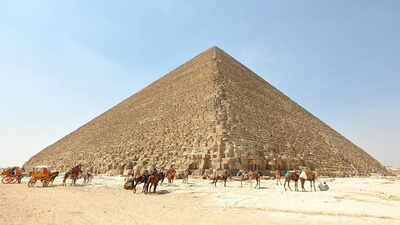
A robot traveled through a hidden passage inside Egypt’s Great Pyramid of Giza and stopped at a sealed barrier that may have remained untouched for about 4,500 years. The discovery has renewed questions about what could be hidden inside the ancient monument. According to an online report, researchers used modern robotic and scanning technology to explore a narrow passage that would be difficult and risky for people to enter. The robot reached the end of the corridor but found a solid wall or sealed doorway. Archaeologists say further study could reveal new details about the pyramid’s design and construction.
Robot explores hidden passage inside Great Pyramid
The Great Pyramid of Giza has been studied for centuries, but scientists still do not know everything about its internal structure. As part of the latest investigation, modern technology was used to examine areas that cannot be easily reached by archaeologists. The robot travelled a 100 feet long passage to a sealed section. The journey ended at a barrier that had remained closed for thousands of years.
What did the robot find
Instead of finding an open chamber, the robot reached a solid wall or sealed door. The finding has not answered the biggest question surrounding the passage. It has instead created a new one: What is behind the sealed barrier?The area has not been opened, and there has been no confirmed public announcement about what may be on the other side. Egyptologist Zahi Hawass has said that he plans to issue an official report on findings related to the passage after 2026.He has also suggested that a breakthrough of a discovery could radically change our understanding of ancient Egypt.
Modern technology used to study pyramids
Researchers have increasingly turned to technology to study the Great Pyramid without damaging its ancient stonework. Scientists have used techniques such as thermal imaging, 3D mapping and muon scanning to look inside the massive structure.


