
From trainee to Tata chairman: The remarkable rise of Ratan Tata’s pick N Chandrasekaran

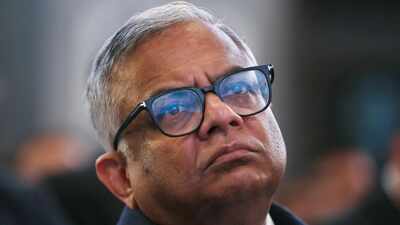
N Chandrasekaran on Wednesday stepped down as chairman of Tata Sons, ending a tenure of nearly a decade during which he transformed the salt-to-software-to-SUV conglomerate by expanding its presence into emerging sectors such as aviation, semiconductors, electronics and digital platforms.The 63-year-old informed the Tata Sons board of his decision, saying that although the Sir Dorabji Tata Trust and the Sir Ratan Tata Trust had unanimously recommended a five-year extension of his tenure, and the proposal had subsequently been endorsed by the Nomination and Remuneration Committee and the Tata Sons board, it failed to secure unanimous support after one board member opposed it in February.With the issue remaining unresolved for six months, Chandrasekaran said the prolonged uncertainty was untenable for an organisation executing several critical strategic projects. He therefore decided not to seek another term after his current tenure expires on February 20, 2027, and urged the board to identify his successor at the earliest to ensure a smooth leadership transition.Also Read | Standoff with Noel Tata: What led to N Chandrasekaran’s exit as Tata Sons chairman
Tata Group under N Chandrasekaran
Popularly known as Chandra in corporate circles, he became the first non-Parsi chairman in the Tata Group’s 150-year history and was personally chosen for the role by the late Ratan Tata.Natarajan Chandrasekaran joined TCS in 1987 as a trainee programmer after graduating from the Regional Engineering College, Trichy. Over the years, he steadily climbed the ranks within the company before eventually becoming TCS’ Chief Executive Officer.Chandrasekaran assumed leadership of Tata Sons in 2017 during one of the most turbulent periods in the group’s history, following the abrupt and acrimonious removal of Cyrus Mistry, which had triggered a leadership crisis and deep divisions within the organisation.Before taking over Tata Sons, Chandrasekaran had already established himself as one of the group’s most trusted executives. He led Tata Consultancy Services, the conglomerate’s largest company and biggest profit generator, before being elevated to the top role.Chandrasekaran joined the Tata Sons board in October 2016. Following the removal of Cyrus Mistry, he was appointed chairman in January 2017 and formally assumed office the following month.A substantial part of his first term was dominated by the group’s prolonged legal dispute with Cyrus Mistry and the Shapoorji Pallonji Group. During the litigation, the National Company Law Appellate Tribunal (NCLAT) ruled that Chandrasekaran’s appointment was invalid and ordered Mistry’s reinstatement as chairman. The decision was later overturned by the Supreme Court.Also Read |Why N Chandrasekaran is stepping down as Tata Sons chairman: Full statementThe Tata Group expanded significantly under his leadership. According to company figures, aggregate revenue increased from Rs 7.89 lakh crore in FY20 to Rs 16.24 lakh crore in FY26, according to an ET report.During the same period, profit after tax rose more than fivefold from Rs 32,000 crore to Rs 1.71 lakh crore. The combined market capitalisation of the group’s listed companies grew from Rs 9.31 lakh crore in FY20 to Rs 24.39 lakh crore in FY26, although it had reached Rs 27.85 lakh crore in FY25.Chandrasekaran’s tenure was marked by a series of major strategic moves that reshaped the Tata Group’s business portfolio. Under his leadership, the conglomerate re-entered the aviation sector through the acquisition of Air India while expanding into semiconductors, electronics manufacturing, battery technology, digital businesses and electric vehicles.These diversification efforts required substantial capital investment and also became a source of differences within Tata Trusts over the performance of the newer businesses and the level of funding they required.As part of a broader restructuring exercise to reduce losses, Chandrasekaran also oversaw the sale of the group’s loss-making telecom business, Tata Teleservices, to Bharti Airtel.In May 2018, Tata Steel completed the acquisition of the bankrupt Bhushan Steel for Rs 35,200 crore, one of the largest corporate acquisitions in India’s history.Among the defining moments of Chandrasekaran’s tenure was the Tata Group’s successful bid for Air India in October 2021, which returned to the conglomerate the airline it had originally established before it was taken over by the government.He also led the acquisition of online grocery platform BigBasket in May 2021 in a deal valued at Rs 9,500 crore. The company reported revenue of about Rs 9,900 crore in FY25, while its losses widened to around Rs 2,000 crore.At a recent board meeting, Tata Trusts Chairman Noel Tata reportedly focused his comments on the continuing challenges at BigBasket and Air India, the latter having suffered a fatal crash a year earlier and recording an estimated annual loss of $3 billion.One setback during Chandrasekaran’s tenure was the group’s inability to complete the proposed sale of Tata Steel’s European operations to ThyssenKrupp.Chandrasekaran has spent his entire professional career within the Tata Group.
Beyond Tata Group
Chandrasekaran serves on the International Advisory Council of Singapore’s Economic Development Board, the International Advisory Committee of Mitsubishi and the Board of Governors of the New York Academy of Sciences. He is also Co-Chair of the India-US CEO Forum.His contributions have been recognised through several prestigious honours. He received the Padma Bhushan, one of India’s highest civilian awards, in 2022, followed by France’s highest civilian honour, the Légion d’Honneur, in 2023. In 2025, he was appointed an Honorary Knight of the Most Excellent Order of the British Empire.He has also been awarded honorary doctorates by several leading institutions in India and overseas, including an honorary Doctor of Letters from Macquarie University in Australia, a Doctor Honoris Causa from Nyenrode University in the Netherlands and a Doctor of Letters from the Regional Engineering College, Trichy, Tamil Nadu.Chandrasekaran is the author of Bridgital Nation, a book that explores how technological disruption can help bring Indians closer to achieving their aspirations.He is widely known for his interest in photography and his passion for long-distance running. A Six Star Finisher of the World Marathon Majors, he continues to actively promote fitness.Born in 1963, Chandrasekaran holds a Bachelor’s degree in Applied Sciences and a Master’s degree in Computer Applications.


