
Scientists discovered China’s first freshwater cave snail in a dark mountain cave, but only three living adults have been found

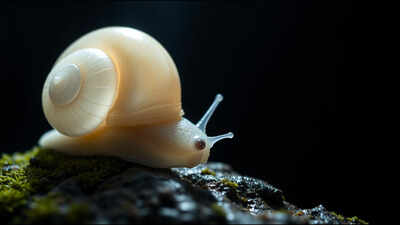
Scientists have identified China’s first known freshwater cave snail, a species so rare that only three living adults have ever been found. The tiny animal has no eyes, almost no colour in its body, and a translucent shell thin enough to reveal the delicate tissue underneath. Researchers discovered it deep inside a mountain cave in southwestern China, where sunlight never reaches, and life has adapted accordingly. The newly identified species, named Erhaia dijiang, was found in Hongta District of Yuxi City in Yunnan Province. Its discovery fills a notable gap in the study of East Asia’s underground freshwater ecosystems, which remain far less explored than habitats above ground, and raises fresh questions about how such a fragile species has managed to survive at all.
Why this newly found snail has no eyes or colour
Erhaia dijiang belongs to a group of animals called troglobionts, meaning it is built entirely for life inside caves and cannot survive elsewhere. Over countless generations in permanent darkness, the species lost its eyes and the related structures that once supported them, since vision offers no advantage where there is no light to see by. Its body also lacks the pigmentation that protects many surface-dwelling animals from sunlight, another trait common among cave-adapted species that never need such protection. In laboratory observations, the snails avoided light strongly whenever they were exposed to it, quickly crawling into narrow spaces beneath rocks to hide.
How the snail got its unusual name
The snail’s blank, faceless appearance shaped the name researchers gave it. Erhaia dijiang is named after Di Jiang, a mountain god described in the ancient Chinese text Classic of Mountains and Seas as a faceless creature, a fitting match for an animal whose head shows no trace of eyes or a defined face. The species belongs to the family Erhaiidae, and its formal description appears in a study published in the journal Subterranean Biology, titled A new eyeless species in Erhaiidae (Gastropoda, Truncatelloidea) from a cave in Yuxi City, Yunnan, China, authored by Yue-Ming He and colleagues.
Where this rare cave snail was found living
The discovery also extends the known range of these snails to unusually high elevation. The cave sits 2,062 metres above sea level, the highest recorded elevation for a cave-dwelling member of the Erhaiidae family, showing that freshwater cave snails can survive in high-altitude karst systems more than 2,000 metres up. Karst landscapes form when water slowly dissolves soluble rock underground, creating networks of caves, hidden streams and isolated pools. These systems often function like biological islands, keeping populations cut off from the outside world and from each other for long stretches of time, which allows highly specialised species to evolve within a single cave or water system and nowhere else.
What life looks like inside the cave habitat
Erhaia dijiang lives among gravel and broken stone in shallow cave water less than one metre deep, where the temperature stays close to 20 degrees Celsius despite the cave’s high elevation. The snails feed by grazing on diatoms growing across submerged rocks, and researchers found they will also eat fish food under laboratory conditions. Heavy rain occasionally pushes fast-moving water through the cave, sweeping a few snails toward the entrance, yet researchers found no individuals in the surface streams nearby. The animals consistently stayed within the cave and within two metres of its entrance, suggesting that even brief exposure to conditions outside the cave may be unsuitable for their survival.
Why researchers are worried about its survival
During a survey conducted in August 2025, scientists found only three living adult snails and a single empty shell, with no juveniles observed at all, raising concern about whether the population is reproducing successfully. Researchers described the species’ survival outlook as far from optimistic, given how few individuals have been documented and how narrowly the population is confined to one small underground habitat. That extreme specialisation leaves the species with almost no protection against pollution, changes in water flow, disturbance to the cave, or other localised threats that would pose little risk to a more widespread animal. Because the entire known population exists within a single cave system, any damage to that one site could be enough to wipe out the species completely, and researchers are now calling for wider surveys across China’s other caves to determine whether Erhaia dijiang survives elsewhere or whether similarly overlooked species remain undiscovered.


