
Nasa says SpaceX Falcon 9 upper stage hit the Moon exactly as predicted, revealing new clues about lunar impacts

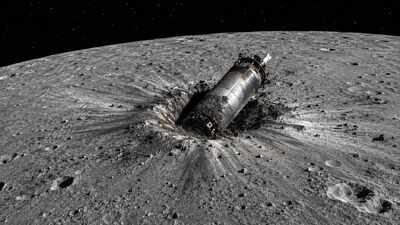
The Moon has absorbed billions of impacts over roughly four billion years, most from meteoroids whose origin, mass and impact velocity remain permanently unknown. The object expected to strike near the Einstein and Bell craters on Wednesday, 5 August, breaks that pattern entirely. According to Nasa, a spent Falcon 9 upper stage from a January 2025 SpaceX launch is on a confirmed collision course with the lunar surface, and unlike almost every crater before it, this one arrives with a complete paper trail: a known manufacturer, a known launch date, a known payload, and a known point of origin. Scientists intend to use the rare traceability to refine how they study impact events elsewhere on the Moon.
Why the SpaceX Falcon 9 upper stage returned to strike the lunar surface
The stage in question began its journey on 15 January 2025, when a Falcon 9 rocket lifted off carrying Firefly Aerospace’s Blue Ghost 1 lunar lander. The mission was flown under the agency’s Commercial Lunar Payload Services initiative and successfully delivered Blue Ghost to the Moon. The upper stage’s job ended once deployment was complete, leaving it in a trajectory that was not initially intended to result in a lunar impact.Solar activity and gravitational forces gradually altered that trajectory over the following year and a half. These forces caused the stage’s unplanned return towards the Moon, a shift that was first identified not by government tracking systems but by independent astronomers working from publicly available orbital data. Nasa’s Centre for Near Earth Object Studies, based at the Jet Propulsion Laboratory, later confirmed the object’s path and determined it had effectively no chance of missing the Moon.
What happened when the SpaceX Falcon 9 rocket stage hit the Moon
Because the Moon lacks an atmosphere, nothing slows an incoming object before contact, and the surface is struck by natural meteoroids on a near-daily basis. The Falcon 9 stage was due to strike on Wednesday, 5 August, carving out a crater roughly 60 feet wide and 12 feet deep and scattering ejecta outward across the surrounding terrain. The agency notes that a meteoroid carrying comparable energy strikes the Moon on average every six days, placing this artificial impact well within the range of forces the lunar surface already absorbs routinely.The comparison matters because it frames the event as geologically unremarkable in scale, even though its origin is anything but. Researchers are less interested in the size of the resulting crater than in what it can reveal about how ejecta plumes form and disperse, insight that feeds into broader models of lunar geology used to plan future missions.
Nasa, Danuri and ground telescopes tracked the Falcon 9 Moon impact
The impact itself was not visible to the naked eye from Earth, but Nasa attempted to observe it in real time regardless. The agency’s Meteoroid Environments Office at Marshall Space Flight Centre used ground-based telescopes in an effort to image the collision, while Nasa’s Lunar Reconnaissance Orbiter and the ShadowCam instrument aboard South Korea’s Korea Pathfinder Lunar Orbiter looked for opportunities to photograph the site both before and after impact.The stage struck as predicted, at 6:35 UTC on 5 August. According to EarthSky, South Korea’s Danuri orbiter carried out eight separate imaging passes around the impact, one roughly thirty minutes before and seven afterwards, and the resulting before-and-after comparison shows a faint but visible dark streak at the site. Separately, the European Southern Observatory’s Very Large Telescope detected sodium and lithium in the debris plume for five to ten minutes after impact, with the sodium likely thrown up from the lunar soil and the lithium probably originating from the rocket stage itself.Early estimates put the resulting crater at around 20 to 30 metres wide, broadly in line with pre-impact forecasts, though full measurements from orbital imagery are still being finalised. Nasa and independent trackers, including astronomer Bill Gray, had projected the stage would strike at roughly 5,400 miles per hour, and confirmed observations since 5 August are consistent with that estimate.
Why Nasa intentionally directs spent rocket stages to crash into the Moon
Despite the unusual level of detail available for this particular impact, Nasa frames the disposal method itself as standard practice rather than an anomaly. Directing spent upper stages into the lunar surface is a technically accepted and safe disposal approach, and in some cases the only practical option for missions operating in low lunar orbit.Operators favour controlled impacts precisely because they produce predictable, trackable end-of-life outcomes rather than debris left drifting indefinitely. Nasa has positioned the event as consistent with its broader commitment to debris mitigation, describing the goal as balancing safe disposal practices with the scientific value gained from studying how man-made objects interact with planetary surfaces.


