
Fish may know who you are: Wild seabream fish learned to identify the diver associated with food, study finds

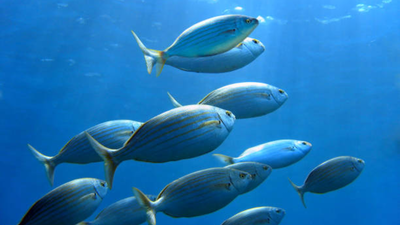
Fish may know us better than we think.A study by researchers from the Max Planck Institute of Animal Behavior in Germany has found that wild fish can recognise individual humans and learn which person is likely to bring them food. The research, published in Biology Letters in February 2025, is one of the first experiments to show this ability in fish living in the wild.Researchers working at a Mediterranean field station noticed that local fish would regularly follow divers underwater and steal food that was meant to be used as experimental rewards. What caught their attention was that the fish didn’t seem to follow everyone. They appeared to remember the particular diver who had previously carried food.So the researchers decided to test whether the fish really could tell people apart.The team trained wild seabream to follow a particular diver, Katinka Soller, during underwater swims. At first, Soller wore a bright red vest and fed the fish. Gradually, the obvious cues were removed. Eventually, she was swimming in ordinary diving equipment with the food kept out of sight until the end of the route.And the fish learned.After 12 days of training, around 20 fish were regularly following Soller during the swims. Some of the same fish appeared repeatedly, and Soller was even able to identify individual animals by distinctive features, giving a few of them names.The researchers then introduced a second diver, Maëlan Tomasek. The two divers started from the same place but swam in different directions. Their diving equipment had some visible differences, particularly in colour.At first, the fish followed both divers. But after learning that only Soller was associated with food, they increasingly chose to follow her. When the researchers looked more closely at six individual fish, four showed clear evidence of learning to choose the diver who provided the reward.The really interesting part came next.Soller and Tomasek repeated the experiment while wearing identical diving gear. This time, the fish could no longer reliably tell them apart.That suggests the fish weren’t necessarily recognising a person’s face in the way another human might. Instead, they were using visible features, most likely colours and patterns on the divers’ wetsuits and fins, to distinguish one person from another. Almost all fish have colour vision, so the researchers say this kind of visual learning isn’t as surprising as it might sound.Still, there’s something striking about watching a fish approach a diver because it remembers that particular person.The scientists also noticed that some of the fish would come close to the divers’ faces and appear to examine their bodies. Whether the fish could eventually learn to recognise subtler features, such as a person’s face, hair or hands, isn’t known. The study wasn’t designed to answer that question.What it does show is that wild fish are capable of learning about individual humans and changing their behaviour based on previous encounters. That’s significant because much of the earlier evidence for fish recognising people came from controlled laboratory experiments. Archerfish, for example, have previously been shown to distinguish between human faces displayed on screens.This new research puts that ability in a much more natural setting.It also adds to a growing body of research challenging the old idea that fish are simple animals with limited memory or intelligence. Fish navigate complicated environments, interact with other animals and learn from what happens around them. Recognising a particular human who provides food is another example of that learning ability.And perhaps the most interesting question is what else we’ve been missing.The researchers aren’t saying that fish recognise humans in exactly the same way we recognise one another. But the findings suggest that the underwater world may contain far more individual relationships and memories than we tend to notice.For years, the scientists saw fish following particular divers. Now they have evidence that the fish really were paying attention to who was who.


