
Saudi Arabia, Pakistan & Turkey sign ‘Mecca’ pact for mutual defence; India reacts

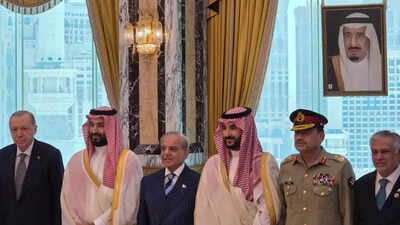
Saudi Arabia, Pakistan and Turkey Friday signed a trilateral defence agreement aimed at strengthening their collective security as the conflict involving Iran continues to fuel instability across the West Asia.The agreement was signed following a joint defence summit attended by Saudi crown prince Mohammed bin Salman, Turkish president Recep Tayyip Erdogan and Pakistani prime minister Shehbaz Sharif, who attended after performing the Umrah pilgrimage in the city.According to Pakistan’s foreign ministry, the pact is “guided by the longstanding historical ties among the three states, based on the enduring bonds of brotherhood and Islamic solidarity that unite them, and building upon their shared strategic interests and longstanding defence cooperation”.The agreement is intended to strengthen collective deterrence against any act of aggression and stipulates that an armed attack against any of the three would be regarded as an attack on all, they said in a joint statement.The Pakistani ministry said the agreement reflects “the three states’ shared commitment to further strengthening their collective security and to promoting peace, security, and stability in the region and beyond, in pursuit of a secure and prosperous future.”Also read: Evening news wrap: CBI chargesheet alleges NTA’s own experts leaked NEET-UG, MEA rejects US criticism of of FCRA Bill & moreIt added that “The agreement is intended to strengthen collective deterrence against any act of aggression, and stipulates that any armed attack against any one of the three states shall be regarded as an attack against them all.”Meanwhile, India reacted to the development, saying “developments were closely watched”.Responding to reports on the agreement, MEA spokesperson Randhir Jaiswal said: “The pact between the three countries is, again, a development that we are closely following, and we will keep you updated on that.”
Deal amid turbulent West Asia
The deal comes as Saudi Arabia and other Gulf countries continue to face missile attacks and disruptions to energy shipments amid the ongoing conflict involving Iran and its regional allies. The war escalated after the United States and Israel launched attacks on Iran on February 28, triggering a wider regional crisis.A Turkish official said the agreement was purely defensive, was not aimed at any particular country and remained open to participation by other regional nations. The official also said it would not replace any existing bilateral or multilateral security arrangements.Analysts said the summit carried significant geopolitical weight at a time of growing uncertainty in the region.“The political symbolism of the summit is significant. Three of the Muslim world’s most influential states are convening at a moment of heightened uncertainty, demonstrating a growing willingness among regional and middle powers to coordinate more closely on security matters,” Abdulaziz Sager, chairman of the Saudi-based Gulf Research Center, told new agency Reuters.“If institutionalised and translated into concrete cooperation, the trilateral framework could strengthen the three countries’ collective diplomatic and defense weight while contributing to the emergence of a more regionally driven security architecture,” Sager added.
3 distinct strategic strengths
Saudi Arabia, Turkey and Pakistan each bring distinct strategic strengths to the partnership. Turkey has Nato’s second-largest military, Saudi Arabia is one of the world’s biggest oil exporters and custodian of Islam’s holiest sites, while Pakistan is the only Muslim-majority country with nuclear weapons.The agreement follows months of discussions on expanding regional security cooperation. Earlier this year, Turkish foreign minister Hakan Fidan had said Ankara supported a broader regional security platform to promote stability.Experts believe the pact builds on long-standing military ties among the three countries. Pakistan has trained Saudi security forces for decades, while Turkey and Pakistan have cooperated on defence equipment and military training. Saudi Arabia also signed a major deal in 2023 to purchase Turkish drones.Mansoor Ahmed of the Australian National University’s Strategic and Defence Studies Centre said Pakistan and Turkey could contribute advanced defence manufacturing capabilities, while Saudi Arabia could provide financial and technological investment.He added, however, that the new agreement was unlikely to include a nuclear component because Pakistan’s nuclear deterrent remains focused on India.Pakistan has also expanded its military presence in Saudi Arabia in recent months by deploying thousands of troops, fighter aircraft, drones and air defence systems. It has simultaneously pursued broader security partnerships with Gulf countries, including talks with Kuwait on an expanded defence arrangement linked to energy cooperation and investment.


