
Detroit was built for 2 million people, but its shrinking population turned abandoned lots into one of America’s largest urban farming movements | World News

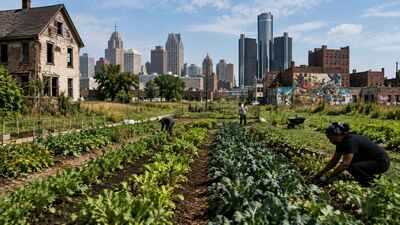
Detroit was once built for two million residents, but the population today stands at under a million. That shift left behind a vast amount of unused space, and rather than let it sit idle, residents began reclaiming it. What started with small community gardens on scattered plots has grown into one of the strongest urban agriculture movements in the United States. Today, the city counts more than 2,200 gardens and farms, run largely by local residents who turned neglected land into a source of food, income and community pride. This transformation reflects decades of grassroots effort, changing city policy and a determination to make the most of the land Detroit has in abundance.
How Detroit’s urban agriculture movement evolved from potato patches to 2,200 community gardens
Detroit’s relationship with urban farming is not new. According to Planet Detroit, the city’s urban agriculture movement dates back to the 1890s, when Mayor Hazen Pingree introduced a potato patch scheme, and it continued through the victory gardens of the Second World War and Mayor Coleman Young’s Farm-A-Lot programme in the 1970s. Over the past two decades, this history has taken on new significance as the city dealt with municipal bankruptcy and a shrinking population, with residents turning to the land as a practical response to abandonment.The modern surge in urban farming can be traced to a handful of key organisations. The Garden Resource Program launched in 2003 and Grown in Detroit followed in 2006, laying the groundwork for further expansion. The founding of D-Town Farms and the Detroit Black Food Security Network in 2008, along with Keep Growing Detroit in 2013, strengthened the role of urban agriculture in supporting food security for the city’s largely African American population. What began as isolated community gardens has since grown into a network of around 2,200 gardens and farms involving close to 20,000 residents.
Detroit’s urban agriculture leadership is transforming land use and food systems
For much of this growth, Detroit lacked the government infrastructure that other cities had developed to support urban farming. Cities including Atlanta, Philadelphia, Boston and Washington DC had already introduced plans, ordinances and dedicated offices, while Detroit’s farmers largely worked without that kind of institutional backing. This changed in September 2023, when the city appointed Tepfirah Rushdan as its first director of urban agriculture, a role created to help formalise the movement and support residents navigating city processes. Rushdan came to the position from Keep Growing Detroit, where she had worked as co-director, and had also served with the Detroit Food Policy Council and The Greening of Detroit. Her priorities have centred on five areas: land access, food systems, water access, community engagement and coordination across city departments. Rushdan has been developing land use policy for green spaces and composting, while also working to align efforts across departments so that urban farmers face fewer bureaucratic obstacles when starting or expanding projects.One of her key initiatives involves reworking the city’s approach to mixed-use land. Rushdan is establishing a new Office of Urban Agriculture and Community Spaces, since not all land use in the city is strictly agricultural, with some residents transforming lots into community spaces with flowers and seating rather than food production. She has also been working on composting standards and exploring the permitted use of fire hydrants to give community gardens more reliable access to water, following examples set by cities such as Lansing and Flint.
How Greenprint Detroit is helping residents turn vacant land into thriving community spaces
Beyond city government, universities and community organisations have played a significant role in helping residents turn vacant land into productive space. According to the University of Michigan’s Steward, an estimated 19 square miles of vacant land remain scattered across Detroit, and the question of who acquires this land and how it gets used holds real potential to reshape communities. Lisa DuRussel, an assistant professor at the University of Michigan’s School for Environment and Sustainability, has worked with residents since 2020 to help them navigate this process.One of DuRussel’s projects, Greenprint Detroit, focused on helping residents work through the Detroit Land Bank Authority’s acquisition process, which requires buyers to submit a land use plan within six months of purchase. Many existing plans were too costly for most residents to implement, so DuRussel’s team created a toolkit offering realistic, lower-cost designs that account for climate adaptation, such as planting meadows or rain gardens to improve stormwater management. Community members such as Tanya Stephens, founder of Detroit Vacant Land CDC, have used this kind of support to convert vacant parcels into gardens, art spaces and, in one case, a planned creative residency near the Heidelberg Project.Independent research has also supported the case for expanding urban agriculture at scale. According to Michigan State University’s AgBioResearch, researcher Mike Hamm and graduate student Kathryn Colasanti found around nine square miles of publicly owned vacant land within Detroit, and calculated that just 2,000 acres of that space could produce up to 75 percent of the vegetables and roughly half the fruit needed to feed 900,000 people. Hamm noted that reaching this scale would require a substantial increase in farmers, alongside careful attention to soil quality and contamination on land that was previously used for other purposes.
Challenges facing Detroit’s urban farming movement: Land access, water and future growth
Access to land and water remains one of the biggest ongoing challenges for Detroit’s urban farmers. Purchasing land through the Detroit Land Bank Authority still involves multiple departments, including the assessor’s office, the Buildings, Safety Engineering and Environmental Department, and the Planning Commission, which can make the process time-consuming for individual gardeners. Rushdan has said that simplifying this process is central to her role, with the goal of reducing the number of separate steps residents must take to secure and use land legally.Water access presents a similar set of obstacles, since installing a dedicated spigot for a community garden can cost upwards of ten thousand dollars. The city is working with the Detroit Water Consortium to explore permitted use of fire hydrants as a more affordable alternative, an approach already used in nearby cities. Alongside this, a proposed ordinance allowing residents to keep a limited number of chickens or ducks is currently before the city council, reflecting years of demand from gardeners who have sought clearer rules around small-scale animal keeping. City officials and community organisers share a similar vision for Detroit’s urban farming future. Rushdan hopes that within five years, gardens across the city will be fully compliant with regulations, well understood by residents and able to support growers entering different markets.


