
Analysis of ADR report Politics often comes wrapped in familiar assumptions. With the BJP, the ruling party at the Centre, now also in power in a majority of states, either alone or in alliance, one might expect a degree of sameness in the profiles of India’s chief ministers. Yet the Association for Democratic Reforms reports show a more varied picture. The country’s CMs come from different social strata, age groups, educational backgrounds and economic profiles, even within their own parties. There is no single formula for political ascent.That is what makes the comparison between ADR’s 2025 and 2026 reports more revealing than either report viewed alone. The 2025 study examined 30 chief ministers, since Manipur was then under President’s Rule. The 2026 report covers 31, after the return of a chief minister in the state. More importantly, the occupants of the chief minister’s office changed in Karnataka, Tamil Nadu, Kerala, Bihar and West Bengal.South pulls the wealth mapThe combined assets declared by India’s chief ministers rose from Rs 1,632 crore in the 2025 report to Rs 3,660 crore in 2026. Average assets more than doubled from Rs 54.42 crore to Rs 118.07 crore. The number of billionaire chief ministers rose from two to four.In 2025, N Chandrababu Naidu, with assets of Rs 931.84 crore, and Pema Khandu, with Rs 332.57 crore, were the only billionaire chief ministers. Siddaramaiah was a distant third with Rs 51.94 crore. A year later, Karnataka CM D K Shivakumar is the clear number one with Rs 1,413.8 crore, while cine star and Tamil Nadu CM C Joseph Vijay declared assets of Rs 648.86 crore. Together, these four account for approximately Rs 3,327 crore, or 90.9% of the assets declared by all 31 chief ministers. The remaining 27 account for only around Rs 333 crore between them.Analysing the assets held by CMsA geographical cut makes the imbalance sharper. Using a broad four-zone grouping, not an ADR classification, the South has only six of the 31 CMs but accounts for roughly Rs 3,059 crore, or about 83.6% of all declared CM assets in 2026. That is because three of the four billionaire CMs, Shivakumar, Naidu and Vijay, are from southern states. So the South, in a way, lives up to the larger-than-life CM personalities. Naidu is a veteran politician who has survived many ebbs to rise again and regain his lost glory. D K Shivakumar finally got rewarded after a power tussle with Siddaramaiah, and Vijay was the new kid on the block who broke through the DMK-AIADMK binary, while also ticking the box of another cine star to become CM of Tamil Nadu. So the profiles of these billionaire CMs could not be more different.East and the Northeast together have the largest number of CMs in this grouping, 12, but account for about Rs 495 crore, helped substantially by Khandu’s declaration. North and Central India together have 10 CMs but only around Rs 75 crore in declared assets, while the West has three CMs and around Rs 31 crore.Same party, different worldsThe party-wise picture is just as uneven. The BJP has 17 chief ministers in the 2026 list, but they are far from a single economic bloc. Its richest CM is Pema Khandu, with Rs 332.57 crore in declared assets. Its poorest is West Bengal CM Suvendu Adhikari, with about Rs 85.88 lakh. That is a nearly 387-fold gap within the same party.The Congress spread is smaller in headcount but sharper in scale. Of its four CMs, Shivakumar alone accounts for Rs 1,413.8 crore. At the other end is Kerala CM V D Satheesan, with Rs 6.66 crore. Revanth Reddy, at Rs 30.05 crore, and Himachal Pradesh CM Sukhvinder Singh, at Rs 7.82 crore, sit far below Shivakumar’s level. In effect, Congress’s CM asset profile is overwhelmingly shaped by one leader.This is why the average can mislead. A calculation based on individual entries puts the 2026 median at only around Rs 8.23 crore, barely higher than the 2025 median of about Rs 8.02 crore.Total declared liabilities rose from roughly Rs 242 crore in 2025 to nearly Rs 505 crore in 2026, though the number of CMs declaring liabilities of Rs 1 crore or more remained unchanged at 11. Khandu led the 2025 liability table with Rs 180.28 crore. In 2026, Shivakumar moved to the top with Rs 265.07 crore, followed by Khandu and Himanta Biswa Sarma.Younger leaders, uneven party trendThe leadership profile also became younger. In 2025, 12 of the 30 chief ministers were in the 51-60 group. By 2026, that number had risen to 17. The number aged 61 or above fell from 10 to six. The 41-50 category remained unchanged at eight.India now has younger CMsThe average reported age declined from 58.8 to 56.7, though the median remained 56. The shift reflects the exit of several older CMs, including Siddaramaiah, Pinarayi Vijayan, Nitish Kumar, M K Stalin and Mamata Banerjee. The ages are those recorded when election affidavits were filed, not necessarily current ages. So the actual decline is much sharper because the 2025 calculation accounted for many outgoing CMs’ 2021 affidavits.Here again, parties differ internally. Congress’s four CMs are tightly bunched. Revanth Reddy is 56, Sukhvinder Singh 58, Shivakumar 60 and Satheesan 61. The BJP’s spread is wider. It has Pema Khandu at 44 and Manik Saha at 70, with several CMs clustered in their 50s. In other words, the Congress CM cohort is smaller and more middle-aged, while the BJP’s larger pool stretches from younger leadership to older veterans.There was a reversal on gender. The 2025 report listed two women among 30 chief ministers. The 2026 report lists only one among 31. Mamata Banerjee’s exit from the CM roster left Delhi’s Rekha Gupta as the sole woman in the group.Degrees stay broadly stableMany of the politicians are products of student politics. They may not have worked professionally, but they still believed in the inherent importance of formal education. In 2025, 25 of the 30 CMs were graduates, professional graduates, postgraduates or doctorate holders. In 2026, the number remained 25, despite the larger group. The proportion with graduate-level qualification or higher slipped slightly, from about 83% to 81%.Within parties, the BJP shows the widest educational spread. Its CM list includes doctorate holders such as Mohan Yadav, Himanta Biswa Sarma and Samrat Choudhary, but also leaders listed as Class 10 pass, diploma holders, graduates, professional graduates and postgraduates. Congress’s four CMs are more compact educationally: Shivakumar and Sukhvinder Singh are postgraduates, Revanth Reddy is a graduate and Satheesan is a graduate professional.Cases rise, but cluster in five namesThe criminal-record figures worsened modestly. In 2025, 12 of 30 chief ministers, or 40%, had declared criminal cases; 10 had cases classified by ADR as serious. By 2026, 14 of 31, or 45%, had declared criminal cases; 11 had serious cases.The combined number of declared cases rose from 187 to 195. The burden remained concentrated. Revanth Reddy continued to head the list with 89 cases, followed by Suvendu Adhikari with 29, Shivakumar and Naidu with 19 each, and Kerala’s V D Satheesan with 18. Five chief ministers accounted for 174 of the 195 cases, or 89.2%.Criminal cases against CMsThree of Congress’s four CMs are among the top five by declared cases: Revanth Reddy, Shivakumar and Satheesan. Among BJP CMs, Adhikari carries the highest declared case load, while several BJP chief ministers have no declared criminal cases. Join conversationView All Comments →Share your thoughts in the commentsInsightfulAgreeDisagreeSkepticalConcerningPromisingWorth ReadingBig DevelopmentPost CommentBe respectful · TOI community guidelinesGeography shows a similar concentration, though for different reasons. The six southern CMs together account for 147 declared cases, driven mainly by Revanth Reddy, Shivakumar, Naidu and Satheesan. East and the Northeast account for 38 cases, led by Adhikari. North and Central India account for six, while the West accounts for four.It is perhaps not a coincidence that many of the CMs with high case loads were opposition leaders for a significant time. Thus, criminal cases need to be treated with caution. A low case count may not strictly be a virtue; it may just be a case of friendly police administration. Disclosures aren’t the only way to understand the nature of a politician. But they are an important starting point, particularly when compared over the years, to understand how the seat of power remains the same, but the nature of those who occupy it changes, perhaps as an inevitable reflection of the realities of the times.Get the latest India News and Live updates. Download the TOI app.About the AuthorArghya Prasun RoychowdhuryInterested in politics, policy, data and cricket.End of ArticleFollow Us On Social MediaVideos’30-Year Stronghold Fell In 30 Days’: Prashant Kishor’s 1st Remarks As He Eyes Historic Bankipur Win‘I Was A Moderate Hindu’: Kangana Ranaut Says ‘People Become Leftist After Meeting Islamists’’Will Lay Down Protocol’: Pellet Guns Under Supreme Court Lens After Jantar Mantar ProtestsCandidates Protest, Walk Out Of Exam Centre Over OMR Mismatch Confusion; Exam Board ClarifiesOnly One Woman Finds Place In DK Shivakumar’s Karnataka Cabinet Even After Major ExpansionDelhi Court Acquits Brij Bhushan In Wrestlers’ Sexual Harassment Case After Two-Year TrialWhy Two Crucial ISRO Satellites Are Still Waiting For Government Clearance To Launch?JPSC Protest Escalates: Devendra Mahato Begins Hunger Strike, Demands Exam Cancellation & CBI ProbeThree Bypolls: From Prashant Kishor’s Make-or-Break to BJP’S Bastion, What’s At Stake?Delhi Police To Not Register Case Against Minor Who Abused PM Modi, Say Sources123PhotostoriesWhy eating dinner after 7 pm may be silently damaging your health: Doctor explains what happens inside your body at nightOTT releases this week (August 3 to August 9): ‘Main Vaapas Aaunga’, ‘Sterling Point’, ‘Operation Safed Sagar’, ‘The Super Mario Galaxy Movie’ and moreWant a happy married life after becoming parents? These 7 simple rules can bring you and your partner closer than ever8 Montessori principles every parent should follow to raise confident and independent childrenMost people skip leg day, but doctors say it could be one of the smartest things you do for your heart, bones, blood sugar, and longevityAncient India’s forgotten fashion: What women wore in the era of Lord Rama8 foods served on Japan’s famous bullet trainsWomen who stay calm even when life falls apart often use these 7 simple phrases, according to psychologyWhy is there always a chair in hotel rooms? The hidden reason most guests never noticeOptical illusion brain teaser: Only the top 1% of people can spot the second ‘Hidden tiger’123Hot PicksBypoll resultsPM ModiBankipur bypoll resultCET CAP Round 1 allotmentRBI FD rulePrashant KishorKarnataka cabinet expansionAssam floodsKanwar Yatra 2026Top TrendingNew Karnataka Cabinet ListJoe BradyBrittany MahomesGhaziabad Psychiatrist SuicideJeM Operative GirlfriendRuchika SharmaHamim Mondal ArrestWomen Wrestlers Sexual Harassment CaseBypoll Election Result 2026Shradha Singh


Politics often comes wrapped in familiar assumptions. With the BJP, the ruling party at the Centre, now also in power in a majority of states, either alone or in alliance, one might expect a degree of sameness in the profiles of India’s chief ministers. Yet the Association for Democratic Reforms reports show a more varied picture. The country’s CMs come from different social strata, age groups, educational backgrounds and economic profiles, even within their own parties. There is no single formula for political ascent.That is what makes the comparison between ADR’s 2025 and 2026 reports more revealing than either report viewed alone. The 2025 study examined 30 chief ministers, since Manipur was then under President’s Rule. The 2026 report covers 31, after the return of a chief minister in the state. More importantly, the occupants of the chief minister’s office changed in Karnataka, Tamil Nadu, Kerala, Bihar and West Bengal.
South pulls the wealth map
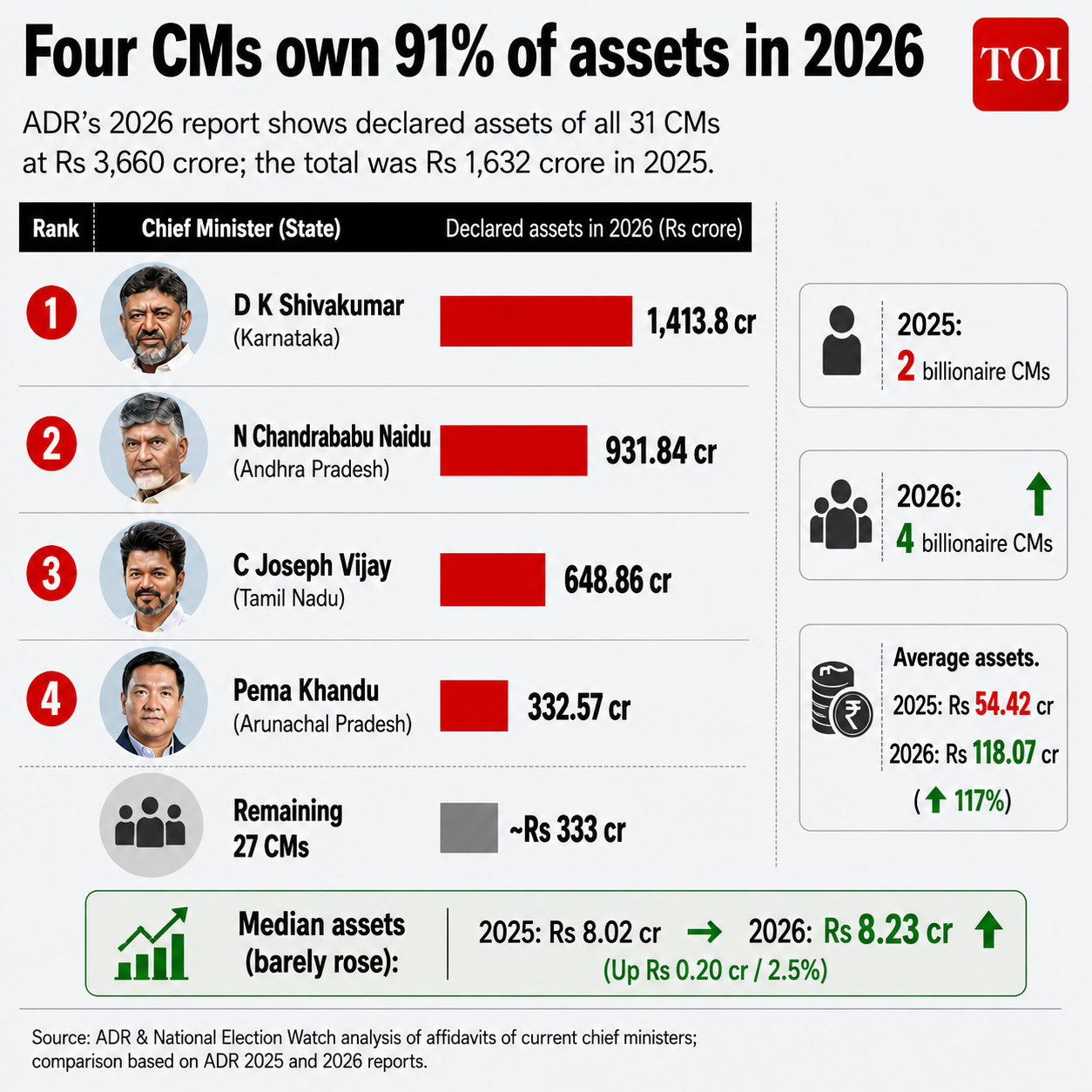
The combined assets declared by India’s chief ministers rose from Rs 1,632 crore in the 2025 report to Rs 3,660 crore in 2026. Average assets more than doubled from Rs 54.42 crore to Rs 118.07 crore. The number of billionaire chief ministers rose from two to four.In 2025, N Chandrababu Naidu, with assets of Rs 931.84 crore, and Pema Khandu, with Rs 332.57 crore, were the only billionaire chief ministers. Siddaramaiah was a distant third with Rs 51.94 crore. A year later, Karnataka CM D K Shivakumar is the clear number one with Rs 1,413.8 crore, while cine star and Tamil Nadu CM C Joseph Vijay declared assets of Rs 648.86 crore. Together, these four account for approximately Rs 3,327 crore, or 90.9% of the assets declared by all 31 chief ministers. The remaining 27 account for only around Rs 333 crore between them.
Analysing the assets held by CMs
A geographical cut makes the imbalance sharper. Using a broad four-zone grouping, not an ADR classification, the South has only six of the 31 CMs but accounts for roughly Rs 3,059 crore, or about 83.6% of all declared CM assets in 2026. That is because three of the four billionaire CMs, Shivakumar, Naidu and Vijay, are from southern states. So the South, in a way, lives up to the larger-than-life CM personalities. Naidu is a veteran politician who has survived many ebbs to rise again and regain his lost glory. D K Shivakumar finally got rewarded after a power tussle with Siddaramaiah, and Vijay was the new kid on the block who broke through the DMK-AIADMK binary, while also ticking the box of another cine star to become CM of Tamil Nadu. So the profiles of these billionaire CMs could not be more different.East and the Northeast together have the largest number of CMs in this grouping, 12, but account for about Rs 495 crore, helped substantially by Khandu’s declaration. North and Central India together have 10 CMs but only around Rs 75 crore in declared assets, while the West has three CMs and around Rs 31 crore.
Same party, different worlds
The party-wise picture is just as uneven. The BJP has 17 chief ministers in the 2026 list, but they are far from a single economic bloc. Its richest CM is Pema Khandu, with Rs 332.57 crore in declared assets. Its poorest is West Bengal CM Suvendu Adhikari, with about Rs 85.88 lakh. That is a nearly 387-fold gap within the same party.The Congress spread is smaller in headcount but sharper in scale. Of its four CMs, Shivakumar alone accounts for Rs 1,413.8 crore. At the other end is Kerala CM V D Satheesan, with Rs 6.66 crore. Revanth Reddy, at Rs 30.05 crore, and Himachal Pradesh CM Sukhvinder Singh, at Rs 7.82 crore, sit far below Shivakumar’s level. In effect, Congress’s CM asset profile is overwhelmingly shaped by one leader.This is why the average can mislead. A calculation based on individual entries puts the 2026 median at only around Rs 8.23 crore, barely higher than the 2025 median of about Rs 8.02 crore.Total declared liabilities rose from roughly Rs 242 crore in 2025 to nearly Rs 505 crore in 2026, though the number of CMs declaring liabilities of Rs 1 crore or more remained unchanged at 11. Khandu led the 2025 liability table with Rs 180.28 crore. In 2026, Shivakumar moved to the top with Rs 265.07 crore, followed by Khandu and Himanta Biswa Sarma.
Younger leaders, uneven party trend
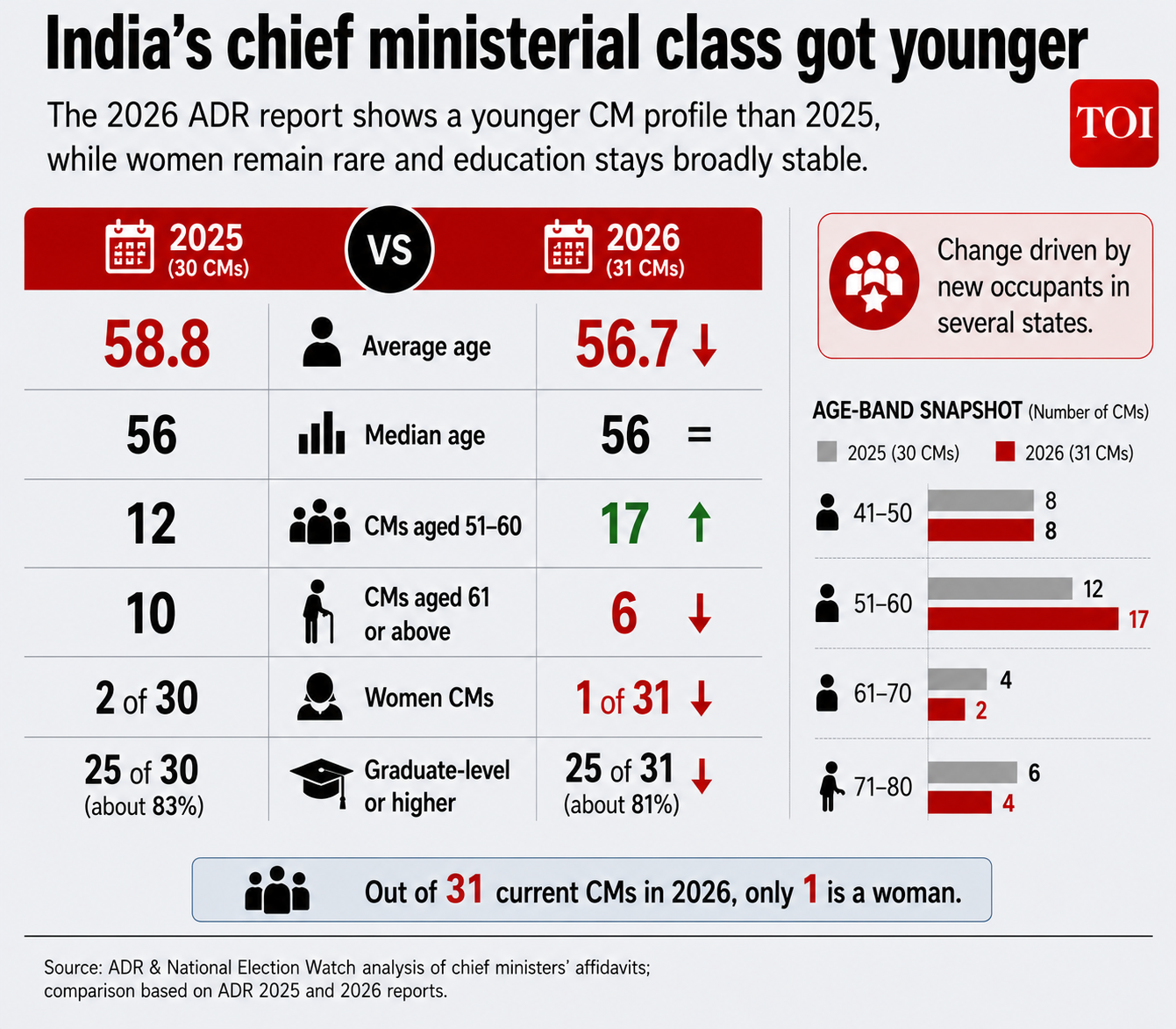
The leadership profile also became younger. In 2025, 12 of the 30 chief ministers were in the 51-60 group. By 2026, that number had risen to 17. The number aged 61 or above fell from 10 to six. The 41-50 category remained unchanged at eight.
India now has younger CMs
The average reported age declined from 58.8 to 56.7, though the median remained 56. The shift reflects the exit of several older CMs, including Siddaramaiah, Pinarayi Vijayan, Nitish Kumar, M K Stalin and Mamata Banerjee. The ages are those recorded when election affidavits were filed, not necessarily current ages. So the actual decline is much sharper because the 2025 calculation accounted for many outgoing CMs’ 2021 affidavits.Here again, parties differ internally. Congress’s four CMs are tightly bunched. Revanth Reddy is 56, Sukhvinder Singh 58, Shivakumar 60 and Satheesan 61. The BJP’s spread is wider. It has Pema Khandu at 44 and Manik Saha at 70, with several CMs clustered in their 50s. In other words, the Congress CM cohort is smaller and more middle-aged, while the BJP’s larger pool stretches from younger leadership to older veterans.There was a reversal on gender. The 2025 report listed two women among 30 chief ministers. The 2026 report lists only one among 31. Mamata Banerjee’s exit from the CM roster left Delhi’s Rekha Gupta as the sole woman in the group.
Degrees stay broadly stable
Many of the politicians are products of student politics. They may not have worked professionally, but they still believed in the inherent importance of formal education. In 2025, 25 of the 30 CMs were graduates, professional graduates, postgraduates or doctorate holders. In 2026, the number remained 25, despite the larger group. The proportion with graduate-level qualification or higher slipped slightly, from about 83% to 81%.Within parties, the BJP shows the widest educational spread. Its CM list includes doctorate holders such as Mohan Yadav, Himanta Biswa Sarma and Samrat Choudhary, but also leaders listed as Class 10 pass, diploma holders, graduates, professional graduates and postgraduates. Congress’s four CMs are more compact educationally: Shivakumar and Sukhvinder Singh are postgraduates, Revanth Reddy is a graduate and Satheesan is a graduate professional.
Cases rise, but cluster in five names
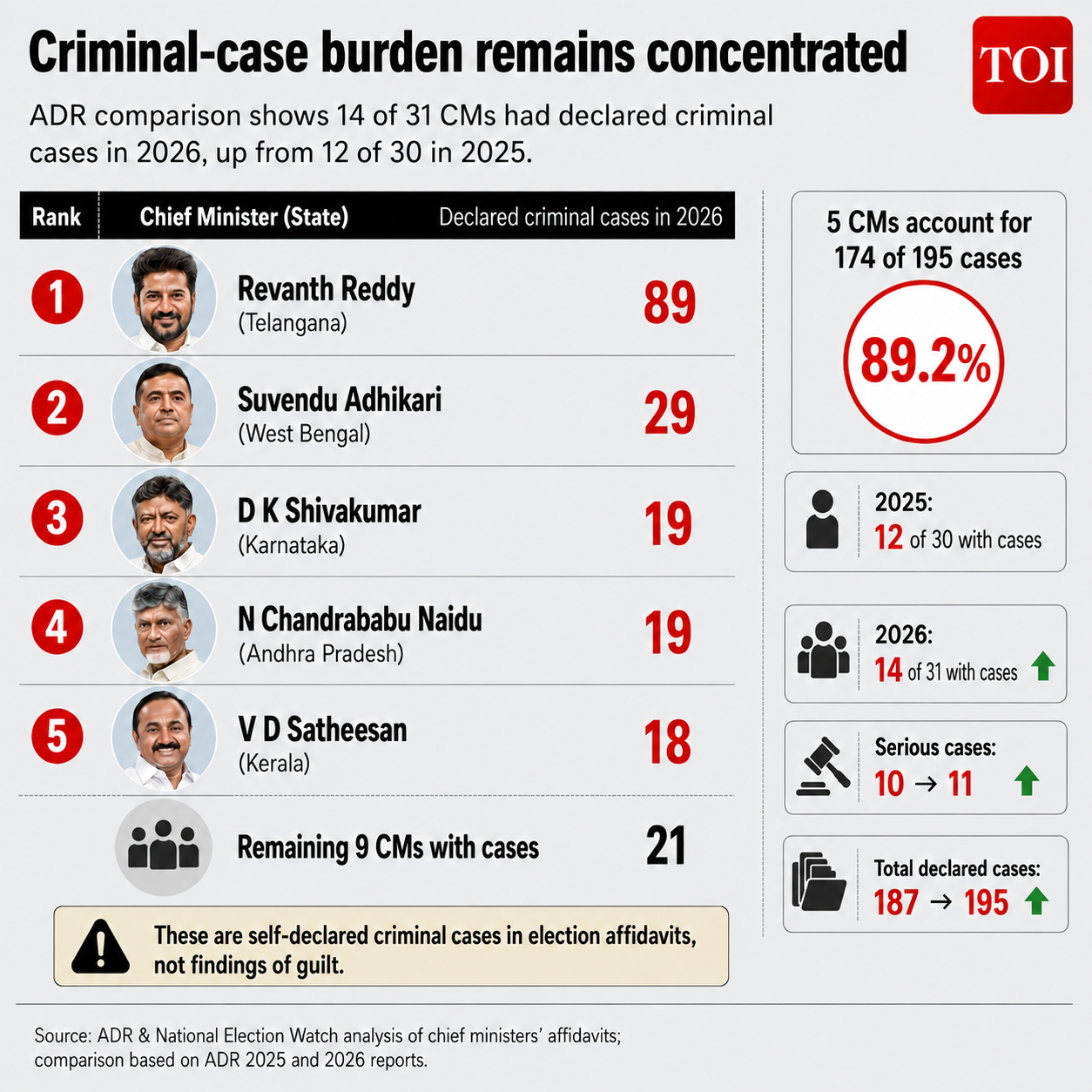
The criminal-record figures worsened modestly. In 2025, 12 of 30 chief ministers, or 40%, had declared criminal cases; 10 had cases classified by ADR as serious. By 2026, 14 of 31, or 45%, had declared criminal cases; 11 had serious cases.The combined number of declared cases rose from 187 to 195. The burden remained concentrated. Revanth Reddy continued to head the list with 89 cases, followed by Suvendu Adhikari with 29, Shivakumar and Naidu with 19 each, and Kerala’s V D Satheesan with 18. Five chief ministers accounted for 174 of the 195 cases, or 89.2%.
Criminal cases against CMs
Three of Congress’s four CMs are among the top five by declared cases: Revanth Reddy, Shivakumar and Satheesan. Among BJP CMs, Adhikari carries the highest declared case load, while several BJP chief ministers have no declared criminal cases.
Share your thoughts in the comments
Be respectful · TOI community guidelines
Geography shows a similar concentration, though for different reasons. The six southern CMs together account for 147 declared cases, driven mainly by Revanth Reddy, Shivakumar, Naidu and Satheesan. East and the Northeast account for 38 cases, led by Adhikari. North and Central India account for six, while the West accounts for four.It is perhaps not a coincidence that many of the CMs with high case loads were opposition leaders for a significant time. Thus, criminal cases need to be treated with caution. A low case count may not strictly be a virtue; it may just be a case of friendly police administration. Disclosures aren’t the only way to understand the nature of a politician. But they are an important starting point, particularly when compared over the years, to understand how the seat of power remains the same, but the nature of those who occupy it changes, perhaps as an inevitable reflection of the realities of the times.


