
In 1898, a mysterious boat moved without a captain and left New York crowds speechless until Nikola Tesla revealed his secret

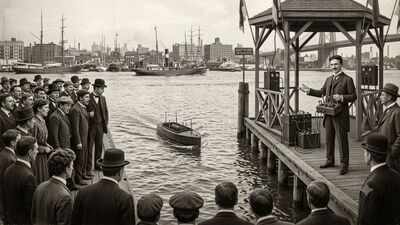
In the autumn of 1898, visitors at Madison Square Garden witnessed something that looked impossible. A small metal boat moved across a pool without a visible person guiding it. It changed direction, responded to commands, and appeared to act with a mind of its own. The demonstration came from Nikola Tesla, an inventor already known for his unusual electrical experiments, but even his supporters struggled to understand what they were seeing. At a time when wireless communication was still unfamiliar to most people, Tesla had created a machine that could be controlled from a distance using radio signals; a concept that would later become central to robotics, remote control technology, and modern autonomous systems.
Nikola Tesla’s early inventions and vision for wireless technology
In 1856, Nikola Tesla was born in Smiljan, which was then under the rule of the Austrian Empire. His contribution to electrical engineering is significant because it includes the development of AC power, induction motors, and various wireless communication-related technologies.For some time, Tesla worked with Thomas Edison, but after leaving Edison’s firm, he began to create his inventions independently. During his career, Tesla acquired hundreds of patents related to different aspects of electrical machinery and wireless technology. Some of them were practical and commercial, while other ideas of Tesla were merely experimental and far ahead of their time.ResearchGate titled, ‘Nikola Tesla’s Contributions to Radio Development ’ details that by the end of the 1890s, Tesla became very interested in the use of radio waves to control devices. He believed that not only could they be used to send messages to each other, but also give orders.The invention was straightforward in principle but revolutionary at the time: develop a device that will get the commands transmitted wirelessly from afar and execute them regardless of any physical connection between the operator and the device.
Nikola Tesla’s 1898 radio-controlled boat demonstration at Madison Square Garden
As mentioned in the research above, Tesla revealed his remote-controlled vessel during the Electrical Exhibition held at Madison Square Garden in New York in 1898. The display featured a small indoor pool and a compact boat measuring around four feet in length.The craft was built with a metal hull and contained the components needed to receive wireless signals. Inside were a battery, an electric motor, and mechanisms that controlled both the propeller and the rudder. On its deck were several antennas designed to capture signals sent from Tesla’s control device.The operator stood away from the boat and used a box fitted with switches and levers. By moving the controls, Tesla could make the vessel travel forward, turn, stop, and activate lights on the boat.To modern audiences, the demonstration sounds familiar. Remote-controlled cars, drones, and robotic systems are now common. In 1898, however, the idea of sending invisible instructions through the air was almost impossible for many people to imagine.Guinness World Records reports the boat became known as the “Teleautomaton”, a name Tesla used for machines that could operate through remote intelligence. The particular demonstration craft was also referred to as the “Devil Automata”.
Why Nikola Tesla’s radio-controlled boat was mistaken for magic
Tesla understood that his audience was seeing something completely unfamiliar, and he played with their expectations. During the demonstration, he suggested that the machine operated through mysterious means, adding to the confusion surrounding the invention.Some spectators struggled to believe that wireless control was responsible. Since there were no wires connecting Tesla to the boat, some wondered whether there was a hidden mechanism inside. Others reportedly speculated that the vessel contained a trained animal controlling its movements.Tesla even encouraged people to ask the machine questions. During one demonstration, someone asked for the cube root of 64. The lights on the boat flashed four times, creating the impression that the vessel had somehow answered correctly.As reported by PBS, when he later explained the technology, Tesla described the machine as having a “borrowed mind” because its actions came from a distant human operator. The phrase reflected his interest in the relationship between machines and intelligence, a subject that would continue to appear in his writings.
The patent that introduced remote control
The research reports that Tesla protected his invention through US Patent No. 613,809, titled “Method of and Apparatus for Controlling Mechanism of Moving Vessels or Vehicles”. The patent covered a method of controlling moving machines through wireless signals.The design was not limited only to boats. Tesla imagined that the same principle could be applied to different types of vehicles and mechanical systems.The boat itself was relatively complex for its time. Its propeller provided movement, while the rudder allowed it to change direction. The antennas received radio signals from the transmitter, and electrical circuits translated those signals into physical actions.The demonstration was an early example of what would eventually become remote robotics.
Nikola Tesla’s wireless boat and its military applications
Tesla Science Centre at WardenClyffe revealed that the new invention drew the attention of the military for the potential use of the innovation in military affairs. Newspapers covered the wireless controlled boats and the notion of the weapons that could be controlled wirelessly.Tesla thought that such innovations could revolutionise warfare at sea as it allowed to control a vessel in an automatic manner without any personnel aboard. The inventor came up with the concept of remote boats capable of carrying weapons and being maneuvered wirelessly.Despite the fact that the notions of the inventors had not found practical application, the fundamental idea was similar to that used several decades later. Modern unmanned vehicles including military drones and robotic units use the same principles of functioning.However, the technology of those times did not allow using it extensively as communication, electronics and computers were far from being developed.
Nikola Tesla’s vision for automation and the future of intelligent machines
Tesla’s interest in remote control was connected to a larger fascination with automation. He believed machines could eventually become more independent and respond to their surroundings rather than simply follow direct commands.In his writings, Tesla explored the idea that future machines might develop forms of decision-making ability. He imagined a progression from simple devices controlled by humans to systems capable of reacting automatically to the world around them.His 1898 boat did not think for itself. It followed signals sent by an operator. Yet the demonstration introduced a concept that would later become fundamental to robotics: the separation between the person giving instructions and the machine carrying them out.The small vessel in the Madison Square Garden pool represented an early step toward technologies that now shape everyday life, from remote-controlled devices to autonomous machines. At the time, many saw only a strange boat moving through water. Tesla saw the beginning of a new relationship between humans and machines.


