
This UNESCO-listed underground city in Poland hides 245km of tunnels, a cathedral carved from salt and an entire world below the surface |

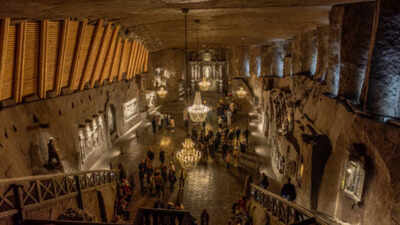
A 245km network of tunnels distributed over nine levels hides one of Poland’s most astonishing works of architecture and life. While visuals might deceive you into believing it’s some grand mall, what truly lies in front of the eyes is an underground city made up of salt, which is one of the best-kept secrets about the country.Located near Krakow, the Wieliczka Salt Mine reaches approximately 327 metres in depth. Exploited for centuries, the extraction from the mine ceased in 1996 and today, it functions as a tourist attraction and UNESCO World Heritage Site.
A natural wonder
The formation of the reserve began about 13.5 million years ago, when a sea that occupied part of Europe receded due to the movement of tectonic plates.
The formation of the reserve began about 13.5 million years ago, when a sea that occupied part of Europe receded due to the movement of tectonic plates. The process left open large salt deposits called halite under the region near the Carpathian Mountains. The mountain range extends through countries such as Poland, the Czech Republic, Slovakia, Romania, Ukraine, Hungary and Serbia. Ninety to ninety-five per cent of the rock is salt, and impurities give it the grey colour instead of white. The mix includes other minerals as well as sand, silt and claystone.Long before the runnels were opened, prehistoric groups had already been relying on the resources present there. Neolithic tools found in the surroundings indicate that brine was extracted from natural sources and boiled until the water evaporated. The remaining salt was used in food and food preservation. Around the 11th and 12th centuries, when the sources began to dry up, it became necessary to open increasingly deeper wells.In the 14th century, the mine became a royal asset under King Casimir III of Poland. Known as Casimir the Great, he recognised salt’s economic power which accounted for as much as a third of the royal treasury’s income during his reign, wealth that helped finance Poland’s first university. By the end of the 15th century, Wieliczka was producing between 7,000 and 8,000 tons of salt annually.During World War II, it was even converted into a subterranean factory producing aircraft components. Forced labourers, prisoners from the nearby Płaszów concentration camp, including many Hungarian Jews, worked there, forbidden from speaking to regular miners.Though mining has ceased over the years, salt production still continues. Water infiltration is pumped to the surface, the brine is evaporated, leaving behind crystals in a process similar to sea salt production. More than 10,000 tons are produced annually.
Nine underground levels
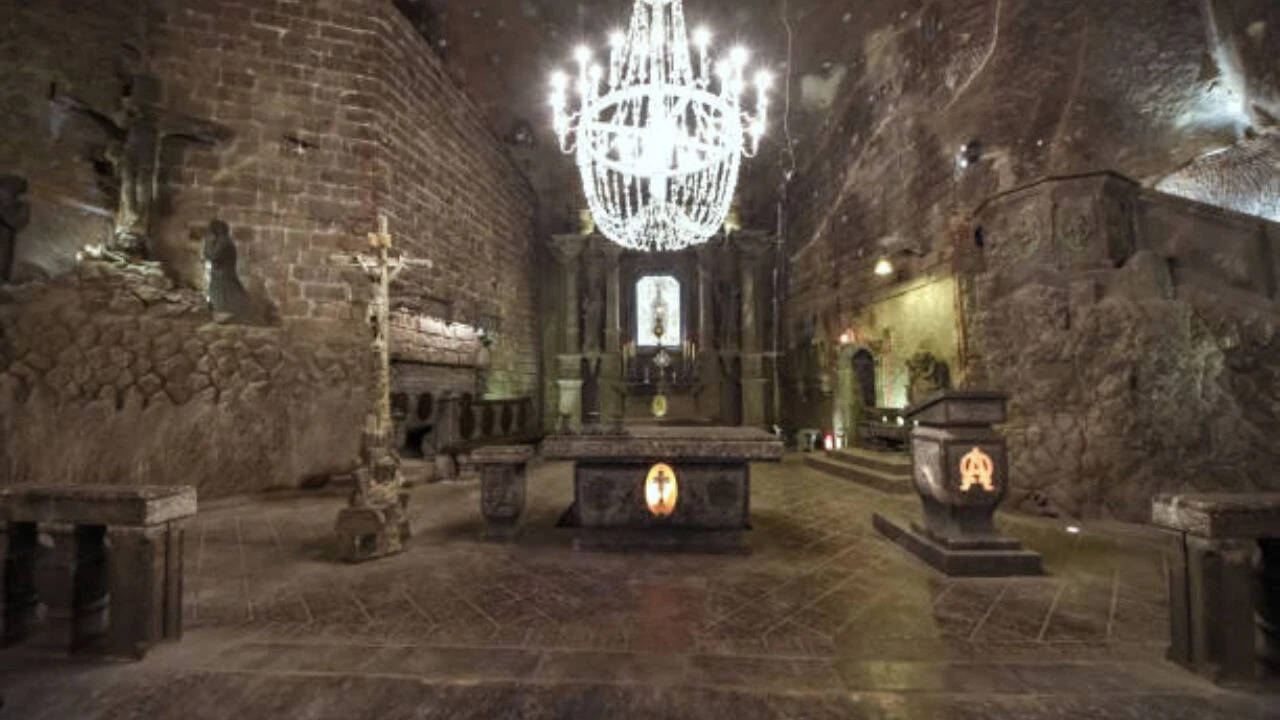
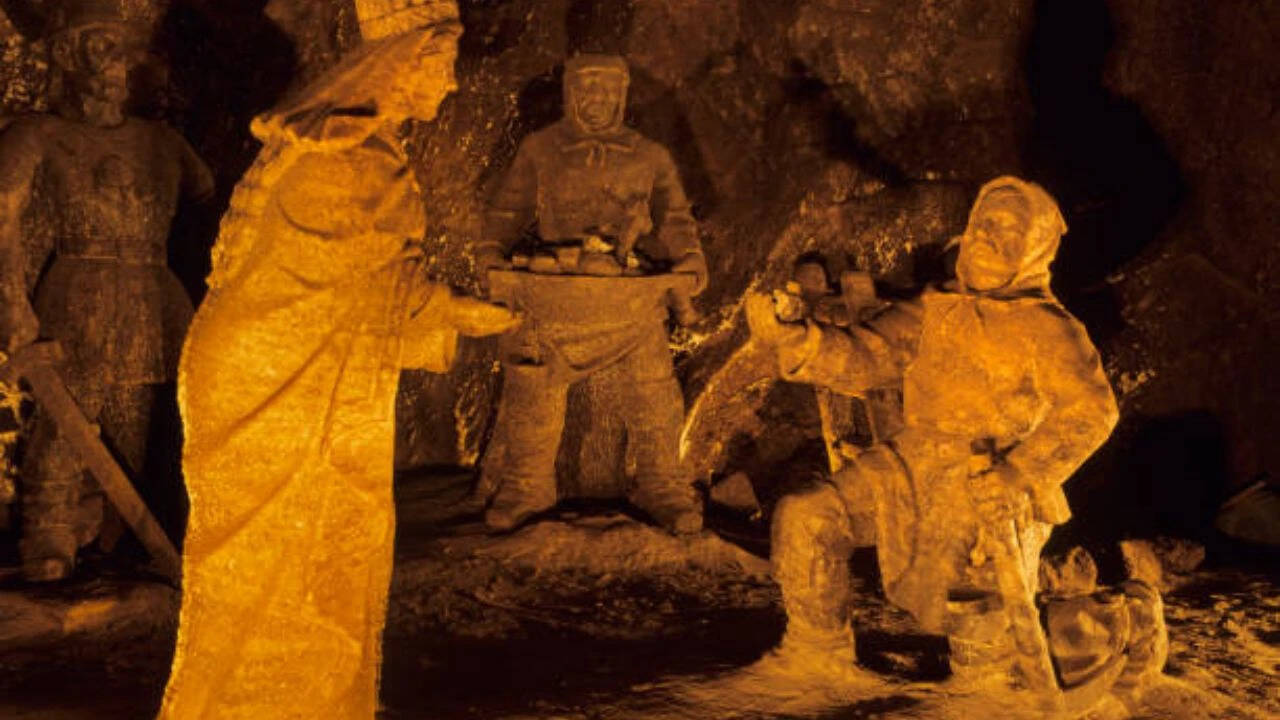
Continuous excavation transformed the Wieliczka Salt Mine into one of the oldest salt mining operations in the world. The activity continued for hundreds of years, until 1996, when it ceased.Now, the complex houses 245 kilometres of galleries. The tunnels are spread over nine underground levels and reach about 327 metres below the surface. The interior boasts of chambers, underground lakes, museums and spaces sculpted directly into the salt. A combination of mining, engineering and artistic work has given the place the appearance of a city built underground.One of the main spaces of the complex is the Chapel of St Kinga, also called St Cunegunda, the 13th-century Hungarian princess and patron saint of salt miners. Legend holds that Kinga asked her father for a dowry of rock salt when she married a Polish duke. After he offered her Hungary’s largest salt mine, she threw her engagement ring down a shaft there. The ring was later said to have been found in Poland, embedded in a lump of salt discovered near Krakow, possibly at Wieliczka. It is located approximately 101 metres below the surface and was excavated by miners themselves over a period of 67 years. Altars, religious reliefs, chandeliers and sculptures were all produced in salt. Among the works are a representation of the Last Supper by Leonardo da Vinci and a statue of Pope John Paul II.It is also a vital events venue. Two chambers have been fitted with wooden flooring for galas and private functions. One, nearly 120 feet high, has even hosted a bungee jump and tethered hot air balloon ride. There’s also a spa, located 450 feet below ground, specialising in respiratory treatments, a subterranean version of modern wellness “salt caves.”The physical dimension and historical value led UNESCO to recognise Wieliczka as a World Heritage Site in 1978. The complex’s peculiarity has also led it to receive visitors such as Polish astronomer Nicolaus Copernicus, Johann Wolfgang von Goethe and Alexander von Humboldt. Copernicus was the first ‘tourist’ in the mine who came to see the miners cutting and transporting salt. A salt sculpture of him was installed in a chamber in 1973.
Attracting visitors from worldwide
In 2025, a record 1.91 million people, over 70% from abroad, visited the historic mine.
Today, the former mining operation functions exclusively as a tourist attraction, preserving galleries, artworks and structures that document different periods of salt exploration in Poland. In 2025, a record 1.91 million people, over 70% from abroad, visited the historic mine. The figure is up 10% from 2024 and beats the previous record set in 2019.In April last year, the mine introduced AI-based chatbots to help manage increasing numbers of tourists. Created by the Krakow-based company ChatLab, the bots, which can answer questions in 20 languages, now deal with 17% of interactions with potential visitors.Officials at the mine expect that it might welcome even more visitors this year, hoping to break 2 million for the first time.


