
Costa Rica covered a dead pasture with 12,000 tonnes of orange peel. Sixteen years later, scientists found a thriving forest | World News

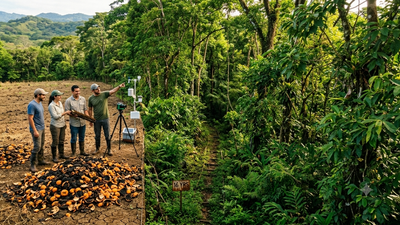
For most people, discarded orange peel is little more than food-processing waste. In Costa Rica, one abandoned environmental experiment showed it could become something very different. During the late 1990s, around 12,000 tonnes of leftover citrus peel were spread across a worn-out cattle pasture beside the Guanacaste Conservation Area as part of an unusual restoration project. The trial was cut short after a legal challenge and soon faded from public attention. Years later, when scientists returned to inspect the site, they struggled to find it at all. The barren field had been replaced by dense woodland. Comparisons with nearby untreated land later revealed richer soils, greater tree diversity and a dramatic increase in forest biomass, offering an unexpected insight into how organic waste can aid ecological recovery under carefully managed conditions.
How 12,000 tonnes of discarded orange peel ended up in a protected forest
The project emerged during the late 1990s from an arrangement linking environmental restoration with agricultural waste management. Conservation scientists working in Costa Rica proposed that a citrus producer could transfer neighbouring land to expand the Guanacaste Conservation Area. In return, the company would be allowed to dispose of processed orange peel on a nearby section of badly degraded pasture inside the protected area.According to the study published in Restoration Ecology, titled ‘Low-cost agricultural waste accelerates tropical forest regeneration’ revealed that instead of sending the waste elsewhere, roughly 12,000 tonnes of peel arrived over the course of about 1,000 truck journeys. The material was spread across approximately three hectares of exhausted land where years of intensive use had left soils in poor condition and natural forest regeneration had largely stalled.
What happened after the peel was spread
Fresh citrus waste did not create an attractive landscape straight away. As the enormous pile began to break down, the site entered a messy period of decomposition. Moist organic material accumulated, insects flourished and the surface became thick with decaying plant matter.That stage did not last indefinitely. Within months, the waste had largely decomposed into dark, nutrient-rich soil. The process returned organic matter to ground that had lost much of its fertility, creating conditions far more favourable for plant growth than the compacted pasture it replaced.
The experiment was halted before anyone knew the outcome
The restoration effort survived for only a short period before it became the subject of a legal dispute. Another juice company challenged the arrangement, arguing that allowing industrial waste to be deposited inside a national park was inappropriate.Costa Rica’s Supreme Court eventually ruled against the agreement, bringing the programme to an end. No further orange peel was delivered, and the site received little attention afterwards. For many years, it remained largely absent from scientific discussion while the surrounding landscape continued changing without active management.More than a decade later, ecologist Timothy Treuer visited Costa Rica for unrelated fieldwork and decided to locate the old experimental plot. Finding it proved harder than expected.The original clearing had become so densely vegetated that identifying its boundaries required repeated visits. Even a large sign placed to mark the location had become hidden beneath climbing plants. The former pasture no longer resembled open grassland, making the transformed site difficult to recognise against the surrounding forest.
Measuring the changes
To understand what had happened, the restored area was compared with nearby land that had not received orange peel. The contrast extended well beyond appearance.The treated site supported richer soils, substantially greater quantities of woody vegetation and a wider variety of tree species. Above-ground biomass had increased by around 176 percent compared with the untreated area. Large native trees had established themselves, including an enormous fig tree that had reached remarkable size during the years following the experiment.The comparison suggested that natural forest recovery had progressed much faster where organic waste had been added than on neighbouring degraded pasture left to recover on its own.
Why did it work so well
The precise biological processes remain uncertain. Scientists have proposed several possibilities rather than a single explanation.One idea is that the thick layer of decomposing orange peel suppressed aggressive pasture grasses that normally dominate disturbed land and prevent young trees from becoming established. At the same time, decomposing organic matter supplied nutrients, improved soil structure and increased the ground’s ability to retain moisture. Those combined effects may have created conditions that allowed native forest species to gain a foothold.Exactly how much each factor contributed has not yet been fully determined, leaving room for further research into how similar restoration methods might function under different environmental conditions.


