
Quote of the day by Charles Darwin: “Ignorance more frequently begets confidence than does knowledge: it is those who…”

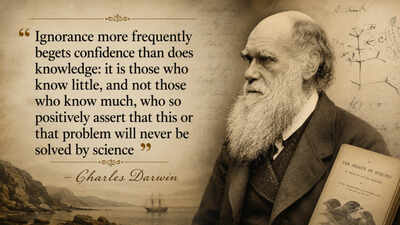
The more we learn about the world, the more we realise how much remains unknown. Yet people with the least understanding often express the greatest certainty, while true experts are usually more cautious in their conclusions. Charles Darwin’s thought-provoking observation, “Ignorance more frequently begets confidence than does knowledge: it is those who know little, and not those who know much, who so positively assert that this or that problem will never be solved by science,” highlights this paradox of human nature. The quote reminds us that genuine knowledge encourages curiosity and humility, whereas ignorance often creates an illusion of certainty.Charles Darwin (1809-1882) was an English naturalist whose theory of evolution by natural selection transformed biology and our understanding of life on Earth. Throughout his scientific career, Darwin valued evidence, observation and the willingness to question existing beliefs, recognising that science advances by remaining open to new discoveries.
Quote of the day by Charles Darwin
“Ignorance more frequently begets confidence than does knowledge: it is those who know little, and not those who know much, who so positively assert that this or that problem will never be solved by science”
What does this quote mean?
The quote teaches that people who possess only limited knowledge are often the most confident in their opinions because they are unaware of the complexity of a subject. By contrast, those who study a topic deeply understand its uncertainties, unanswered questions and evolving nature. Rather than claiming to know everything, truly knowledgeable people recognise that learning is an ongoing process.
The more we know, the more we question
Every scientific discovery answers some questions while raising many others. A beginner may believe a subject is simple, but deeper study often reveals layers of complexity that were previously invisible. This is why experienced researchers, scholars and professionals frequently speak with caution rather than absolute certainty. The quote reminds us that wisdom is measured not by having all the answers but by asking better questions.
Confidence without understanding can be misleading
History offers countless examples of ideas that were once declared impossible but later became reality. Human flight, space travel, organ transplantation and artificial intelligence were all dismissed by some people before science made them possible. When opinions are formed without sufficient knowledge, confidence can become a barrier to progress. Darwin’s words encourage us to remain open-minded and avoid confusing certainty with truth.
Science grows through curiosity, not certainty
One of the greatest strengths of science is its willingness to change when new evidence emerges. Scientists do not advance knowledge by assuming they already know everything; they do so by testing ideas, admitting mistakes and refining their understanding over time. This spirit of curiosity has led to breakthroughs that have transformed medicine, technology and our understanding of the universe. The quote reminds us that progress depends on questioning assumptions rather than defending them unquestioningly.
Why this quote still matters today
In an age of social media, instant opinions and misinformation, Darwin’s observation is more relevant than ever. People are often encouraged to speak confidently about complex issues after reading only a few headlines or watching short videos. Meanwhile, experts who have spent decades studying a subject are more likely to acknowledge uncertainty and nuance. The enduring lesson behind Darwin’s words is that true intelligence is not measured by how loudly we express our opinions, but by our willingness to keep learning, examine evidence and accept that there is always more to discover.


