
24-million-year-old Kevda fossil leaves discovered in Assam reveal ancient tropical forests of India

For most people, Kevda is recognised by its unmistakable fragrance. Its flowers are distilled into the aromatic essence used in sweets, perfumes, religious offerings and traditional remedies across India. Yet the plant has quietly carried a far older story than its cultural role suggests. Fossil leaves uncovered in Assam are now pushing that story back by around 24 million years, showing that the ancestors of today’s kevda were already growing on the Indian subcontinent long before humans appeared. According to the press release by the Ministry of Science and Technology, the discovery provides fresh evidence that India preserved ancient tropical plant lineages through periods of dramatic climatic change, offering a rare glimpse into ecosystems that have otherwise disappeared.
How scientists identified 24-million-year-old Kevda fossil leaves in Assam
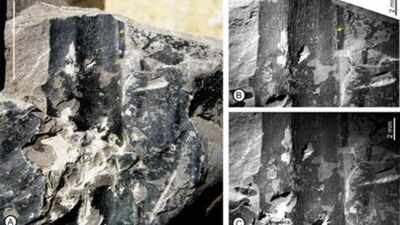
The discovery comes from the Tikak Parbat Formation within the Makum Coalfield in Assam, where scientists recovered four exceptionally preserved fossil leaves. Their age places them in the late Oligocene, roughly 24 million years ago, making them among the oldest known records connected with the modern Kevda family in South Asia.According to the Ministry of Science and Technology, the fossils retain several features that remain distinctive in living Kevda plants. The leaves include long sword-shaped leaves with parallel veins while small prickles along the edges closely resemble those seen in modern members of the Pandanaceae family. Those preserved characteristics allowed researchers to confidently compare the fossils with present-day specimens as well as earlier fossil records from other continents.
Assam Kevda fossils bridge a major gap in the Pandanaceae fossil record
The study published in ScienceDirect titled “Fossil leaves of Pandanaceae from India suggest Paleogene persistence of the family in South Asia” was carried out by scientists from the Birbal Sahni Institute of Palaeosciences in Lucknow, who examined the fossils using detailed morphological and microscopic techniques before comparing them with herbarium collections and international botanical records.Their findings suggest that the lineage was already well established in India millions of years before human civilisation. The study also helps bridge a long-standing gap in the fossil history of the family. The Assam fossils connect much older records found in Europe and North America, dating between 85 and 66 million years ago, with younger occurrences reported from tropical Asia and Australia.
Assam Kevda fossils reveal how ancient plants survived climate change
The wider significance of the discovery lies in what it reveals about Earth’s changing environments. Evidence gathered from geology, fossil plants and ancient climate data suggests that pandanaceous plants once occupied a far broader area across the Northern Hemisphere than they do today. As global temperatures declined after about 34 million years ago, their range gradually contracted, disappearing from many regions while surviving in tropical environments.According to the Ministry of Science and Technology, the fossils from Assam indicate that the Indian subcontinent acted as a refuge where this ancient plant lineage continued to persist even as it vanished elsewhere. The surrounding landscape during the late Oligocene is believed to have consisted of warm, humid lowland swamps, river corridors and evergreen forests, conditions that closely resemble the habitats preferred by living Pandanaceae species today.Although the study centres on a familiar fragrant plant, its implications extend well beyond Kevda itself. As per the study, evidence suggests that India’s tropical forests have preserved lineages stretching deep into geological history. They also provide scientists with another reference point for understanding how plants responded to large-scale climate shifts in the distant past, information that may improve reconstructions of ancient biodiversity and environmental change. Identifies the Makum Coalfield fossils as important macrofossil evidence for the Pandanaceae family in the Indian Paleogene and add another piece to the evolutionary history of tropical vegetation across South Asia.


