
From oil to atoms: Donald Trump to open nuclear door to Saudis

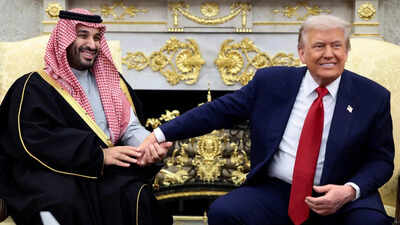
TOI correspondant from Washington: The Trump White House is expected to unveil a landmark 30-year civilian nuclear cooperation agreement with Saudi Arabia on Wednesday in a deal that may reverberate far beyond the middle east while triggering a fierce debate in Washington over nuclear proliferation, regional security, and America’s long-term interests.The proposed agreement, similar to the one with India under Section 123 of the US Atomic Energy Act, would permit extensive US-Saudi civilian nuclear cooperation and eventually allow Riyadh to enrich uranium on its own soil under jointly agreed conditions. U.S firms led by Westinghouse are expected to play a central role in building Saudi nuclear infrastructure, a project potentially worth tens of billions of dollars.Unlike the “gold standard” agreement signed with the United Arab Emirates in 2009, Riyadh is not required to immediately renounce uranium enrichment or plutonium reprocessing, and the reported agreement also omits the International Atomic Energy Agency’s Additional Protocol requiring more intrusive inspections. Those departures have alarmed non-proliferation experts and many lawmakers.Secretary of state Marco Rubio sought to reassure critics before the formal announcement, saying, “The US is not going to reach any agreement with any country in the world that leads to the risk of proliferation,” while punting details of the deal to the White House.The administration broadly argues that bringing Saudi Arabia’s nuclear ambitions under an American umbrella is preferable to allowing Riyadh to turn to China or Russia for nuclear technology, not to speak of sidelining Pakistan, which has long provided implicit nuclear cover for the Saudis. It also maintains the agreement would create thousands of American jobs while restoring a relationship strained by disagreements over the recent conflict with Iran and Saudi concerns about US regional commitments.Republican and Democrat lawmakers are expected to scrutinize the agreement when it reaches Congress, particularly because it appears to weaken safeguards that administrations had insisted upon. Congress can reject the agreement only by assembling a veto-proof majority, making outright defeat difficult, but there definitely be hearings that are bound to be contentious.The strongest concerns center on Crown Prince Mohammed bin Salman’s repeated assertion that Saudi Arabia would acquire nuclear weapons if Iran developed one. That statement has become the principal argument for opponents who fear the agreement could accelerate a regional nuclear competition.Darya Dolzikova, Senior Research Fellow for Proliferation and Nuclear Policy at the Royal United Services Institute, argues that a US-Saudi accord has strategic merit because it can “help preclude a bigger Russian and/or Chinese presence in the region” and support America’s nuclear industry. But, she cautions, “robust non-proliferation controls are paramount,” particularly if enrichment remains an option.The timing of the deal, coming in the midst of the U.S-Iran war, is especially delicate. Washington has maintained that Iran should have “zero enrichment” capability while simultaneously considering a framework that could eventually permit Saudi enrichment, an apparent double standard that critics say risks undermining America’s non-proliferation credibility.Meanwhile, the agreement presents an uncomfortable dilemma for Israel, which has traditionally opposed any regional enrichment capability outside its own undeclared nuclear deterrent, and which fears Saudi technological advances could eventually alter the regional balance, regardless of current political ties.Pakistan also figures prominently in the strategic calculus. For decades, Western intelligence assessments have suggested that Riyadh’s close financial and military relationship with Islamabad could provide Saudi Arabia with an implicit nuclear hedge, although neither government has acknowledged such an arrangement publicly. By embedding Saudi Arabia’s civilian nuclear program within an American framework, Washington may hope to reduce incentives for Riyadh to depend on Pakistan for strategic insurance while simultaneously deepening US influence over the kingdom’s long-term nuclear trajectory.The agreement also carries implications for India, which has steadily expanded strategic partnerships with both Washington and Riyadh while strengthening energy, investment and defense ties with Saudi Arabia. A closer US-Saudi alignment could reinforce stability in Gulf energy supplies that are vital to India’s economy. At the same time, any erosion of non-proliferation norms or a future regional nuclear competition would complicate India’s security environment, particularly if Pakistan sought to leverage its historic strategic relationship with Saudi Arabia.Iran is almost certain to portray the agreement as evidence of American double standards after years of pressure on Tehran’s enrichment program. Egypt and Iraq are likely to watch cautiously, wary of any shift in the regional strategic balance, while the UAE, which accepted far stricter restrictions under its own agreement, may privately question why Riyadh is receiving more permissive terms.Beyond the Middle East, the agreement represents a broader geopolitical contest. By anchoring Saudi Arabia’s nuclear future to American technology and financing, the Trump administration is seeking to outmaneuver Beijing and Moscow in one of the world’s most strategically important regions while reaffirming Washington’s role as Riyadh’s principal security partner. Whether that strategic gain outweighs the long-term proliferation risks will dominate the debate on Capitol Hill long after Wednesday’s announcement.


