
China Live-Fire Drill: China conducts rare live-fire drill inside Japan’s claimed EEZ near Okinotorishima

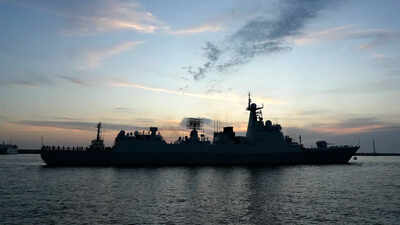
China conducted a rare live-fire naval exercise inside what Japan claims as its Exclusive Economic Zone (EEZ) near the remote Pacific island of Okinotorishima, prompting Tokyo to lodge a diplomatic protest with Beijing.According to Japan’s defence ministry, it was the first time a foreign navy had carried out and publicly acknowledged such a live-fire drill inside Japan’s claimed EEZ.The ministry stated that the exercise took place on Sunday about 180 kilometres southwest of Okinotorishima.Japanese forces had earlier detected two Chinese destroyers, a Chinese supply ship and a Russian frigate operating together in the area before one of the Chinese warships fired a machine gun during the exercise, according to Bloomberg.Japan’s chief cabinet secretary Minoru Kihara said the government protested through diplomatic channels, arguing that the drill “could pose a danger to the navigation of vessels in the surrounding waters.”
China rejects Japan’s protest
China dismissed Japan’s concerns, disputing Tokyo’s claim that Okinotorishima generates an Exclusive Economic Zone.Chinese foreign ministry spokesperson Lin Jian said Japan had no legal basis to claim an EEZ around Okinotorishima because it is a small maritime feature that is largely submerged during high tide.“Japan’s claim of an EEZ around Okinotorishima violates international law,” Lin said.“China’s activities in the high seas are fully consistent with international law and international practice,” he added.As per news agency AP, Lin described Japan’s concerns as “groundless” and accused Tokyo of exaggerating external threats to justify its military build-up.
Japan links exercise to growing China-Russia military cooperation
Japanese officials said the Chinese warship had notified nearby vessels before the drill began, but maintained that the live-fire exercise raised safety concerns.Kihara said Japan viewed the latest joint operation as part of a broader trend of increasing military coordination between China and Russia.“We view this latest joint transit as part of the broader trend toward closer military coordination between the two countries,” he said.Japanese defence minister Shinjiro Koizumi also cited the incident while speaking in Britain on Monday, saying it highlighted “the deepening military cooperation between China and Russia”.Japan has also raised concerns over China’s recent ballistic missile launch from a submarine and multiple joint bomber flights conducted with Russia around Japanese territory.
First publicly disclosed live-fire drill in Japan’s EEZ
Japan’s Joint Staff said this was the first time it had publicly announced detecting live-fire exercises by a foreign navy inside the country’s claimed EEZ, although it acknowledged that the activity does not violate international law.The United Nations Convention on the Law of the Sea (UNCLOS) does not prohibit military exercises within another country’s EEZ.Such zones extend up to 200 nautical miles (about 370 kilometres) from a coastal state’s land and grant countries sovereign rights over natural resources rather than full territorial sovereignty, according to Bloomberg.Tokyo mobilised air and maritime surveillance following the exercise and warned Beijing that the drill “could have endangered the navigation of nearby ships.”
Long-running dispute over Okinotorishima
The incident has also revived a longstanding legal dispute over the status of Okinotorishima.Japan considers Okinotorishima its southernmost island and claims an EEZ around it. China, however, argues that the feature is merely a reef rather than an island under international law and therefore cannot generate an EEZ.China had previously announced that its joint naval exercises with Russia concluded on July 13 and that some participating vessels would continue joint patrols in the Pacific. It remains unclear why those patrols included live-fire drills, as alleged by Japan.Chinese and Russian military activity around Japan has increased in recent years, while Beijing and Tokyo continue to differ over maritime boundaries and regional security issues.The latest incident also came a day before a separate confrontation between Chinese and Philippine personnel at the disputed Second Thomas Shoal in the South China Sea, further highlighting growing tensions in the region.


