
Scientists discover the deepest animal ecosystem ever found, thriving nearly 10 kilometres beneath the Pacific Ocean

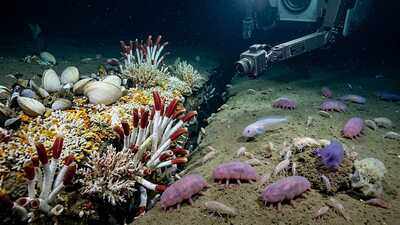
Scientists have discovered the deepest known animal ecosystem on Earth, thriving almost 10 kilometres beneath the Pacific Ocean where sunlight never reaches. At depths of up to 9,533 metres, researchers found dense colonies of blood-red tubeworms, white clams and other marine animals living around methane-rich cold seeps on the ocean floor. The discovery ‘Flourishing chemosynthetic life at the greatest depths of hadal trenches’, published on 30 July 2025 by scientists from the Institute of Deep-sea Science and Engineering (IDSSE) at the Chinese Academy of Sciences in Nature, challenges long-held assumptions about the limits of life and reveals that complex ecosystems can flourish in one of the most extreme environments on the planet.
A thriving animal ecosystem in the darkest depths of the ocean
The remarkable communities were discovered in two deep ocean trenches in the northwestern Pacific using the Chinese crewed submersible Fendouzhe (Striver). The dives reached depths of up to 9,533 metres, well within the hadal zone, the deepest region of the ocean that extends below 6,000 metres.Unlike most ecosystems on Earth, these animals survive in complete darkness under crushing pressures exceeding 900 times the atmospheric pressure at sea level. Temperatures hover just above freezing, and no sunlight penetrates the water, making photosynthesis impossible.Despite these hostile conditions, researchers observed extensive fields of blood-red tubeworms, large white clams, mussels and microbial mats covering the seafloor around methane-rich cold seeps.
How animals survive in complete darkness without sunlight
Instead of relying on energy from the Sun, the ecosystem depends on chemosynthesis. Methane and hydrogen sulphide seeping from beneath the seabed provide the chemical energy needed by specialised bacteria.These microbes convert the chemicals into organic matter, forming the base of the food web. Many of the larger animals, including tubeworms and clams, live in close partnership with these bacteria. The microbes inhabit their tissues and produce nutrients that sustain their hosts, allowing entire communities to flourish without any dependence on sunlight.This process enables complex ecosystems to exist in places once thought too extreme to support abundant animal life.
Why the discovery is scientifically important
Before this study, scientists believed that animal communities became increasingly sparse at the greatest ocean depths because of limited food supplies. The discovery of dense ecosystems at more than 9,500 metres overturns that assumption and suggests that methane seeps can support thriving biological communities even in the deepest ocean trenches.The findings also expand scientists’ understanding of Earth’s carbon cycle, deep-sea biodiversity and the adaptability of life under extreme conditions. Because chemosynthesis-based ecosystems do not require sunlight, they may also provide clues about where life could exist beyond Earth, such as beneath the icy crusts of Jupiter’s moon Europa or Saturn’s moon Enceladus, where subsurface oceans are thought to exist.The discovery represents a major milestone in deep-sea exploration, showing that even the most remote parts of our planet continue to hold extraordinary surprises waiting to be uncovered.


