
The great Indian flip: People on roads, bikes on footpaths | Delhi News

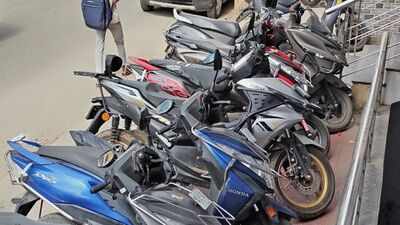
Walking, once the safest way to get around a city, has quietly become a risk for millions of Indians. The danger is no longer from speeding cars or reckless drivers alone, but from the very footpaths that are meant to keep pedestrians away from traffic. Scooters, motorcycles and delivery riders are taking over pavements across Delhi, Bengaluru, Mumbai, Hyderabad, Pune and Chennai as informal traffic lanes, displacing the elderly, children and the disabled from spaces that were initially constructed for their protection.A footpath is not a safe placeFootpaths had a simple purpose — to separate slow-moving pedestrians from fast, heavier traffic. That divide has already disappeared in Indian cities. Delivery riders zip along pavements, two-wheelers dart through pedestrian crossings to beat the red lights and electric scooters glide up from behind almost soundlessly, leaving walkers no time to react. It is common to see this now. This is now a daily occurrence, rather than an exception, outside metro stations, schools and crowded markets, forcing pedestrians to jump aside or step onto the road – trading one danger for another.
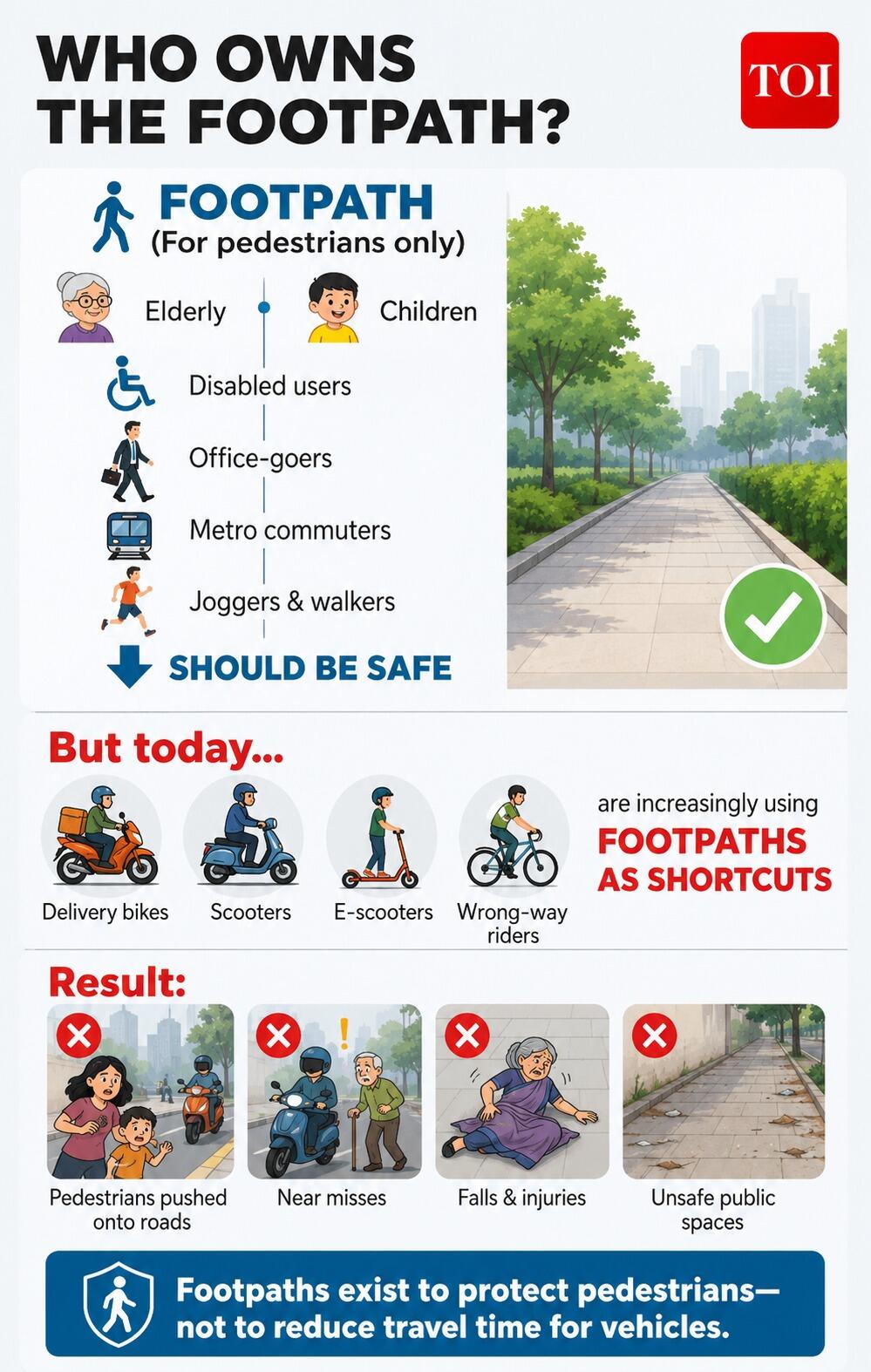
Who owns the footpath
The delivery economy is boomingThe shift is largely driven by the growing app-based delivery economy in India. Food delivery, grocery apps and quick-commerce platforms now rely on hundreds of thousands of riders, many of them are paid per delivery, not per hour. This payment structure creates constant pressure to shave off minutes wherever possible. When roads are choked, footpaths start looking like a convenient shortcut. Companies are not allowed to have such violations on paper, but the economic incentive remains to nudge the riders towards high-risk behaviour on the ground.Congestion, bad design and bad enforcementIndia’s roads are among the most congested in the world and once one rider takes to the pavement to beat the jam, others tend to follow suit almost immediately, normalising what should be a punishable offence. Enforcement, meanwhile, is patchy at best – traffic police cannot be everywhere, on every stretch of road, and riders know full well that the chances of being caught and fined are slim. The problem is compounded by poor urban design. Wide property-entry ramps, the absence of bollards and broken kerbs make it all too easy for two-wheelers to slip onto footpaths without resistance.Whose road is it really?It is a fact that many city design frameworks in India have long prioritized motorized transport, creating a challenging environment for pedestrians. Many riders think that an empty footpath is fair game, but they forget the basic rule that pedestrians have absolute precedence there. This mentality is not easily changed and until it is, engineering fixes alone are unlikely to solve the problem on their own.
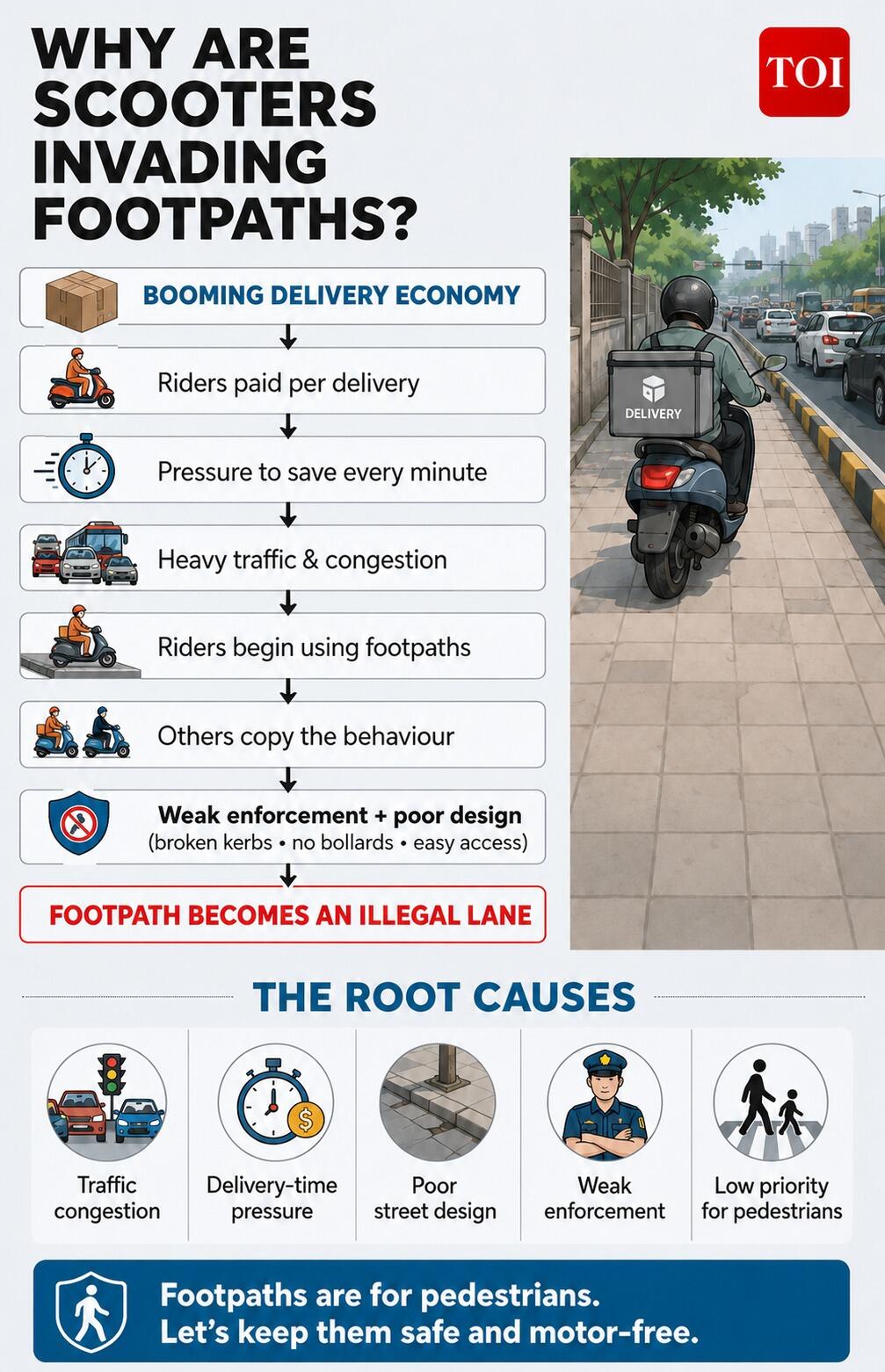
Why are scooters invading footpaths
Who foots the billSudden danger most heavily afflicts those least prepared to meet it. An elderly person can easily be startled by a scooter coming up behind them without warning, and because their reflexes and mobility are slower, they can easily fall. Children, who move unpredictably, are vulnerable to serious injury even in low-speed crashes. For wheelchair users and the visually impaired, a hard journey becomes more dangerous still; and many women say they feel distinctly unsafe when two-wheelers brush past them on narrow, crowded pavements – especially after dark.Why it’s bigger than traffic — it’s public healthWalking remains the most universal form of transport – nearly every bus or metro journey begins and ends with walking. When footpaths are no longer viewed as safe, there is a quiet movement to private vehicles for even the shortest of journeys which perpetuates a cycle of increased congestion, increased emissions and decreased physical activity. In effect, unsafe pavements discourage one of the cheapest, healthiest and most sustainable ways to move through a city, with consequences that ripple well beyond traffic charts.What the law says and where it falls shortIndia’s traffic laws already ban vehicles from footpaths except to reach adjoining properties, and dangerous or negligent driving is punishable under the Motor Vehicles Act. The real gap is not in the legislation, but in the follow-through. Most cities don’t have a dedicated system to track repeat offenders, or to monitor footpath violations in any structured manner. On the ground, the rules are largely symbolic.
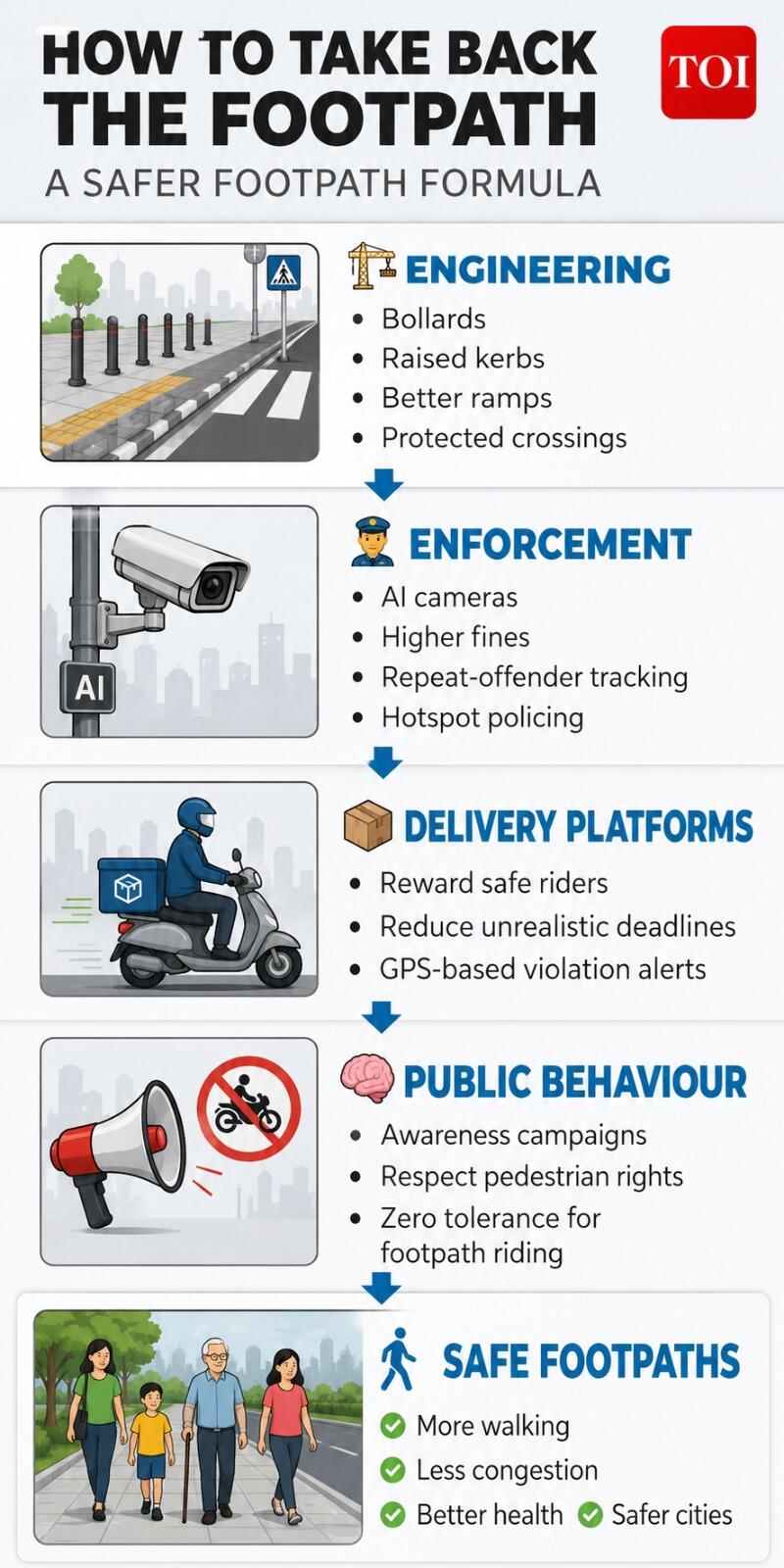
How to take back the footpath.
Lessons from cities that got it rightElsewhere, riding on footpaths is regarded as a serious offence, not a minor nuisance. Japan and Singapore have strict laws and heavy penalties, so you rarely see motorcycles in pedestrian areas. In some European cities, it’s the design of the street that works: the presence of bollards, raised kerbs and narrow entry points physically prevents a two-wheeler from getting onto a pavement anyway. The basic idea is simple: make it hard to break the rule by building streets that do so, rather than depending on police to catch people after they’ve done it.
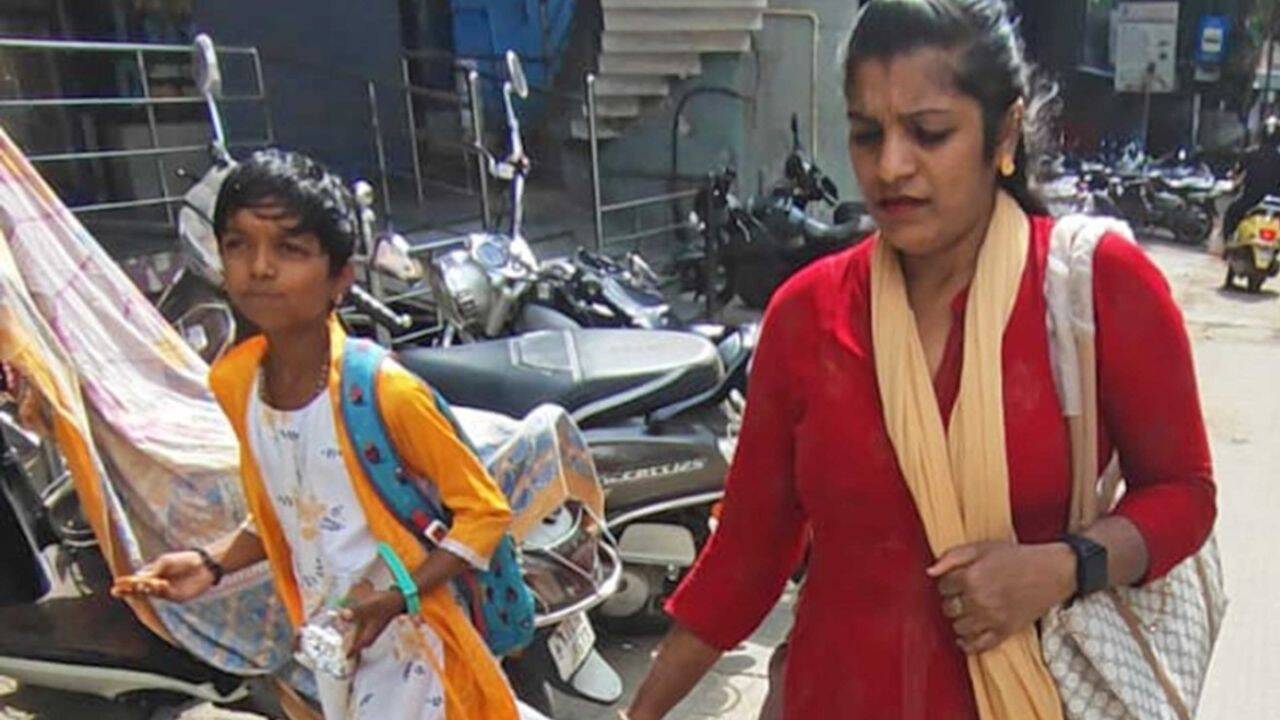
Congestion and poor enforcement exacerbate the problem across major cities
What Indian cities – and delivery platforms – can doIt will take engineering, enforcement and a change in behaviour working together to get this right, not any one measure. Physical barriers such as bollards, AI-powered cameras that automatically flag footpath violations and targeted policing at hotspots such as metro stations and flyover approaches can all help restore order. Delivery platforms already track riders via GPS. They could use this data to flag risky routing patterns, reward safe driving and relieve unrealistic delivery-time pressures, rather than just optimising for speed. Attitudinal campaigns, like those that once altered attitudes to helmets and seatbelts, could reinforce a simple message – footpaths are for pedestrians, not for anyone in a hurry. As Indian cities get denser, reclaiming the humble footpath may be one of the more pressing tests of how seriously urban India takes its people who choose simply to walk.


