
Scientists thought this ancient fish had been extinct for 66 million years, until it suddenly appeared in a fishing net in South Africa

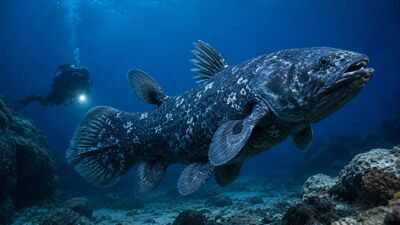
For decades, the coelacanth existed in scientific literature as a creature of the distant past. Fossils showed that members of this ancient fish lineage had lived alongside dinosaurs and vanished from the fossil record around 66 million years ago. The assumption seemed straightforward: they were gone.Then, in December 1938, a fishing trawler operating off the coast of South Africa hauled up an animal that should not have existed. Resting among the catch was a large blue fish unlike anything local museum curator Marjorie Courtenay-Latimer had seen before. What followed became one of the most remarkable episodes in modern natural history. A species believed to have disappeared tens of millions of years earlier had been quietly surviving in deep ocean waters while the world assumed its story had already ended.
How the coelacanth was identified as a fish thought extinct since the dinosaurs
According to the Natural History Museum, the fish measured roughly one and a half metres in length and carried an unusual appearance. Its scales formed a heavy armour-like covering, while its fleshy fins looked strikingly different from those of most familiar fish.Recognising that the specimen was unusual, Courtenay-Latimer sought expert help. The description and sketches eventually reached South African ichthyologist J.L.B. Smith, who immediately suspected something extraordinary. When he examined the preserved specimen weeks later, he concluded that it belonged to a group previously known only from fossils.The discovery stunned the scientific community. A lineage believed extinct since the end of the age of dinosaurs had survived unnoticed in the depths of the Indian Ocean. Smith later named the species Latimeria chalumnae, honouring both Courtenay-Latimer and the Chalumna River near where the fish had been caught.
Why coelacanths remained hidden for millions of years
The reason coelacanths remained undiscovered for so long becomes clearer when considering where they live.As per the Natural History Museum, unlike many fish that inhabit coastal shallows, coelacanths spend their lives in deep marine environments, generally hundreds of metres below the surface. During daylight hours they shelter inside underwater caves and rocky formations before emerging at night to hunt squid, cuttlefish and smaller fish.Their habitat lies far beyond the range where people routinely observe marine life. Long before underwater exploration became common, these depths were effectively invisible. Entire populations could persist there with little chance of attracting attention.In parts of the Comoros Islands, local fishermen were already familiar with the fish and knew it by the name “gombessa”. To them, the species was unusual but not unknown. The surprise existed mainly within Western science, which had never realised the animal was still alive.
What makes the coelacanth different from other fish
The coelacanth belongs to a group known as lobe-finned fishes. Unlike the thin rays that support the fins of most modern fish, coelacanth fins are attached to muscular lobes that give them an almost limb-like appearance.This feature helped fuel excitement after the 1938 discovery. Some researchers initially wondered whether the fish might represent a missing link between aquatic animals and the first vertebrates that moved onto land.Later studies showed the story was more complicated. While coelacanths are relatives of the lineage that eventually produced amphibians, reptiles, birds and mammals, they are not direct ancestors of those groups. Genetic research has since indicated that lungfish share a closer relationship with land vertebrates.Still, the coelacanth retains a collection of unusual characteristics. It possesses a flexible notochord rather than a fully developed bony spine and has a rare joint within its skull that allows its mouth to open unusually wide. Scientists have also observed the fish holding vertical positions in the water, a behaviour linked to sensory organs used for detecting prey.
How scientists found more living coelacanths after 1938
The story did not end with the South African specimen. For years, scientists searched for additional examples. A second documented specimen eventually emerged from the Comoros Islands in 1952, confirming that the first discovery had not been an isolated accident.As per the Natural History Museum, another unexpected chapter arrived decades later. In 1997, a coelacanth appeared at a market in Indonesia. Genetic analysis revealed that it belonged to a different species, now known as Latimeria menadoensis.The finding demonstrated that the surviving coelacanth lineage was more diverse than previously believed. It also raised fresh questions about whether undiscovered populations might still exist in remote parts of the ocean.
Why the coelacanth is known as a ‘living fossil’
The phrase “living fossil” is often applied to species whose modern appearance closely resembles ancient ancestors known from fossils. Few animals fit that description as dramatically as the coelacanth.Its fossil relatives stretch back hundreds of millions of years, with specimens dating from long before the dinosaurs appeared. Yet a modern coelacanth still carries many anatomical features that would be familiar to those ancient fish.The label can sometimes be misleading because coelacanths have continued evolving throughout their history. They are not frozen in time. What makes them remarkable is that their lineage survived while many related forms disappeared, leaving a gap of millions of years between the youngest known fossils and the first living specimen identified in the twentieth century.
Why the coelacanth still matters to scientists today
Nearly ninety years after that famous catch, coelacanths remain elusive. Scientists still do not know their exact global population size, and both recognised living species face conservation concerns.Their rediscovery transformed the way researchers think about extinction and survival. It showed that the fossil record does not always tell the complete story and that remote environments can conceal species for astonishing lengths of time.When the coelacanth emerged from a South African fishing net in 1938, it revealed more than the survival of a single fish. It exposed a hidden chapter of Earth’s history that had continued unfolding in darkness for tens of millions of years, unnoticed beneath the waves.


