
OFFSIDE | World Cup semi-final: How Spain ended ‘Dictator’ Kylian Mbappe’s reign and blew France apart

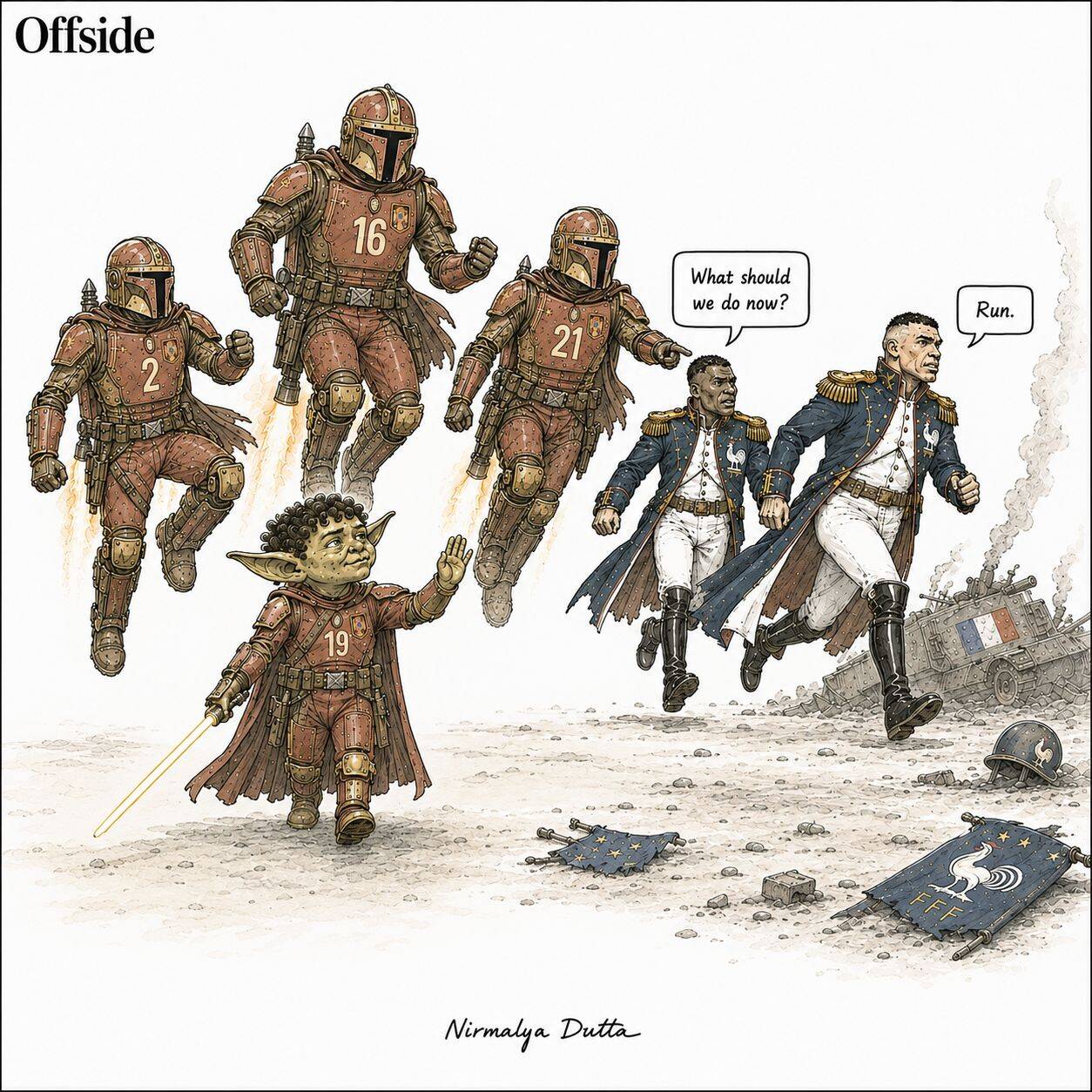
On July 14, 1789, Parisians stormed the Bastille, a day that became a stepping stone towards the modern French Republic — now on its fifth update — and helped lay the foundations for much of the Western civilisation we see today. In doing so, they overthrew Bourbon rule in France.Across the Pyrenees, however, the Bourbons survived. King Felipe VI, a direct descendant of Philip V, the grandson of Louis XIV, still sits on the Spanish throne. On France’s national day, it was Spain who ended ‘Dictator’ Mbappe’s reign with a clinical performance that left the World Cup’s best attacking team stunned.Rayan Cherki sounded a little like the enigmatic Eric Cantona, who once said he did not play against a team but against the idea of defeat. Calling the result an “immense disappointment”, Cherki claimed France had eliminated themselves. Asked what had been missing, he was more direct: “We were beaten technically, we were beaten tactically, we were beaten in the duels.”
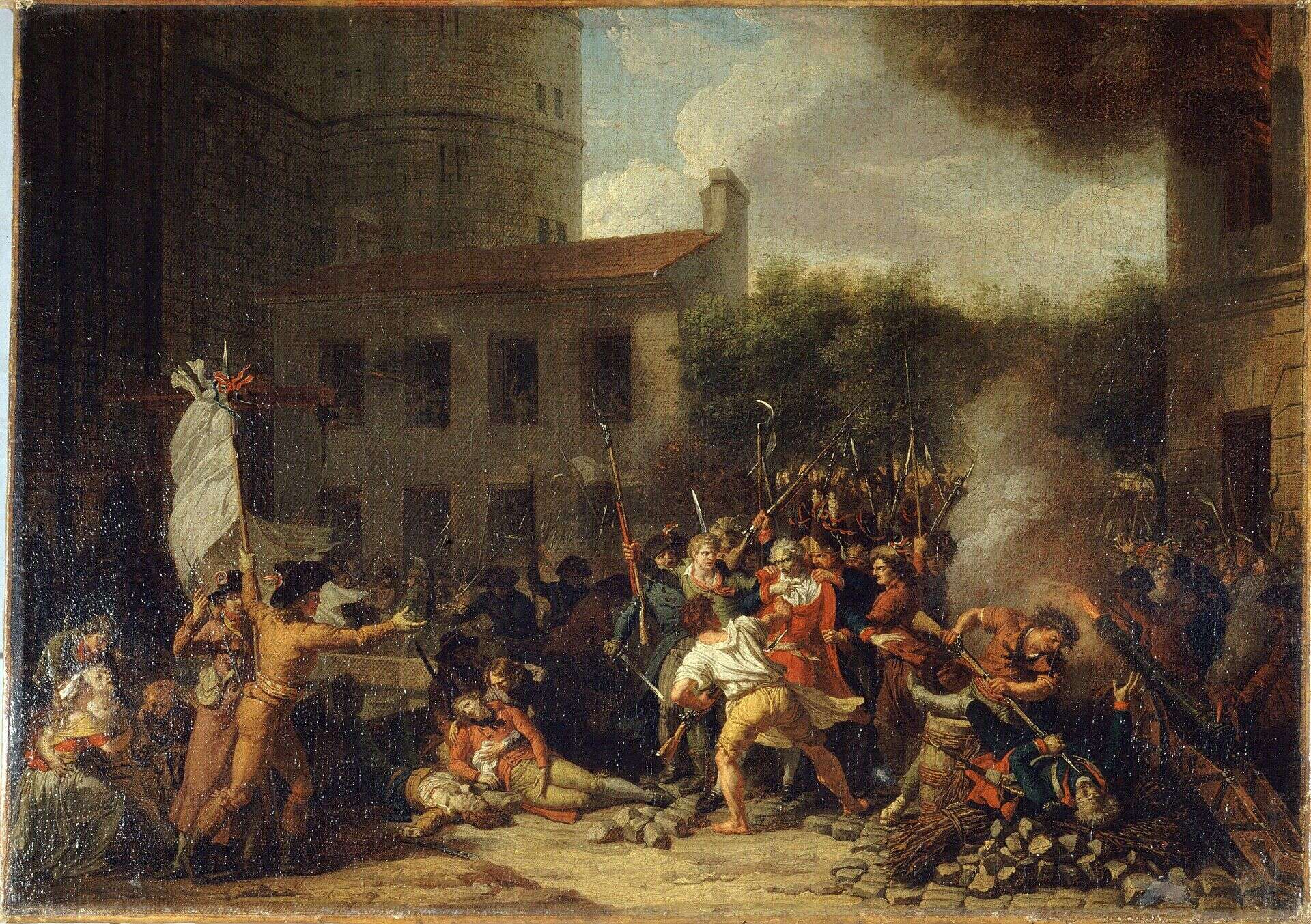
The Storming of the Bastille (French: Prise de la Bastille, le 14 juillet 1789 ) is a 1793 history painting by the French artist Charles Thévenin. (Wikimedia Commons)
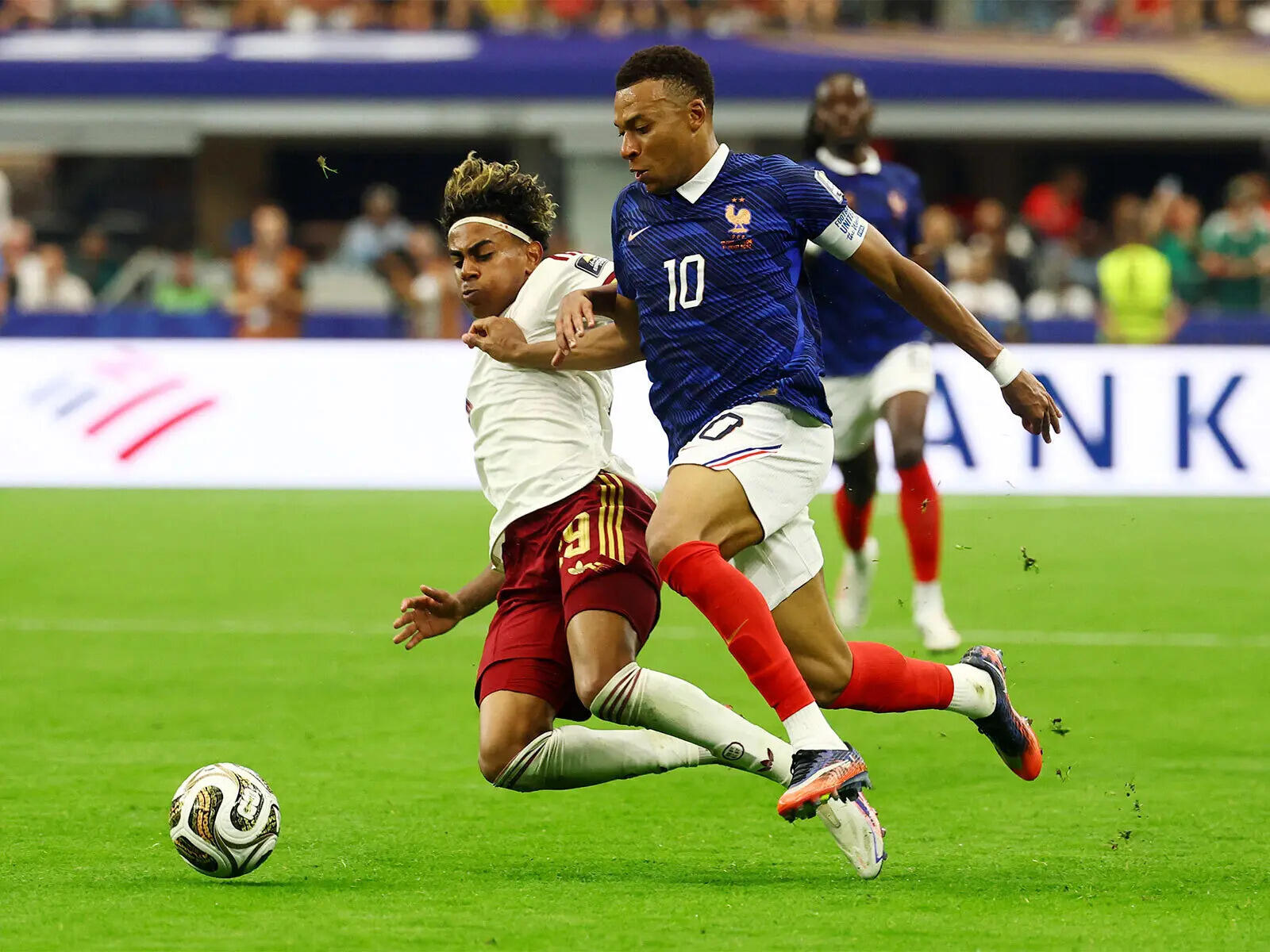
Until they met Spain, Mbappe and Co were tearing defences apart with disdain, but from Spain they finally learnt the meaning of pain.Spain’s first half was good. Their second was sublime and while Mikel Oyarzabal and Pedro Porro will receive the goalscoring plaudits, it was the Spanish midfield, administered by Rodri, that ensured France had to wait until the 82nd minute to register their first shot on target.Indeed, one wry columnist for The Times, after watching Pedro Porro and Cristian Romero excel at this World Cup, wondered how Spurs had spent much of the past two seasons battling relegation. Analysing Spuritis, however, is beyond the scope of this column.The 19-year-old wunderkind Lamine Yamal had promised that Spain would play without fear, and that is what they did against Les Bleus.Oyarzabal opened the scoring from the spot after Lucas Digne’s pub-side hack took out Yamal. Spain nearly had a second after Maignan’s attempted clearance fell to Álex Baena, who found Olmo. His delicate backheel released Yamal, who drilled the ball towards Fabián Ruiz, only for Upamecano to produce a last-ditch block. It was sublime football of the sort Spain specialise in, born from knowing exactly where every teammate is.Pedro Porro added the second in the 58th minute after a lovely give-and-go with Dani Olmo, before the harshest of offside calls denied Yamal a third moments later.
“We were too sloppy technically”: Mbappe rues France’s shortcomings after FIFA World Cup semi-final defeat to Spain
France had reached the semi-final with the best attacking numbers at the World Cup, registering 47 shots on target and 14.3 xG across their first six matches. Spain had faced only seven shots on target and conceded an average of 0.31 xG per game.Mbappe and Co had charged through the tournament like wild bulls, but Spain’s midfield became the matador: Rodri and Fabián controlled the angles, lured France towards empty spaces and moved the cape at the last moment, leaving Oyarzabal and Porro to apply the sword. It was also Spain’s third successive semi-final victory over France, following Euro 2024 and the 2025 Nations League, turning what had once been an evenly matched rivalry into a recurring French nightmare.How Spain stopped FranceSpain’s solution began several yards away from Mbappe. In older days, coaches tasked individual players with stopping a talisman. Sir Alex Ferguson used Park Ji-sung to shadow Andrea Pirlo during Manchester United’s Champions League tie against AC Milan in 2010. Mourinho used Esteban Cambiasso as part of Inter Milan’s plan to ‘arrest’ Messi in the 2010 Champions League semi-final against Barcelona.Luis de la Fuente did nothing of that sort. Instead, Spain crowded the areas through which Mbappe usually received the ball. Rodri remained in the centre, Fabián Ruiz hunted loose balls and Dani Olmo dropped into midfield whenever France attempted to play through Aurélien Tchouaméni, Adrien Rabiot or Michael Olise.Mbappe, too, pointed to the pressing mismatch: “Right from the start, we were pressing three against two… and we messed up there. Against Spain, you have to press man for man.”The space between Spain’s midfielders and defenders remained tiny, with Rodri and Fabián closing receivers in the middle, while the full-backs and the nearest midfielder protected the return pass inside from the wing. This left France’s technically gifted players isolated and unable to form what Einstein called “spooky action at a distance”.
To put this in context, Olise and Mbappe did not exchange a single pass in the first half, while Olise lost possession 20 times in the first 70 minutes. Mbappe did not attempt his first shot until the 67th minute, while Ousmane Dembélé’s first effort arrived during second-half stoppage time. France produced only 0.3 expected goals, their lowest figure in a World Cup match since such data began to be recorded.Pau Cubarsi and Aymeric Laporte handled Mbappe’s movements intelligently. Cubarsi stepped towards him when he tried to receive with his back to goal, while Laporte protected the space behind. Marc Cucurella repeatedly moved across from the left when France tried to create an overload, including a vital deflection from one of Mbappe’s few dangerous attempts. Unai Simon also raced outside his penalty area during the first half to clear before the French captain could exploit the space behind Spain’s defensive line.France had planned to press Spain high and prevent them from establishing their passing rhythm. Instead, the French front four pressed at different moments rather than as one unit, allowing Rodri, Fabián and the Spanish centre-backs to pass around the first wave.Did Deschamps’ attacking gamble backfire?Much of the footballing world had celebrated France’s gunslinger football with four attackers, but that approach proved disastrous against a side as comfortable on the ball as Spain.Deschamps used a 4-2-3-1 with Tchouaméni and Rabiot behind Dembélé, Olise and Barcola, with Mbappe leading the line. That left the midfield pair to screen the defence, close Rodri and Fabián, track Olmo between the lines and cover the full-backs. Spain’s midfield three kept giving them one problem too many.There had been speculation that Deschamps would remove one attacker and use Manu Koné alongside Tchouaméni and Rabiot in a 4-3-3. He did not. When Koné appeared at half-time, he replaced the booked Rabiot rather than joining him, so France retained the double pivot. The attacking quartet stayed on, but Spain’s control meant they rarely received the ball in useful areas.
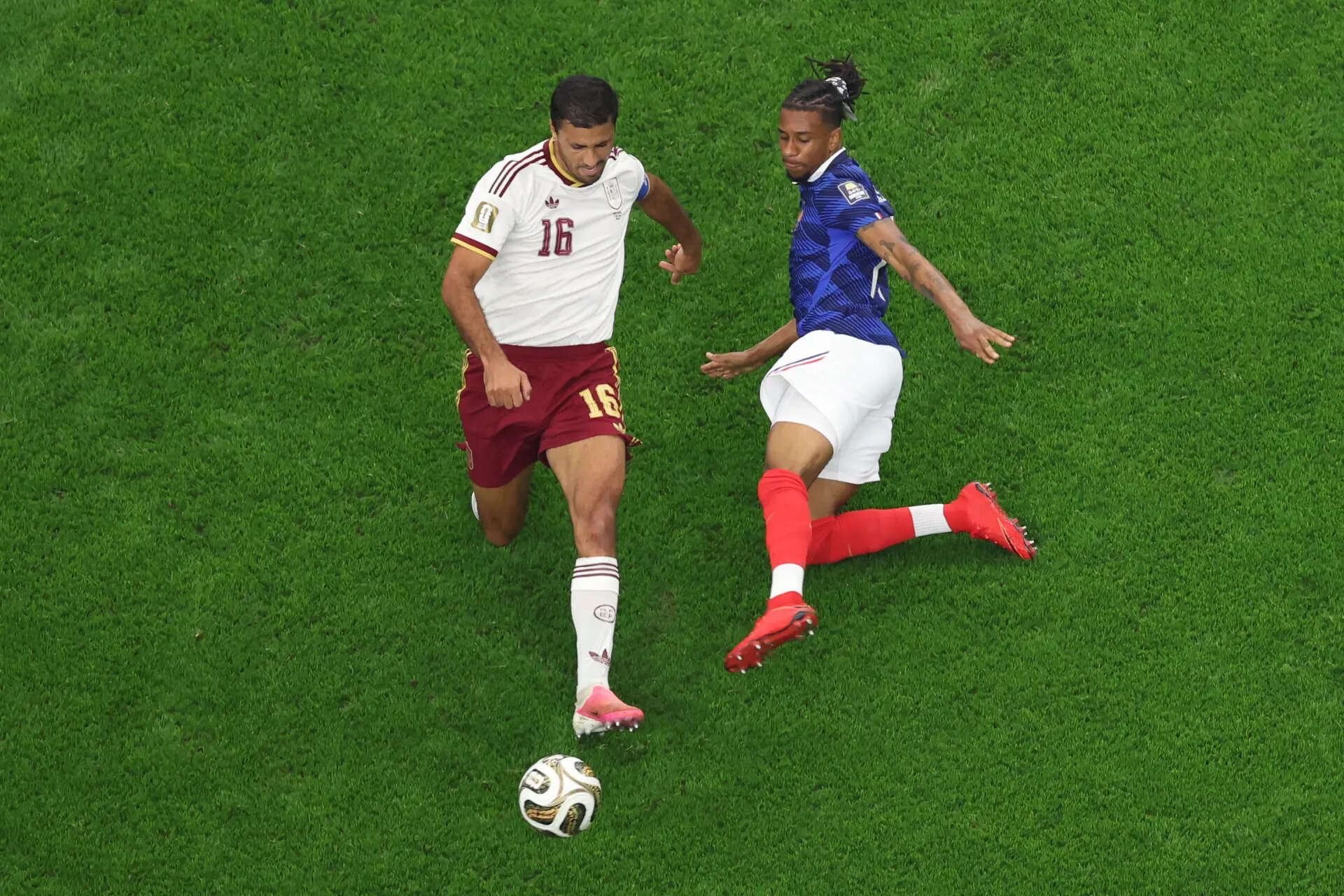
France’s Michael Olise (11) tackles Spain’s Rodri (16) during the World Cup semifinal soccer match between France and Spain in Arlington, Texas, near Dallas, Tuesday, July 14, 2026. (AP Photo/Sam Hodde)
That was a departure from Deschamps’ successful tournament formula.In 2018, Kanté and Pogba were supported by Blaise Matuidi, nominally a left-sided player who moved infield and defended as a third midfielder. In 2022, Tchouaméni and Rabiot had Antoine Griezmann dropping deep, pressing and tracking runners. Neither side literally fielded three defensive midfielders, but both had three players doing midfield work. Against Spain, France had two, and both were overrun.France were also dealing with sustained adversity for the first time at this World Cup. Cherki acknowledged as much afterwards: “Maybe when it’s too easy, we think we’re above the rabble.”Once France fell behind, their problems multiplied. Rabiot, already booked, committed another poor challenge before the interval and risked being sent off. Saliba, who had been playing through pain during the tournament, lasted only half an hour. Digne remained exposed against Yamal in a contest that increasingly resembled a mismatch.Numbers and mindersThe most revealing statistic was Spain’s possession: 50.9 per cent, their lowest share in a World Cup match since 2002.This was a more muscular Spanish performance than the familiar caricature of endless passing. Spain attempted 22 tackles to France’s 14 and won 55.9 per cent of all duels. France won only 32 per cent of the aerial contests, their lowest proportion at a World Cup for four decades. Rodri won 11 of his 15 duels, while Fabián won five of six and regained possession seven times.Spain were happy to let sections of the match become slow. They passed when the pass was available, committed tactical fouls when France threatened to break and refused to turn the semi-final into the transition contest Mbappe, Dembélé and Barcola wanted.Their attacking structure remained fluid. Oyarzabal dropped away from the centre-backs, Olmo appeared between midfield and defence, and Yamal stayed wide enough to isolate Digne. Porro could therefore advance from right-back when France’s attention moved towards Yamal.
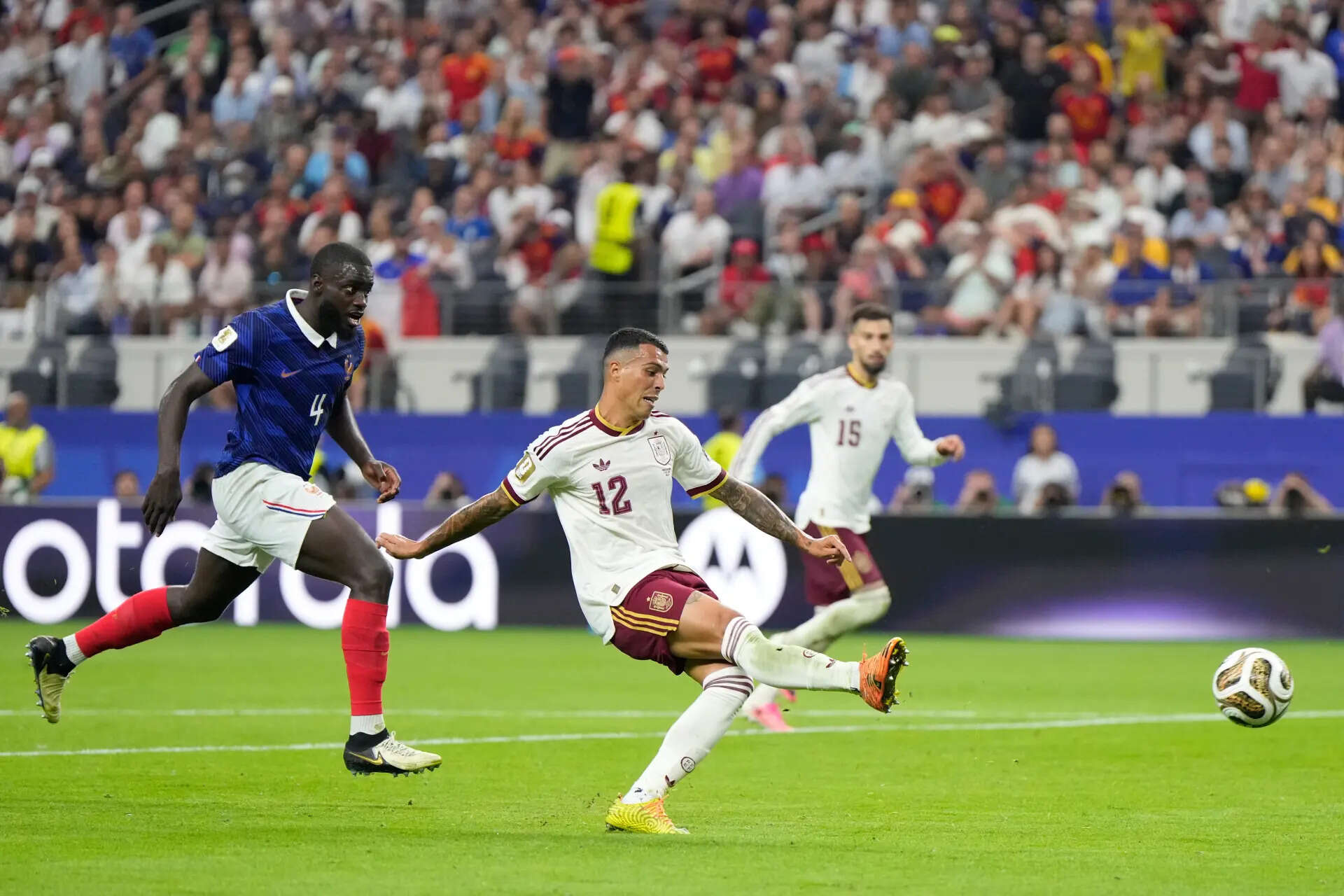
Spain’s Pedro Porro scores his side’s second goal during the World Cup semifinal soccer match between France and Spain in Arlington, Texas, near Dallas, Tuesday, July 14, 2026. (AP Photo/Ashley Landis)
The second goal illustrated the entire plan. Porro moved forward, exchanged passes with Olmo and continued his run into the space behind France’s left side. Olmo, despite being knocked off balance, returned the ball perfectly and Porro finished calmly. France had several defenders near the action, yet Spain’s movement had removed all of them from the decisive passing lane.France had recovered from two goals down against Argentina in the 2022 World Cup final, but nothing on the pitch suggested a comeback. By the end, Spain were playing keep-ball while France were dealing with existential angst.Spain became the first team in World Cup history to keep six clean sheets in a single edition and the first European team to win eight consecutive knockout matches across the World Cup and European Championship. They also equalled Italy’s European record of 37 unbeaten matches.Oyarzabal became only the third Spanish player to score five goals at a single World Cup, after Emilio Butragueño in 1986 and David Villa in 2010. Porro became the second Spanish defender to score multiple goals at one World Cup, after Fernando Hierro.France, meanwhile, have still never won a World Cup match when trailing at half-time, drawing one and losing 12, and this was only their second defeat in their last 23 World Cup knockout matches outside penalty shootouts.Mbappe failed to register a shot on target for only the second time in his last 15 World Cup appearances, while France failed to produce a first-half shot on target in three of their seven matches at this tournament after doing so only four times in their previous 59 World Cup games since 1966.Spain’s garden of heavenIn Candide, one of the great works of French literature, Voltaire’s eternally optimistic Pangloss survives a lifetime of catastrophe while continuing to insist that everything happens for the best. Near the end, Candide and his companions meet an old Turkish farmer who pays little attention to the affairs of Constantinople and devotes himself instead to cultivating his land. Work, he tells them, protects his family from three great evils: weariness, vice and want. The lesson finally cuts through all of Pangloss’s philosophy. Candide ends the argument with the novel’s most famous line: “We must cultivate our garden.”Spain did precisely that. France lost itself in the Panglossian belief that its swashbuckling football would somehow prove sufficient. Spain ditched its Quixotic tendencies and cultivated its garden, sticking to the principles that form part of its national footballing DNA: compact distances, coordinated pressing, intelligent movement and players who always appeared to know where the next pass would go.And now the inheritors of the Bourbons’ legacy wait to discover whether they will face England or Argentina in the final.As for France, they say goodbye to the Deschamps era and welcome the next man to take the reins. A man who headed them to victory in 1998, headed away a World Cup in 2006, and is widely considered the greatest midfielder of all time: Zinedine Zidane. A man who also happens to know what it feels like to put a talented team to the sword. Just ask Brazil.


