
US resumes Iran naval blockade, launches fourth straight day of strikes over Strait of Hormuz

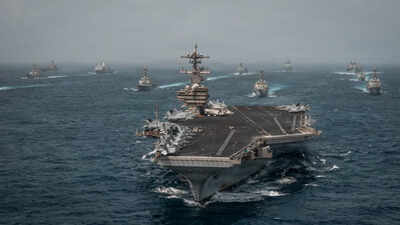
The United States on Tuesday resumed its naval blockade of Iranian ports and coastal areas, while launching another round of strikes against Iranian military capabilities linked to attacks on commercial shipping in the Strait of Hormuz.US Central Command (Centcom) said American forces restarted the blockade at 4 pm ET, hours after carrying out additional strikes against Iran.“US forces resumed the naval blockade against vessels transiting to and from Iranian ports and coastal areas today at 4 pm ET,” Centcom said in a post on X.“There are currently more than 20 US Navy warships and hundreds of military aircraft operating across the Middle East. American forces remain vigilant, lethal, and ready,” it added.The latest action marks the fourth consecutive day of US strikes against Iran, as fighting over the strategic waterway threatens to derail an interim ceasefire agreement and raises fears of a return to a wider regional conflict.
US strikes target Iran
Ahead of the blockade taking effect, Centcom announced another wave of strikes against Iran.“At 3 pm ET today, US Central Command forces began launching an additional round of strikes against Iran to continue degrading Iranian capabilities used to attack commercial shipping in the Strait of Hormuz,” the command said.The military said the strikes were being carried out as US forces prepared to resume the blockade against Iranian ports and coastal areas.Iranian state media acknowledged the attacks, reporting explosions in southern parts of the country. The Islamic Republic News Agency (IRNA) said areas around Bandar Abbas and locations near Sirik in Hormozgan province were hit by what it described as American strikes.Iran’s state media also reported explosions on Qeshm Island, as well as in the southwestern city of Ahvaz and the southern port city of Bandar Abbas.The US military said the strikes were aimed at reducing Iran’s ability to threaten commercial vessels passing through the Strait of Hormuz.“These strikes will continue imposing a heavy cost on Iranian forces and degrade their ability to attack innocent civilians and commercial shipping in the Strait of Hormuz,” Centcom said earlier.
Why Hormuz has become centre of conflict
The naval blockade comes amid escalating tensions over one of the world’s most important energy routes.Before the war, roughly one-fifth of global crude oil and natural gas shipments passed through the Strait of Hormuz, a narrow waterway connecting the Persian Gulf with the Gulf of Oman.The US had previously imposed a blockade on Iranian ports in mid-April, but lifted it in mid-June following an interim ceasefire agreement aimed at ending the conflict and creating space for negotiations over Iran’s nuclear programme.However, the ceasefire has come under increasing strain as Iran and the US have resumed strikes and counterstrikes in and around the Gulf.US President Donald Trump had announced the restoration of the blockade on Monday, saying Washington would act as the “guardian” of the Strait of Hormuz.He had initially proposed imposing a 20% fee on commercial ships passing through the strait to compensate the US for providing security, but reversed that decision after Gulf allies suggested an alternative arrangement involving investments in the United States.Trump said he preferred investment agreements over imposing a toll.“They said we’d love to do it a different way. We’d love to invest in the United States with billions and billions of dollars,” Trump told reporters.
US military buildup in the region
The US has significantly expanded its military presence in the Middle East as tensions with Iran have intensified.At least 19 US warships were operating in the northern Arabian Sea, including two aircraft carriers and an amphibious assault ship carrying more than 1,000 Marines.Centcom said there were also “hundreds of military aircraft operating across the Middle East”.The US military has accused Iran of attacking commercial shipping in the Strait of Hormuz, while Tehran has argued that Washington is attempting to prevent it from exercising control over waters near its coastline.Iranian deputy foreign minister Kazem Gharibabadi said the US was trying to stop Tehran from exercising what he described as “effective sovereignty” over the Strait of Hormuz.“The passage of vessels is not important to the US. The US is not dependent on the Strait of Hormuz,” Gharibabadi said in an interview with Iranian state broadcaster IRIB, according to AP.


